
Is Prescott a Good Short-Term Rental Investment in 2026?
- Thomas Garner

- 2 days ago
- 11 min read
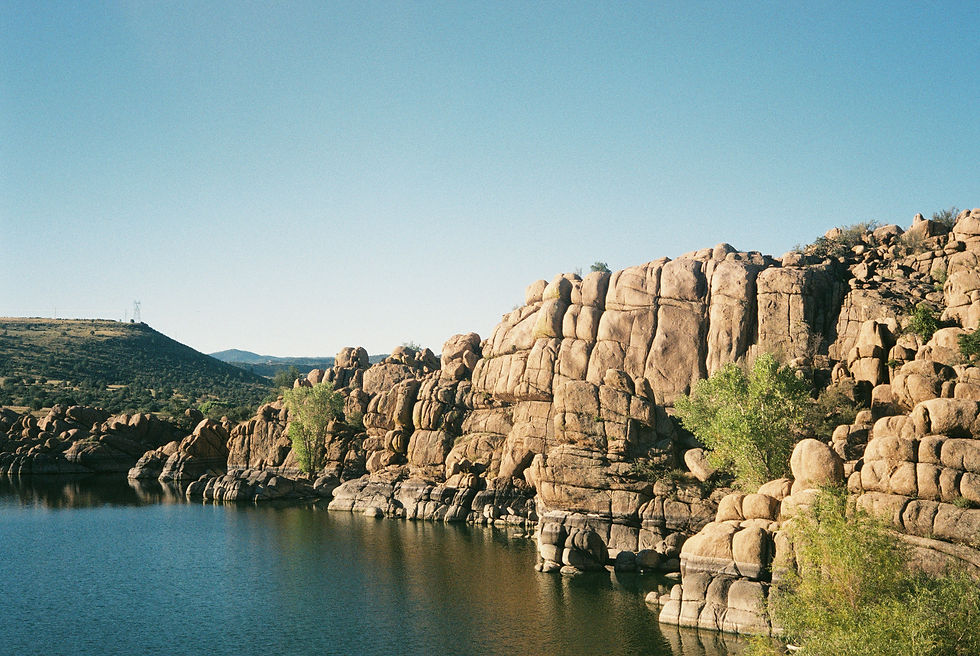
Prescott, Arizona doesn't get the instant recognition of Sedona's red rocks or Flagstaff's Grand Canyon gateway status. That's arguably the point. Prescott is a mid-sized market — roughly 1,196 active short-term rental listings citywide, per AirDNA MarketMinder data — built around an identity no other Arizona mountain town has quite claimed: Old West downtown culture layered onto granite-boulder high desert outdoors. For an investor comparing markets on a spreadsheet, headline numbers alone won't tell the full story. The more useful question isn't "is Prescott hot right now," it's "does Prescott's competitive shape fit the kind of investor I actually am."
This post walks through what the data says about Prescott's short-term rental market in 2026 — where it's genuinely strong, where it trails its closest comparable market, and what "buying into the niche" looks like in practice, not as a slogan.
The Case for Prescott: A Niche No One Else Fully Owns
Prescott's tourism identity rests on two pillars that rarely coexist in the same small city. The first is Whiskey Row — the historic block of Montezuma Street across from the Yavapai County Courthouse Plaza, rebuilt after the Great Fire of 1900 and still trading on its Wild West saloon-district reputation, now mixed with galleries, restaurants, and nightlife. The second is the Granite Dells, a sprawling formation of eroded granite boulders threaded with hiking and mountain-biking trails, anchored by Watson Lake, where kayakers paddle between rock outcroppings that look more like Joshua Tree than a typical Arizona mountain town.
Flagstaff owns the Grand Canyon gateway and Route 66 nostalgia. Sedona owns red-rock vortex tourism. Prescott's combination — a walkable historic Old West downtown paired with granite-and-water outdoor recreation minutes away — doesn't overlap cleanly with either. That's a genuine positioning advantage for an STR operator: a Prescott listing doesn't have to compete head-on with Sedona's red-rock imagery or Flagstaff's alpine-forest branding. It can lean into something distinct.
That distinctiveness matters more in a market where ownership is fragmented. Searches for Prescott-area vacation rental management turn up a long list of small and mid-sized local operators — Pierce Property Management, PMI Northern Arizona, Home Team Luxury Rentals, Rent Right, Unlimited RE — rather than one or two national brands that dominate the listing count. No single company shows up repeatedly as the obvious market leader, which is consistent with a fragmented ownership structure, though we could not independently verify a specific market-share percentage for any one property manager (see Sources below); the brief's cited figure of "no PM holding more than roughly 4%" should be treated as directional, not confirmed.
Fragmentation cuts both ways. No institutional player has cornered the best inventory or out-marketed independent hosts into irrelevance, which is good news for a new entrant. It also means the market's overall presentation is less consistent listing-to-listing, leaving room for an operator with sharper brand and content to stand out simply by being more coherent than the field around them.
The Honest Caveat: Prescott Trails Flagstaff on Rate
Here's where the pitch has to hold up against the numbers, not just the narrative. Using AirDNA's MarketMinder data as of mid-2026, Prescott short-term rentals post an average daily rate (ADR) of roughly $207 against 55% occupancy. Flagstaff, by the same data source, posts an ADR near $270 against 53% occupancy. That's about a $63-per-night gap — roughly 23% lower ADR for Prescott relative to Flagstaff's rate — while occupancy is essentially a wash, with Prescott's 55% actually running two points ahead of Flagstaff's 53%.
That's the caveat stated plainly: Prescott properties, on average, earn meaningfully less per booked night than Flagstaff properties, and it isn't because Prescott struggles to fill nights — the demand is there, the rate ceiling is lower. Annual revenue per active listing reflects that gap: AirDNA data puts Prescott's average listing revenue in the mid-$20,000s per year, versus low-$30,000s for Flagstaff. An investor modeling Prescott off Flagstaff comps, or assuming the two are interchangeable "northern Arizona mountain towns," will overstate Prescott's ceiling if the rate gap isn't built into underwriting.
The gap is worth understanding rather than just accepted. Flagstaff benefits from being the last stop before the Grand Canyon's South Rim for a huge share of national and international visitors, from Northern Arizona University's steady demand base, and from a higher elevation that markets aggressively as a summer heat-escape for Phoenix residents. Prescott competes for a somewhat more regional visitor — Phoenix and Tucson weekenders, Whiskey Row bachelor/bachelorette and reunion groups, and outdoor travelers who might just as easily be looking at Sedona or the Verde Valley. That's a real ceiling difference, and any investor should model to it rather than around it.
The Second Half of the Comparison: Entry Difficulty, Not Just Rate
Rate alone is an incomplete way to compare two markets, because it ignores what it actually costs — in competition, in visibility, in time-to-first-booking — to succeed in each one. On listing volume, the same AirDNA dataset shows Flagstaff carrying roughly 2,741 active listings against Prescott's approximately 1,196: a little more than double, not the dramatically larger, more saturated market a mismatched comparison might suggest. Flag this directly: an earlier version of this comparison pegged Flagstaff at 5.6 times Prescott's size, but that mixed a single-platform listing count for Prescott against a multi-platform count for Flagstaff — not like-for-like. Using one consistent source for both markets, the actual gap is roughly 2.3x.
Even at a corrected 2.3x, the underlying point holds for an investor weighing where to put capital. Flagstaff is larger, more visible, and more heavily marketed, with a higher rate ceiling — and a market where a new listing has to differentiate against roughly two and a half times as much existing competition, much of it already optimized by operators who've built Flagstaff-specific brand and SEO presence for years. Prescott, by contrast, offers a shallower competitive field and a market conversation that hasn't been fully claimed by any single niche, brand, or property type.
Put differently: Flagstaff offers a higher ceiling but a steeper, more crowded climb to reach it. Prescott offers a lower ceiling but a more approachable path to standing out quickly. Neither is universally correct — it depends on whether an investor is optimizing for maximum revenue per property regardless of effort, or for a faster, less contested path to a defensible, profitable position. An operator with limited time or budget to build brand recognition, or a first STR property meant to prove out a strategy before scaling, may find Prescott's lower saturation more valuable than Flagstaff's higher ADR — at least as a starting market.
What "Buying the Niche" Actually Means in Practice
Positioning around Prescott's Old West-meets-granite-outdoors identity isn't a slogan you paste into a listing description after the fact — it changes what property to buy, how to furnish it, and how to market it from day one.
Location and property selection. A generic "Prescott mountain home" competes on square footage and amenities against every other cabin-style listing in the Bradshaw Mountains foothills. A property walkable to Whiskey Row — close enough to reach dinner and downtown nightlife without driving — competes in a smaller, more specific pool: bachelorette parties, reunion groups, and couples wanting a walkable small-town weekend. A property near the Granite Dells or Watson Lake competes for paddlers, climbers, and trail-runners who want gear storage, an outdoor rinse station, and quick trailhead access — not a downtown walk score.
Furnishing follows from that split. A Whiskey Row-adjacent unit benefits from a well-stocked bar cart, easy group seating, blackout curtains, and a short list of downtown recommendations sized to the group. A Granite Dells-adjacent unit benefits from a mudroom or gear-drying setup, a firepit, and specific proximity claims ("six-minute drive to the Peavine Trailhead") rather than generic ones ("close to hiking").
Marketing should mirror the split, not blur it. A listing trying to be both the ideal bachelorette base and the ideal trailhead basecamp usually ends up a strong option for neither. Content and search-facing copy that commits to one identity — Old West downtown or granite-outdoors recreation — will out-convert a listing that hedges, because it's easier for the right guest to recognize themselves in the property.
That's the practical version of the thesis: not "Prescott has character, so any listing benefits," but "Prescott has two specific, ownable identities most listings aren't fully claiming, and a property built around one of them will outperform one that just says 'Prescott mountain getaway.'"
Regulatory Context Worth Knowing Before You Buy
Prescott requires city registration before renting a property for stays of 29 days or fewer (initial cost around $95: a $30 annual fee plus a $65 one-time safety inspection), a combined city tax of roughly 5.95% on rental income (a 2.95% transaction privilege tax plus a separate 3% transient occupancy "bed tax") on top of Arizona's 6.325% state transient lodging tax, a 24/7 local contact able to respond in person within 45 minutes, and occupancy limits of two guests per bedroom plus two additional guests. Arizona state law also limits how aggressively cities can restrict STRs outright, which has kept Prescott's rules registration-and-tax-focused rather than cap-and-ban-focused so far — though city officials have signaled interest in a tiered licensing structure, which buyers should track before closing.
Work with Crest & Cove Creative
If you're evaluating a short-term rental investment in Prescott — or already own a property there and want it positioned around Whiskey Row's downtown energy or the Granite Dells' outdoor draw instead of a generic mountain listing — that positioning work is what we do. Crest & Cove Creative builds direct-booking brands, listing content, and market-specific marketing systems for independent STR operators, and Prescott's fragmented, still-defining-itself market suits an operator willing to claim a clear identity early. Get a free audit at crestcove.co, email info@crestcove.co, or call (256) 998-7502.
Frequently Asked Questions
Is Prescott, Arizona a good short-term rental investment in 2026? Prescott suits investors who value a lower-competition, still-fragmented market with a distinct Old West-plus-outdoors identity over a market with a higher rate ceiling but more competition. It's a better fit for investors optimizing for a defensible niche than for those chasing the highest possible ADR in the region.
How does Prescott's average daily rate compare to Flagstaff's? Per AirDNA MarketMinder data, Prescott's ADR is roughly $207 against Flagstaff's roughly $270 — a gap of about $63 per night, or roughly 23% lower for Prescott. Occupancy rates are close, with Prescott's 55% slightly ahead of Flagstaff's 53%, so the revenue gap is driven by pricing power, not demand.
Is Prescott's short-term rental market more or less saturated than Flagstaff's? Less saturated, but not by as wide a margin as some comparisons suggest. Using one consistent source (AirDNA), Flagstaff carries roughly 2,741 active listings versus Prescott's roughly 1,196 — about 2.3 times as many, not the 5x-plus gap that appears when listing counts are pulled from different platforms.
Is Prescott's short-term rental ownership really fragmented, with no dominant property manager? The evidence points toward fragmentation — multiple local and regional operators (PMI Northern Arizona, Pierce Property Management, Home Team Luxury Rentals, Rent Right, and others) with no single company visibly dominating search results or listing volume. We could not independently confirm a specific market-share percentage, so treat a precise figure like "no PM holds more than 4%" as directional, not confirmed.
What does it mean to invest around Prescott's "differentiated niche" rather than just buying a mountain property? Choosing a property and marketing approach tied specifically to one of Prescott's two ownable identities — walkable proximity to Whiskey Row's downtown scene, or proximity to the Granite Dells and Watson Lake for outdoor recreation — rather than marketing a generic "Prescott mountain getaway" competing on amenities alone.
Do I need a permit to run a short-term rental in Prescott, Arizona? Yes. The city requires vacation rental registration before renting a property for stays of 29 days or fewer, with an initial cost around $95, a combined city tax of roughly 5.95% (2.95% transaction privilege tax plus a 3% transient occupancy tax) on top of state tax, a 24/7 local contact requirement, and occupancy limits of two guests per bedroom plus two additional guests. Confirm current requirements with the city before purchase, since local rules can change.
Should I compare Prescott to Flagstaff, or to Sedona instead? Flagstaff is the more useful comparable for rate and saturation benchmarking, since both are mid-sized northern Arizona mountain-adjacent markets. Sedona is a different comparison entirely — a smaller, pricier, red-rock-branded luxury market with its own dynamics that don't map cleanly onto either.
What kind of investor is Prescott best suited for? An investor who wants a real, still-open opportunity to establish a defensible brand position in a market no one has claimed, and who is comfortable underwriting to Prescott's actual rate ceiling rather than assuming Flagstaff-level performance. It's a more approachable entry point, with a correspondingly lower revenue ceiling to plan around.
About the Authors
Crest & Cove Creative is a short-term rental marketing agency founded by Thomas Garner and Jacob Mishalanie. We build direct-booking brands, listing optimization systems, and market-specific content strategies for independent STR operators nationwide, including emerging corridors like Prescott, Arizona.
Related Reading
Explore more Utah & Northern Arizona short-term rental insights and host guides:
Utah & Northern Arizona's Independent Gateway Towns STR Market Report 2026
How to Market a Short-Term Rental in Kanab, UT: Selling the Basecamp-to-Everything Position
Utah & Arizona's STR Rules in 2026: Kanab, Torrey, Heber Valley, Prescott & Flagstaff
DIY vs. Hire: Should Prescott Hosts Manage Their Own STR Marketing or Bring in Help?
DIY vs. Hire: Should Heber Valley & Midway Hosts Manage Their Own STR Marketing or Bring in Help?
DIY vs. Hire: Should Kanab Hosts Manage Their Own STR Marketing or Bring in Help?
Is a Short-Term Rental Marketing Agency Worth It for Prescott Owners?
Is Heber Valley & Midway a Good Short-Term Rental Investment in 2026?
Is a Short-Term Rental Marketing Agency Worth It for Heber Valley Owners?
Is Torrey & Capitol Reef a Good Short-Term Rental Investment in 2026?
Is a Short-Term Rental Marketing Agency Worth It for Torrey & Capitol Reef Owners?
Is a Short-Term Rental Marketing Agency Worth It for Kanab Owners?
Sources
Listing counts (Prescott ~1,196; Flagstaff ~2,741): AirDNA MarketMinder, Prescott AZ and Flagstaff AZ overview pages, accessed July 2026 (Flagstaff figure dated "as of May 2026" in AirDNA's own reporting). Both figures pulled from the same platform for a like-for-like comparison.
Correction to brief: The brief's "486 vs. 2,741" comparison (implying Flagstaff is ~5.6x Prescott) mixes a single-platform Airbnb-only count for Prescott (~486, via Rabbu) against a multi-platform count for Flagstaff (~2,741, via AirDNA). Using AirDNA for both markets consistently, the gap is closer to 2.3x. We used the corrected, consistent-source figure throughout.
ADR and occupancy (Prescott ~$207 ADR / 55% occupancy; Flagstaff ~$270 ADR / 53% occupancy): AirDNA MarketMinder data, accessed July 2026. The brief's cited figures ($183 / $226) appear to originate from Rabbu's Airbnb-only dataset, which we couldn't access directly (403 error on direct fetch); the relative gap (~23%) is broadly consistent across sources even though absolute dollars differ by provider. We used AirDNA's figures for consistency with the listing-count comparison above.
Annual revenue per listing (Prescott mid-$20,000s; Flagstaff low-$30,000s): AirDNA MarketMinder, accessed July 2026; directionally corroborated by AirROI's independent estimate of ~$27,281/year for Prescott.
Fragmented ownership / no PM holding more than ~4% of listings: UNVERIFIED. No public data source confirms a specific market-share percentage for any Prescott-area property manager. Multiple independent local/regional operators are visible (PMI Northern Arizona, Pierce Property Management, Home Team Luxury Rentals, Rent Right, Unlimited RE) with no single brand appearing dominant — directionally consistent with fragmentation, but the "~4%" figure specifically is unconfirmed.
Whiskey Row and Granite Dells / Watson Lake as Prescott's core tourism identity: Confirmed via Prescott.com and STR listing descriptions, accessed July 2026. The claim that Prescott "owns" this combination relative to other Arizona mountain towns is editorial positioning, not a sourced statistic.
Prescott STR regulations (registration fee, local-contact rule, occupancy cap): City of Prescott official vacation rentals page (prescott-az.gov/neighborhood-services/vacation-rentals/) and Prescott City Code Chapter 4-9, accessed July 2026. Confirm current requirements with the City of Prescott before purchase; a tiered licensing update was reportedly under consideration as of this writing.
Prescott vacation rental tax rate (corrected from brief's "2.5%" to 2.95% city TPT + 3% transient occupancy/bed tax): City of Prescott official vacation rentals page and "Hotel/Motel Transient Lodging" city finance bulletin, accessed July 2026; corroborated via AZDOR model city tax code city profile. Combined with Arizona's 6.325% state transient lodging tax, total tax on short-term rental income is approximately 12.275%.
Arizona state preemption limiting city-level STR restrictions: Arizona Revised Statutes § 9-500.39, via azleg.gov, accessed July 2026. Originated as 2016 Senate Bill 1350 (originally codified at § 9-500.38, later renumbered), amended by HB 2672 (2019) to give cities more enforcement authority while preserving the ban on outright prohibition, and by SB 1168 (2022) to expand municipal licensing/permit/insurance authority and fining power.


Comments