
Murphy Tourism Recovery: What the Latest Data Actually Measures

Updated: Aug 28

Murphy sits at the far western edge of North Carolina in Cherokee County, closer to Chattanooga and Atlanta than to Asheville, and its tourism economy reflects that geography. The visitor mix is heavily driven by market — Southeast travelers from Atlanta, Knoxville, and the broader I-75 and I-85 corridors who find Murphy an accessible mountain weekend without the drive-time commitment of Asheville or the commercial density of Gatlinburg. The recovery pattern here is quieter than the headline WNC narrative, but it's real, and the current shape has implications for how hosts and small-business operators should plan into 2026 and beyond.
This is a directional read on Murphy's recovery trajectory. Cherokee County is a smaller market than Haywood or Buncombe, and public data is noisier at this scale. We're relying on directional patterns, operator feedback, and qualitative benchmarking rather than precise figures. Treat these as planning signals.
Murphy's Market Character: Who Actually Comes
Murphy's visitor profile is distinctive in the WNC context. The dominant demand layer is Atlanta-region weekenders — couples, families, and small groups who want mountain access within a 2- to 2.5-hour drive. This proximity advantage is Murphy's primary structural asset and its primary constraint: the market draws strongly from a large population base, but most visitors are on a weekend schedule rather than a destination-week schedule.
A second meaningful demand layer is retiree and second-home adjacent traffic. Cherokee County has attracted retiree relocation and second-home buyers from Florida, Georgia, and the broader Southeast for decades. This permanent and semi-permanent resident base creates a tourism-adjacent economy — visitors coming to see family or friends who've settled in the area — that provides a steady demand layer independent of pure leisure tourism trends.
The outdoor recreation layer — fly-fishing on the Hiwassee and Valley rivers, hiking in the Nantahala National Forest, kayaking and paddling on area lakes and rivers — is the third demand layer and the one most directly influenced by seasonal conditions. Spring and fall are the strongest outdoor recreation windows; summer is warm but draws lake and river visitors; winter softens but doesn't go dormant for the dedicated outdoor recreation segment.
Recovery Pattern: Slow but Steady
Murphy's recovery has been quieter and slower than the headline WNC recovery narrative, which has been dominated by Asheville, Brevard, and the Nantahala corridor. This reflects the market's character more than its potential — Murphy attracts a visitor type (drive-market weekenders, retirees, fishing-and-outdoor enthusiasts) whose travel behavior recovered more gradually than the branded-destination tourism that drove Asheville's faster recovery.
The patterns that have strengthened through the recovery: stay length has increased, tracking the broader WNC trend toward longer visits. The 3–5 night stay has grown as a share of total bookings relative to the pure 2-night weekend pattern. This shift is meaningful for operators who've adjusted minimum-stay rules to capture it; those still running 2-night minimums may be leaving longer-stay revenue on the table during shoulder seasons.
Per-trip spending among Murphy visitors has also risen. The retiree and second-home demographic that's grown in Cherokee County spends more per trip on dining, local retail, and outdoor experiences than the younger, more budget-conscious weekend visitor that made up a larger share of the pre-2020 mix. This spending pattern benefits Murphy's small-business economy — local restaurants, outdoor outfitters, and specialty retailers — in ways that pure visitor count statistics don't fully capture.
The Hurricane Helene Context
Western North Carolina's 2024 storm season affected Cherokee County alongside the broader WNC region. Infrastructure impacts in Murphy and the surrounding areas required meaningful recovery work, and operator-level disruptions were real for many hosts during the fall 2024 and winter 2024–2025 windows. The recovery from the storm itself has been an added layer on top of the broader tourism recovery trajectory, and operators should distinguish between these two recovery dynamics when evaluating current performance.
The broader WNC tourism recovery narrative has been actively supported by state and regional tourism promotion, emphasizing the region's resilience and the availability of visitor experiences. This marketing effort has accelerated the return of visitor confidence in the region — including in markets like Murphy that don't have the brand profile to carry their own recovery narrative independently.
Want a free audit of your listing's visibility? Get your free visibility score to see exactly where your property stands.
Outdoor Recreation as Positioning Anchor
Murphy's strongest positioning story for STR hosts is outdoor recreation specificity — not generic mountain scenery, but specific access to the Hiwassee River fly-fishing, Valley River water access, Nantahala National Forest hiking, and the broader Cherokee County outdoor recreation network. Hosts who lead with this specificity in listing copy and guidebook content capture a more motivated, higher-intent traveler than hosts who use generic mountain-cabin framing.
The fly-fishing and outdoor recreation visitor in Murphy books further in advance than the leisure weekender, stays longer, and is more willing to pay per night for a property that explicitly accommodates their activity (gear storage, fishing access, outdoor shower). Properties that invest in these amenities and market them specifically earn a premium over their generic competitors, which compounds over time as the fishing and outdoor-recreation guest base grows into a repeat-visitor pool.
Lake Hiwassee and the Tennessee River system, accessible from the Murphy corridor, add a water recreation layer that's underappreciated by most area operators. Lake-access properties that tag explicitly for kayaking, fishing, and water access capture search demand that lake-adjacent properties without this positioning entirely miss.
Downtown Murphy and Small Business Context
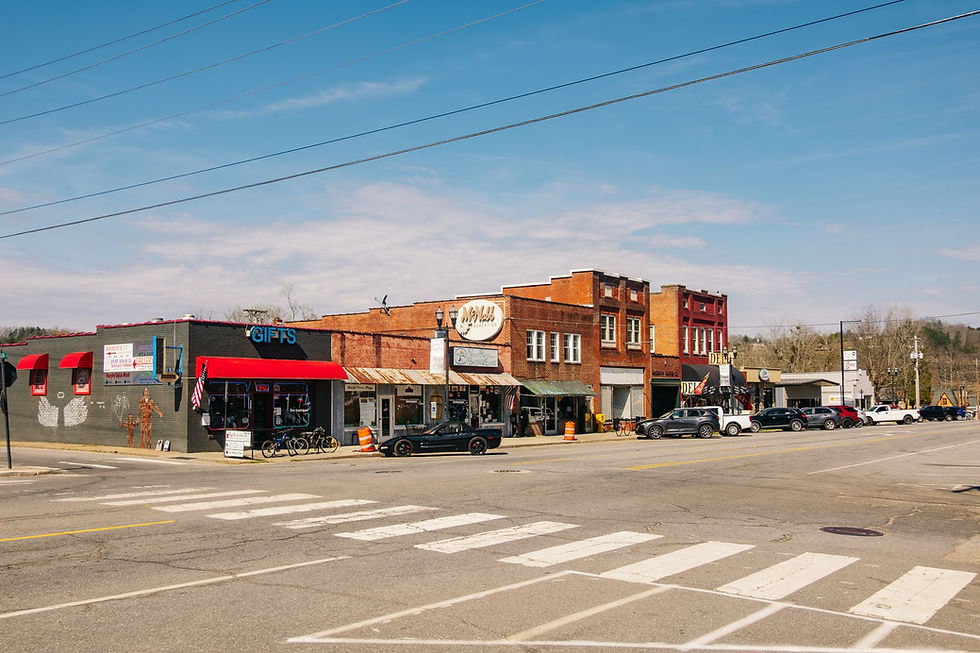
Murphy's small downtown has seen some positive development through the recovery period — restaurant quality has improved, and the broader Cherokee County retiree and second-home economy has supported retail and dining businesses that pure tourist traffic alone wouldn't sustain. For STR operators, an improving downtown is a complementary asset: guests staying 4–5 nights need multiple dinner options and daytime retail, and a stronger downtown makes longer stays more viable without guests feeling they've exhausted the local scene.
Small-business operators in Murphy's downtown economy benefit more from the longer-stay trend than from higher visitor counts alone. A guest spending 5 nights eats 4–5 dinners locally, visits shops multiple times, and engages with the town in ways that a 2-night drive-through visitor doesn't. The compounding effect of longer stays on the local economy is one of the recovery period's more significant and underreported stories in smaller WNC mountain towns.
What Hosts Should Plan Around
First, the outdoor recreation positioning opportunity is real and largely uncaptured in the current Murphy STR listing inventory. Generic mountain-cabin framing leaves specific demand on the table; Hiwassee fishing, Valley River access, and Nantahala hiking specificity reach the motivated traveler that generic listings don't.
Second, the longer-stay trend warrants experimentation with minimum-stay requirements. A 3-night minimum in shoulder seasons may produce better per-booking economics than a flexible 1–2 night minimum, meaningfully, without meaningful occupancy sacrifice, given the current longer-stay demand pattern.
Third, fall pricing should accurately reflect peak-demand compression. Murphy's fall foliage window is the highest-demand period on the calendar; pricing that captures the demand-supply imbalance during this window is the single highest-ROI pricing decision of the year for most Murphy operators.
Ready to reposition? Start with our free visibility audit — a complete read on where your listing wins and where it leaves money on the table.
Frequently Asked Questions
What defines Murphy's tourism recovery pattern compared to the broader WNC narrative?
It's quieter than the headline WNC recovery story but real, driven by Southeast travelers from Atlanta, Knoxville, and the I-75/I-85 corridors rather than Asheville-style convention and event demand. The visitor mix is heavily driven by market — Southeast travelers from Atlanta, Knoxville, and the broader I-75 and I-85 corridors who find Murphy an accessible mountain weekend without the drive-time commitment of Asheville or the commercial density of Gatlinburg.
What is Murphy's primary structural demand asset?
Its 2 to 2.5-hour drive proximity to the Atlanta metro region, which draws a steady weekend-focused visitor base. This proximity advantage is Murphy's primary structural asset and its primary constraint: the market draws strongly from a large population base, but most visitors are on a weekend schedule rather than a destination-week schedule. This reflects the market's character more than its potential — Murphy attracts a visitor type (drive-market weekenders, retirees, fishing-and-outdoor enthusiasts) whose travel behavior recovered more gradually than the branded-destination tourism that drove Asheville's faster recovery.
Why is Murphy's location described as a constraint as well as an asset?
Because most of that Atlanta-driven visitor base is on a weekend timeframe, which limits average stay length even as it provides reliable demand. Murphy's fall foliage window is the highest-demand period on the calendar; pricing that captures the demand-supply imbalance during this window is the single highest-ROI pricing decision of the year for most Murphy operators.
Why should Murphy recovery data be read directionally rather than as precise figures?
Cherokee County is a smaller market than Haywood or Buncombe County, and public data is noisier at this scale. Cherokee County is a smaller market than Haywood or Buncombe, and public data is noisier at this scale. AirDNA — Murphy and Cherokee County NC market summaries. We're relying on directional patterns, operator feedback, and qualitative benchmarking rather than precise figures.
How does Murphy's geography compare to Asheville and Gatlinburg for visitors?
Murphy offers mountain access without Asheville's longer drive time or Gatlinburg's commercial density. The fly-fishing and outdoor recreation visitor in Murphy books further in advance than the leisure weekender, stays longer, and is more willing to pay per night for a property that explicitly accommodates their activity (gear storage, fishing access, outdoor shower). Properties that invest in these amenities and market them specifically earn a premium over their generic competitors, which compounds over time as the fishing and outdoor-recreation guest base grows into a repeat-visitor pool.
What data sources inform this Murphy recovery read?
Directional patterns, operator feedback, and qualitative benchmarking rather than precise public figures. This is a directional read on Murphy's recovery trajectory. Crest & Cove Creative — Murphy operator benchmarking. Crest & Cove Creative is a nationwide short-term rental marketing agency founded by Thomas Garner and Jacob Mishalanie. This marketing effort has accelerated the return of visitor confidence in the region — including in markets like Murphy that don't have the brand profile to carry their own recovery narrative independently. Keep going on Crest & Cove: what Murphy visitor spend measures, Murphy versus Hiwassee against AirROI, Murphy paddling spots worth the drive, the Crest & Cove intro, local SEO keywords that.
What Hosts Should Plan Around?
The recovery pattern here is quieter than the headline WNC narrative, but it's real, and the current shape has implications for how hosts and small-business operators should plan into 2026 and beyond. Murphy's recovery has been quieter and slower than the headline WNC recovery narrative, which has been dominated by Asheville, Brevard, and the Nantahala corridor.
How should a host read this: Murphy's Market Character: Who Actually Comes?
Murphy's Market Character: Who Actually Comes. This reflects the market's character more than its potential — Murphy attracts a visitor type (drive-market weekenders, retirees, fishing-and-outdoor enthusiasts) whose travel behavior recovered more gradually than the branded-destination tourism that drove Asheville's faster recovery. The fly-fishing and outdoor recreation visitor in Murphy books further in advance than the leisure weekender, stays longer, and is more willing to pay per night for a property that explicitly accommodates their activity (gear storage, fishing access, outdoor shower).
Related Reading
Keep reading in the Murphy market spine and nearby towns in the same region: same-cluster pages hosts can use without costume-corridor copy.
The Murphy–Nantahala Divide: A Revenue Per Available Night Showdown
Murphy, NC vs. Ocoee, TN: Why One Side of the State Line Has a
Murphy NC Scenic Overlooks: Lake Chatuge, Brasstown Bald, and the
Murphy, NC Paddling Guide: Hiwassee Lake, the Valley River, and What
Peak Season Maximization for Murphy STR Owners Getting the Top 10
What It Actually Costs to Start a Lake James Airbnb , Dock and HOA First
What It Actually Costs to Start an STR in Black Mountain, NC
What It Actually Costs to Start an STR in Hendersonville, NC
Work with Crest & Cove Creative
Write this town's year. Do not file another market's number as this stay.
Reach out at crestcove.co or (256) 998-7502.


Comments