
Carteret County Occupancy Tax & Beach Nourishment: What Every Bogue Banks Host Must Know
- Thomas Garner

- Jun 24
- 10 min read

Every guest who books your Emerald Isle beach house, Atlantic Beach condo, or Pine Knoll Shores cottage pays more than the nightly rate on the invoice. Carteret County levies a 6% occupancy tax on gross lodging receipts — hotels, motels, vacation rentals, and every Airbnb or Vrbo booking in the county. That tax is not a permit fee, and it is not optional. It is the revenue stream that simultaneously markets the Crystal Coast and rebuilds the Bogue Banks beaches, on which your listing depends.
The mechanics matter because hosts confuse tax registration with STR permitting (they are different obligations under Schroeder v. City of Wilmington and N.C.G.S. § 160D-1207(c)), because marketplace platforms do not always remit the county occupancy tax for you, and because the 50/50 split between tourism promotion and beach nourishment is a genuine marketing story — half of every occupancy-tax dollar either sells the destination or puts sand back on the beach.
This is the compliance and positioning guide for Carteret County STR operators in 2026: how the 6% works, how to register and file through Avenu by the 20th, what the 50/50 TDA/nourishment split funds are, the ~12.75% total guest-tax burden, and how to merchandise the nourishment narrative without sounding like a tax lecture. Read it as an editorial compliance document for hosts who need the tax line item explained to guests — and the filing obligation understood before adding a direct-booking channel.
The 6% Occupancy Tax: What It Covers, Who Owes It, and Registration
Carteret County imposes a 6% tax on gross receipts from the rental of any room, lodging, or accommodation by a hotel, motel, inn, or similar place — expressly including rooms and houses rented through Airbnb, Vrbo, and comparable platforms (Carteret County, Occupancy Tax). Two exemptions hosts should know: nonprofit charitable accommodations are exempt, and lodging furnished to the same person for 90 or more consecutive days is exempt — relevant for snowbird or extended-stay arrangements, not typical Saturday-to-Saturday beach weeks. The tax applies to gross receipts, not net after platform fees. If a guest pays $3,200 for a July week, the 6% occupancy tax is calculated on $3,200 — before you subtract cleaning, management, or OTA commissions.
This is separate from NC sales tax. Carteret County's combined sales tax is 6.75% (4.75% state and 2.0% local) on accommodations for stays under 90 nights (Avalara, Carteret County rates). Add the 6% occupancy tax, and guests face approximately 12.75% total tax on a Carteret County STR stay. Swansboro is the exception within the Crystal Coast brand: it sits in Onslow County and levies a 3% town occupancy tax plus a 3% Onslow County occupancy tax (Town of Swansboro, Occupancy Tax; Onslow County, Occupancy Tax). The headline rate is also ~6% occupancy plus 6.75% sales, but the filing offices and fund allocation differ entirely from Carteret's TDA/nourishment split.
Tax registration is not STR permitting. Post-Schroeder, no Crystal Coast town can require you to register your rental as a short-term lodging permit, but you must register as an occupancy-tax remitter with Carteret County if you collect payment directly — or if your platform does not remit the county tax on your behalf. File a Remitter Information Form with Carteret County Finance, register online through Avenu Insights & Analytics as the county's third-party tax administrator, and register separately with the NC Department of Revenue for sales/use tax if you collect payment directly for more than 15 rental days per year (Avalara MyLodgeTax, North Carolina guide). Marketplace facilitators (Airbnb, Vrbo) that exceed NC's $100,000 or 200-transaction threshold must collect and remit sales tax for hosts, but occupancy-tax remittance responsibility can still fall on the host or property manager, depending on the platform's agreement with Carteret County — verify your platform's current Carteret remittance status before assuming compliance is automatic. Hosts with fewer than 15 rental days per year for a private residence are sales-tax-exempt unless booked through a marketplace facilitator, but the 6% occupancy tax still applies to paid lodging regardless of the day count.
Monthly Filing Through Avenu and the 50/50 TDA-Nourishment Split
The Carteret County occupancy tax is a monthly obligation. Remitters file gross-receipts information and payments through Avenu Insights & Analytics, with returns and payments due by the 20th of the month following the reporting period (Carteret County, Occupancy Tax). Miss the 20th, and you are out of compliance — regardless of whether Airbnb collected sales tax correctly. Set a calendar reminder for the 15th to reconcile platform payouts against your direct bookings before filing. Direct-booking hosts must build the 6% occupancy tax into checkout or itemize it clearly in the Chapter 42A written agreement, and OTA-dependent hosts who add a direct channel without updating their Avenu filing are the most common compliance gap on Bogue Banks — the platform handled taxes until it did not.
This is the story most compliance blogs skip, and most guests never hear. Per the enabling session law (S.L. 2013-223), Carteret County's 6% occupancy tax revenue splits evenly: 50% to the Crystal Coast Tourism Development Authority for travel and tourism promotion in Carteret County, and 50% retained by the county, restricted solely to beach nourishment on Bogue Banks through the Shore Protection Office (N.C. General Assembly, S.L. 2013-223; ccountync.com, occupancy tax explainer).
Half sells the destination. Half rebuilds the beach your guests walk on. The scale is not trivial. Carteret County occupancy-tax collections first surpassed $10 million in fiscal year 2020–21, and calendar year 2021 topped $12 million for the first time (Carolina Coast Online, FY2020-21 milestone). At a 50/50 split, that implies roughly $6 million annually to TDA marketing and $6 million to the Bogue Banks nourishment fund — before collections grew further alongside $743.38 million in county visitor spending in 2024 (Carolina Coast Online, 2024 tourism impact).
State law also allows Carteret to bank beach-nourishment proceeds up to a reserve ceiling raised from $30 million to $60 million (Senate Bill 154, 2023–2024 session) — a signal that the nourishment half of the tax is accumulating faster than sporadic renourishment projects spend it. Karen Gould became Crystal Coast TDA executive director effective May 16, 2026, succeeding Jim Browder after more than a decade at the authority (Coastal Review, TDA leadership). The TDA half funds the destination marketing that fills your summer calendar; the nourishment half funds Greg Rudolph's Shore Protection Office work that keeps the beach wide enough to rent. Occupancy tax is not an STR license under Schroeder — it is a revenue-collection obligation on lodging receipts that funds the physical and promotional infrastructure your listing depends on.
What ~12.75% Total Tax Means on a Real Booking and How to Market the Nourishment Story
Guests do not think in tax-component percentages. They see a total price. But hosts who misquote the all-in tax rate lose trust at checkout and invite compliance questions afterward. On a $4,000 Saturday-to-Saturday Emerald Isle beach-house week, 6.75% NC sales tax runs approximately $270, 6% Carteret occupancy tax runs approximately $240, and total guest tax lands near $510 — roughly 12.75% of $4,000.
Quote the combined rate in your listing description, direct-booking checkout, and written agreement. Itemize sales tax and occupancy tax separately on direct invoices because Carteret County requires occupancy-tax reporting on gross receipts as its own line, and NCDOR treats sales tax as a distinct obligation. Platform-displayed "taxes and fees" on Airbnb or Vrbo may bundle components differently than your direct site, so do not copy the OTA tax display onto your direct checkout without verifying each component.
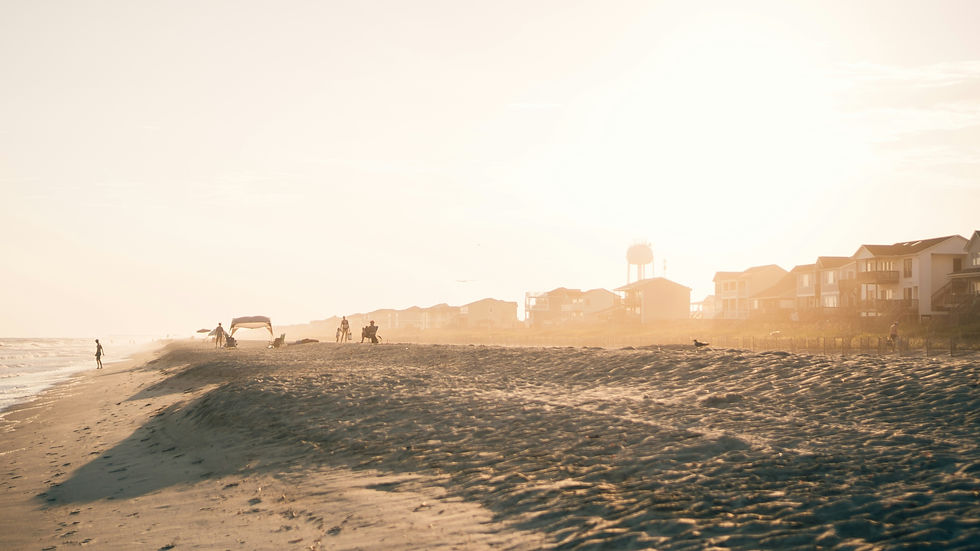
The beach-nourishment narrative is a positioning asset, not a compliance footnote. Bogue Banks is a south-facing barrier island whose rental economy depends on maintained beach width, and half of every occupancy-tax dollar your guests pay funds that maintenance. In the digital guidebook, add a one-paragraph "Why our beach stays wide" section naming the Carteret County Shore Protection program and the occupancy-tax nourishment fund, because guests who understand that their tax rebuilds the beach they are renting convert the line item from grudge to purpose. In fall and spring shoulder-season emails, tie lower rates to "same nourished beach, fewer crowds" — the nourishment work continues year-round even when your July calendar is full. For Triangle and Charlotte feeder-market families (Raleigh-Durham-Fayetteville DMA supplies 16% of Coastal Region overnight visitors per Visit NC's 2024 Regional Visitor Profile), frame the Crystal Coast as the calmer, better-maintained alternative to the northern Outer Banks — Dare County posted $2.1 billion in visitor spending with a −2.2% decline in 2024 while Carteret grew +1.5% to $743.38 million (NC Commerce, 2024 county tourism).
Do not apologize for the tax. Explain what it builds. A guest paying $240 in occupancy tax on a $4,000 week is contributing $120 to the beach outside their rental door.
Direct Bookings, Occupancy Tax, and the Compliance Gap Most Hosts Miss
Marketplace platforms often handle sales-tax collection automatically. Carteret County occupancy tax is a separate filing obligation — and direct-booking hosts bear the full weight of both taxes without platform assistance. If you build a direct-booking channel, your compliance checklist adds Avenu monthly filing by the 20th for all direct gross receipts, NCDOR sales-tax filing for direct collections, a Chapter 42A written agreement with explicit tax disclosure, and calendar sync so OTA and direct bookings do not create unreported receipt gaps. The 86% repeat-visitor rate for Coastal Region overnight travelers (Visit NC 2024 Regional Visitor Profile) means your past guests are the most likely direct-booking converts — and the most likely to book a channel where you must self-remit if the platform does not.
The gap appears when hosts assume Airbnb's tax line covers everything. Sales-tax collection by marketplace facilitators does not automatically cover county occupancy tax, and a host who adds a direct-booking checkout without updating the Avenu filing is the most common compliance failure on Bogue Banks. Set a recurring reminder for the 15th of each month to reconcile platform payouts, direct gross receipts, and Avenu filing before the 20th deadline. Merchandise the nourishment story in listing materials and direct-site copy so guests understand the tax before checkout — half of every occupancy-tax dollar either sells the Crystal Coast through the TDA or puts sand back on Bogue Banks through the Shore Protection Office. That is not a surcharge defense; it is the reason the beach outside the rental door stays wide enough to market.
Work with Crest & Cove Creative
Need help positioning your Crystal Coast listing around the tax-and-beach story — or building a direct-booking checkout that itemizes Carteret occupancy tax correctly?
We help Bogue Banks hosts with the practical work this guide describes: tax-disclosure copy for listings and direct sites, digital guidebook sections that merchandise the nourishment narrative, and direct-booking flows that keep Avenu filing clean. If you want hands-on help implementing any of that on your property, our team takes a limited number of new engagements per quarter. Reach out at crestcove.co — we'll take an honest look at where your listing stands and tell you plainly whether we can help.
Frequently Asked Questions
What is the Carteret County occupancy tax rate? 6% on gross receipts from rooms, lodging, and accommodations, including vacation rentals booked through Airbnb, Vrbo, and similar platforms. Combined with 6.75% NC sales tax, guests pay approximately 12.75% total tax on stays under 90 nights in Carteret County.
How is the 6% occupancy tax split? 50% goes to the Crystal Coast Tourism Development Authority for travel and tourism promotion, and 50% is restricted to Bogue Banks beach nourishment through the Carteret County Shore Protection Office (S.L. 2013-223).
Do I need to register for occupancy tax if I only list on Airbnb? You may still need to register and file with Carteret County, depending on whether your platform remits the 6% occupancy tax on your behalf. Sales tax collection by marketplace facilitators does not automatically include county occupancy tax. Verify your platform's current Carteret remittance arrangement and file a Remitter Information Form if you are responsible.
When are Carteret County occupancy tax payments due? Monthly, through Avenu Insights & Analytics, by the 20th of the month following the reporting period (Carteret County Occupancy Tax page).
Is occupancy tax the same as an STR permit? No. Post-Schroeder, North Carolina towns cannot require STR registration under N.C.G.S. § 160D-1207(c). Occupancy tax is a revenue-collection obligation on lodging receipts — not a rental permit.
Are long-term stays exempt from occupancy tax? Lodging furnished to the same person for 90 or more consecutive days is exempt from the 6% Carteret occupancy tax. Typical weekly beach rentals under 90 days are fully taxable.
What occupancy tax applies in Swansboro? Swansboro is in Onslow County, not Carteret. The town levies a 3% occupancy tax, and Onslow County levies an additional 3% for a combined 6% occupancy tax plus 6.75% sales tax — a similar ~12.75% total, but filed to different jurisdictions with no TDA/nourishment split.
Does the occupancy tax fund anything guests can see? Yes. Half funds Crystal Coast TDA destination marketing; half funds Bogue Banks beach nourishment projects managed by the Shore Protection Office. Collections surpassed $12 million in calendar year 2021, implying roughly $6 million per year to each fund at that collection level.
About the Authors
Crest & Cove Creative is a Southeast-focused short-term rental marketing agency founded by Thomas Garner and Jacob Mishalanie. We build direct-booking brands, listing optimization systems, and market-specific content strategies for independent STR operators across the Gulf Coast, Appalachian Mountains, Coastal Georgia, the Carolinas, and Southeast lake country.
Related Reading
Explore more North Carolina short-term rental insights and host guides:
Photographing Your Crystal Coast Rental: The Shots That Sell Bogue Banks Beach Houses
How to Choose a Vacation Rental Photographer on the Cape Fear Coast & Brunswick Islands
Coastal NC Listing Photography: Selling the Sound, the Surf, and the Sunset
Shoulder Season Revenue Strategy for North Georgia Mountain Cabin Operators
Blairsville vs. Helen GA on Repeat Guest Rates: Which North Georgia Market Builds More Loyalty?
The Checkout Process That Earns Reviews: Why Most Hosts Get This Wrong
Instant Book vs. Request to Book: How Each Affects Your Search Ranking
Brevard vs. Blue Ridge GA: Which Market Wins on Repeat Guest Rates?
The 4-Star Review Recovery Play: How to Respond and Prevent It From Happening Again
Ranking for "Highlands Cabin with Hot Tub": The Highest-Intent Query in Your Market
How to Handle Noise Complaints Before They Become 1-Star Reviews
Ranking for "Pet-Friendly Cabin Robbinsville": A Niche-Search Playbook
The Welcome Basket That Pays for Itself: What to Include and What Wastes Money
Sources
Carteret County — Occupancy Tax (6%, Avenu, monthly by 20th, exemptions) (https://www.carteretcountync.gov/843/Occupancy-Tax). N.C. General Assembly — S.L. 2013-223 (50/50 TDA/beach nourishment) (https://www.ncleg.net/enactedlegislation/sessionlaws/html/2013-2014/sl2013-223.html). ccountync.com — What Carteret County occupancy tax funds (https://ccountync.com/what-carteret-county-nc-occupancy-tax/). Coastal Review — Karen Gould TDA / 6% split (https://coastalreview.org/2026/05/karen-gould-to-become-carteret-tda-executive-director/). Carolina Coast Online — FY2020-21 occupancy tax >$10M (https://www.carolinacoastonline.com/newstimes/article8971d67c-f09c-11eb-b3a4-fb19d5264724.html). Carolina Coast Online — Calendar 2021 >$12M (https://www.carolinacoastonline.com/newstimes/articleb2f6556a-9324-11ec-bc24-3779ca2bac6b.html). Carolina Coast Online — Carteret $743.38M visitor spending 2024 (https://www.carolinacoastonline.com/newstimes/articlea4a61db3-9e38-440e-9f7a-de2de02e52a8.html). NC Commerce — 2024 county tourism growth (https://www.commerce.nc.gov/news/press-releases/2025/08/27/2024s-record-tourism-growth-boosts-economies-most-nc-counties). Avalara — Carteret County 6.75% sales tax (https://www.avalara.com/taxrates/en/state-rates/north-carolina/counties/carteret-county.html). Avalara MyLodgeTax — NC vacation rental tax guide (https://www.avalara.com/mylodgetax/en/resources/vacation-rental-tax-guides/north-carolina.html). UNC School of Government — Schroeder / 160D-1207(c) (https://canons.sog.unc.edu/blog/2022/04/14/short-term-rental-regulations-after-schroeder/). Town of Swansboro — Occupancy Tax (https://swansboro-nc.org/occupancy-tax/). Onslow County — Occupancy Tax (https://www.onslowcountync.gov/874/Occupancy-Tax). Visit NC — 2024 Regional Visitor Profile (86% repeat, Raleigh DMA 16%) (https://www.visitnc.com/sites/default/files/2025-08/2024%20North%20Carolina%20Regional%20Visitor%20Profile_0.pdf). NC General Assembly — SB 154 beach-nourishment reserve cap (https://lrs.sog.unc.edu/bill-summaries-lookup/S/154/2023-2024%20Session/S154).
<!-- batch02-tracked: 2026-06-24-editorial-r2 -->


Comments