
Garden Valley, Idaho STR Market Report 2026: $27,102 Across 154

Updated: Aug 27

Garden Valley, Idaho is a small, dispersed mountain corridor along the South Fork Payette River, and its short-term rental market reads that way in the numbers: a real but modest published year, spread across a wide sample of listings rather than concentrated around a single town center. The current AirROI extract puts Garden Valley at $27,102 across 154 listings, with an average daily rate of $286, occupancy of 32.6 percent, and RevPAR of $96. Those figures describe a genuine mountain-corridor rental market - not a resort town, not a metro suburb, and not something that should be quietly averaged together with its neighbors to make a bigger, rounder story.
This report exists because that averaging happens constantly in loose market talk, and it produces bad underwriting. Garden Valley's number is Garden Valley's number. Nearby Lowman carries a separate, smaller sample. Idaho City, an hour or so away by a different road, has its own distinct year. Boise, the regional metro anchor, is a completely different scale of market. None of those belong blended into a single market, and a host or buyer who treats them as interchangeable will underwrite the wrong property. This is not legal advice.
The Published Year: $27,102 on 154 Listings
Garden Valley's current AirROI extract shows $27,102 in typical annual revenue spread across a sample of 154 listings, with an average daily rate of $286 and occupancy of 32.6 percent, producing a RevPAR of $96. Read those together rather than in isolation: a $286 ADR paired with 32.6 percent occupancy is a market where individual bookings command a real mountain-cabin rate, but where the calendar is not close to full. That combination is typical of a dispersed, seasonal, drive-to corridor rather than a market with year-round urban demand - guests are paying for a specific kind of stay on specific weeks, not filling beds in every shoulder month.
For a host or buyer evaluating a Garden Valley property, the RevPAR of $96 is the number that actually matters for underwriting, because it already blends the rate and the occupancy gap into a single per-available-night figure. A pro forma built on the $286 ADR alone, assumed to run at anything close to full occupancy, will overshoot this market's real performance by a wide margin. This is a $27,102-a-year market on the current sample, not a market secretly capable of a much larger number if only the marketing improved.
Do Not Blend Lowman, Idaho City, or Boise Into this market
The single most common underwriting mistake in this corridor is treating nearby, differently-scaled markets as interchangeable with Garden Valley. Lowman, a smaller community further up the same general corridor, carries its own separate extract of $13,657 across a sample of just 20 listings - a genuinely different, thinner market with far less data behind it. Idaho City, reached by a different route and its own distinct county-seat identity, shows $16,176 on 41 listings. And Boise itself, the metro anchor roughly 55 miles away, is an entirely different order of magnitude at $25,127 across a sample near 268 listings.
None of those four numbers describe the same thing, and averaging them together - which is exactly the kind of shortcut a rushed comp sheet takes - produces a blended figure that describes no real property anywhere. A cabin in Garden Valley should be underwritten against Garden Valley's $27,102 sample, full stop. If a broker or a marketing packet hands you a number that quietly folds in Lowman's thin 20-listing sample or Boise's metro-scale extract to make the corridor look bigger or steadier than it is, that packet is describing a corridor average that does not correspond to any actual overnight stay a guest will book.
A Census of 377 Is Not a Town Center
Garden Valley's year-round population is small - on the order of a few hundred residents - and that fact should shape how the market is described, not just footnoted. This is not a market with a walkable downtown commercial district driving demand the way a true town center would. It is a dispersed rural corridor where the rental listing stock is spread across cabins, riverside properties, and forested lots rather than clustered around a central business strip. A listing description that implies a town-center experience - shops, restaurants, foot traffic - sets up the same mismatch that plagues plenty of mountain markets: guests arrive expecting an amenity base that simply is not concentrated in one walkable place.
The honest version of this market is a corridor, not a town. Guests are coming for the river, the drive, and the specific property they booked, not for a Main Street experience they can walk to from the door. Marketing that leans into what the corridor actually offers - the drive, the river access, the seclusion - will outperform marketing that borrows town-center language this market does not support.
The Corridor Runs on the River, Not a Downtown
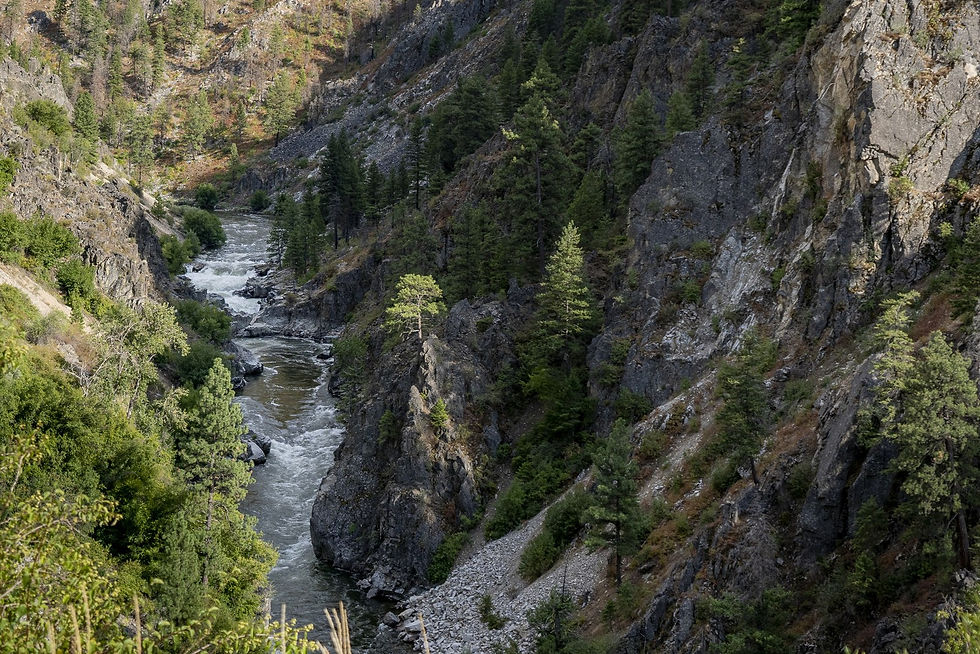
What Garden Valley actually offers is access: whitewater put-ins on the South Fork Payette for guests who want to raft or kayak, and natural hot-spring soaking spots along the same corridor for guests who don't. Both of those are real, specific draws that a listing can honestly describe if the property is genuinely positioned near them - a put-in a guest can actually drive to, a soak they can actually reach without a long detour. That specificity matters more here than in a market with a dense commercial center, because the entire selling proposition of a dispersed corridor rests on how close a given property actually sits to the thing a guest booked it for.
Boise's own paved riverside path, its Greenbelt, is a different amenity in a different market roughly an hour away, and it should stay there in the marketing copy. Guests booking a Garden Valley stay for river access are not looking for an urban paved trail; conflating the two blurs what is actually a strong, honest selling point - genuine backcountry river and hot-spring access - into a vague, borrowed urban amenity that doesn't exist on-site.
Seasonality: August, June, and July Carry the Desk
The available seasonal pattern for this market points to summer as the load-bearing season, with August, June, and July carrying the bulk of demand, consistent with a corridor built around river access and warm-weather outdoor recreation. On the other side of the calendar, the winter and early-spring months - broadly the January-through-March stretch - read as the market's hole, when whitewater season is over and the corridor's main draw is dormant. A host underwriting this market needs a calendar strategy that matches that shape: aggressive summer pricing and listing stock management during the June-through-August window, and a realistic expectation - not a marketing aspiration - for the winter months.
This seasonality also explains why the annual occupancy figure of 32.6 percent looks moderate rather than strong even though summer weekends likely run close to full. A corridor that depends heavily on a three-to-four-month peak will always show a lower blended annual occupancy than a market with steadier year-round demand, and that is not a marketing failure to fix - it's the structure of a seasonal river-corridor market that should be priced and staffed accordingly.
HB 583 Is a Statewide Rule, Not a Garden Valley Advantage
Idaho's HB 583 governs short-term rental regulation at the state level, and it applies uniformly across Idaho jurisdictions - it is not a Garden Valley-specific ordinance, and it should not be marketed or underwritten as a local regulatory edge unique to this corridor. Any host or buyer using HB 583 as part of a pitch for why Garden Valley specifically is a favorable STR market is misreading what the law actually does: it sets a statewide baseline, which means every comparable Idaho market referenced elsewhere in this report - Lowman, Idaho City, Boise - operates under the same framework.
The practical takeaway is to treat HB 583 as background context worth knowing, not as a differentiator. What actually differentiates Garden Valley from its neighbors is the corridor's specific listing stock, its river and hot-spring access, and its own $27,102 sample - not a state law that applies everywhere else in Idaho too.
154 Listings, and Professional Management Is Genuinely Present
A sample of 154 listings is a meaningful base for this size of market, and it is worth noting that professional management, including at least one recognized national operator, is genuinely active in this corridor rather than being a theoretical possibility. That matters for two reasons. First, it means part of the sample behind the $27,102 figure reflects professionally optimized listings - pricing tools, dynamic calendars, and consistent guest communication - not purely owner-run properties learning as they go. Second, it means an independent host evaluating this market is competing against at least some professionally managed listing stock, and should benchmark against that reality rather than only against other independent listings.
None of that changes the underlying market number. It does mean that a host entering this corridor should expect competent competition in at least part of the sample, and should price and photograph accordingly rather than assuming the entire 154-listing set is amateur listing stock that's easy to outperform on presentation alone.
Reading This as a Host: What the Numbers Actually Recommend
For a host or prospective buyer, the useful read of this market is straightforward: Garden Valley is a real, moderate-revenue, seasonally concentrated corridor market with a $27,102 typical year, a $286 ADR, and 32.6 percent occupancy, built on river access and hot-spring proximity rather than a walkable town center. It is not a market to underwrite optimistically by borrowing a neighboring town's bigger number, and it is not a market to dismiss because the blended annual occupancy looks modest - that occupancy figure is the natural result of a strongly seasonal demand pattern, not evidence of a weak asset.
The corridor rewards specificity: an honest description of exactly which river put-in or soaking spot a given property sits near, honest photography of what a guest will actually see on arrival, and a calendar strategy built around the June-through-August peak rather than a flat year-round pricing assumption. Buying or marketing a Garden Valley rental starts with this published year - not a blended close that borrows a bigger number from somewhere else on the map.
Related Reading
More Garden Valley and Lowman, Idaho reading already live on Crest & Cove.
Frequently Asked Questions
What is Garden Valley, Idaho's current published short-term rental revenue?
The current AirROI extract shows $27,102 in typical annual revenue across a sample of 154 listings, with a $286 average daily rate and 32.6 percent occupancy, producing a RevPAR of $96. That figure describes this specific corridor's sample and should not be blended with nearby markets like Lowman, Idaho City, or Boise, each of which has its own distinct extract.
Why shouldn't I average Garden Valley with Lowman's numbers?
Lowman carries a much smaller, separate sample of just 20 listings and a lower typical year of $13,657, reflecting a thinner market with less data behind it. Blending it with Garden Valley's larger 154-listing sample produces a figure that doesn't accurately describe either market, and it can mislead underwriting for a property in either location.
How far is Garden Valley from Boise, and does that make it part of the Boise market?
Garden Valley is roughly 55 miles from Boise, and while that's a manageable drive, it does not make Garden Valley part of the Boise metro market for underwriting purposes. Boise's own extract, at roughly $25,127 across a much larger sample near 268 listings, describes a fundamentally different scale of market and should be kept separate in any comp analysis.
Is Garden Valley a walkable town with a downtown commercial district?
No. Garden Valley's year-round population is small, on the order of a few hundred residents, and the area functions as a dispersed rural corridor rather than a market with a concentrated downtown. Listings should describe the corridor honestly - river access, seclusion, the drive - rather than implying a walkable town-center experience the area doesn't have.
What actually drives demand in the Garden Valley corridor?
The corridor's core draws are whitewater access on the South Fork Payette River and natural hot-spring soaking spots along the same stretch. A listing's proximity to a specific put-in or soak is a genuine, honest selling point worth naming precisely, rather than a generic reference to outdoor recreation.
When is the peak season in Garden Valley, and when is the slow season?
The available seasonal data points to August, June, and July as the months carrying the bulk of demand, consistent with river and warm-weather recreation. The January-through-March stretch reads as the market's hole, when whitewater season has ended and the corridor's primary draw goes dormant, which is a structural seasonal pattern rather than a marketing gap to fix.
Does Idaho's HB 583 give Garden Valley hosts a regulatory advantage?
No. HB 583 is a statewide short-term rental law that applies uniformly across Idaho jurisdictions, including Lowman, Idaho City, and Boise. It should be understood as background regulatory context, not marketed or underwritten as something unique to Garden Valley specifically.
Is professional management active in the Garden Valley short-term rental market?
Yes. At least one recognized national management operator is genuinely present in this corridor's 154-listing sample, meaning part of the market reflects professionally optimized pricing and calendar management rather than purely owner-run listings. Independent hosts entering this market should benchmark against that reality.
Why is occupancy only 32.6 percent if the market is considered real and worth buying into?
The 32.6 percent figure is an annual blend across a strongly seasonal corridor, where summer months likely run much closer to capacity while winter months are structurally slow due to the end of whitewater season. That blended number reflects the shape of seasonal demand, not evidence that the underlying asset or market is weak.
Should Boise's Greenbelt be mentioned in Garden Valley listing marketing?
No. The Greenbelt is a paved riverside path specific to Boise, roughly an hour away, and it is a different amenity in a different market. Garden Valley's genuine draw is backcountry river and hot-spring access, and conflating the two amenities blurs an honest, strong selling point into something the property doesn't actually offer on-site.
Work with Crest & Cove Creative
Garden Valley's real published year is $27,102 across 154 listings - not a rounder number borrowed from Lowman's thin 20-listing sample, Idaho City's separate extract, or Boise's metro-scale market fifty-five miles down the road. Name the failure mode the guest.
If your Garden Valley pro forma is quietly blending in a neighboring market's bigger number, we'll rebuild it against this corridor's actual $27,102 sample before you commit to a purchase or a pricing strategy. Reach out at crestcove.co or (256) 998-7502.
Reach out at crestcove.co or (256) 998-7502.


Comments