
Murray County and Chatsworth: Building a Cabin Listing Around the

Updated: Aug 27
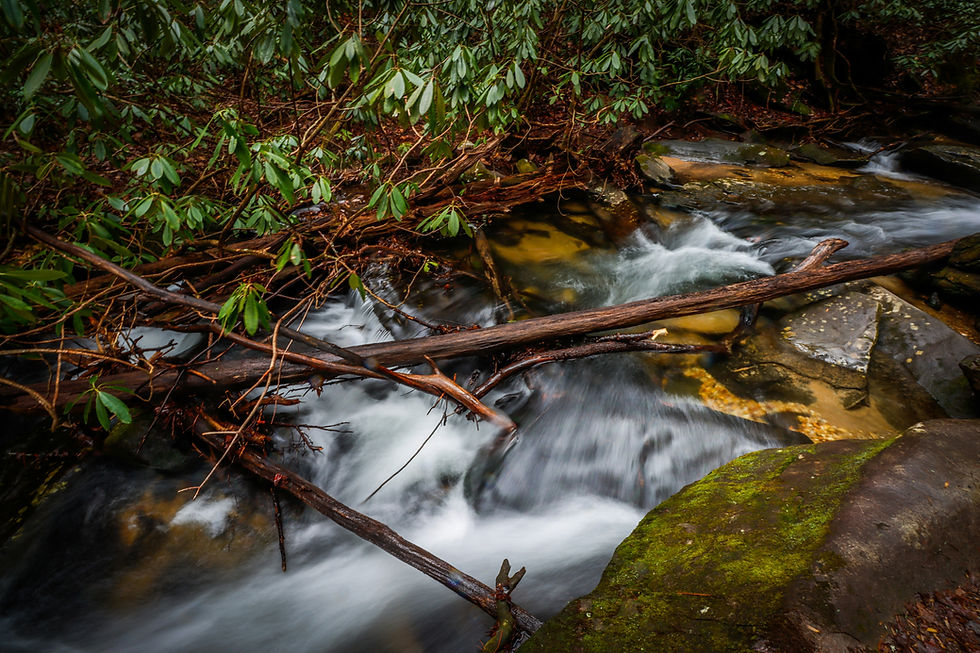
Chatsworth sits at the western hinge of the North Georgia mountains, close enough to the Cohutta Wilderness that a cabin here can promise something Blue Ridge and Ellijay cannot: a trailhead into 36,977 roadless acres, not a scenic overlook of them from a distance. That geography is the whole pitch. Murray County is not competing on brand recognition with the mountain towns thirty and forty-five minutes to the east, and pretending otherwise is how a good cabin ends up priced and marketed like a mediocre one.
The county's position is transitional in a way that cuts both directions. It is wilder and less developed than Ellijay's thirty-minute drive or Blue Ridge's forty-five-minute drive, which means less foot traffic and less name recognition among Atlanta guests who already have those two towns in their search history. But it is also closer to the Nashville-Chattanooga drive corridor than either of its eastern neighbors, and it holds a genuinely singular asset in the Cohutta Wilderness, Fort Mountain State Park, and the Conasauga River — three reasons for a specific kind of guest to book Murray County on purpose rather than settle for it. This piece works through what each of those assets actually offers a guest, what the numbers say and don't say about Murray County's own performance, and how to write a listing that sells wilderness access instead of a generic mountain-cabin story. This is not legal advice.
The Cohutta Wilderness Is the Asset, Not the Backdrop
The Cohutta Wilderness spans approximately 36,977 acres across Murray and Gilmer Counties, and its size alone puts it consistently among the largest wilderness areas east of the Mississippi River — a boundary debate that matters less to a guest than the fact that this is roadless country with no mechanized equipment, no ATVs, and no maintained-trail machinery cutting through it. That absence of mechanization is the actual product. The wilderness holds roughly 95 miles of maintained foot trail, including the Conasauga River Trail, which follows the river through the interior, and the Jacks River Trail, a 17-mile traverse that crosses the river 39 times.
Thirty-nine crossings is not a detail to bury in an amenities list — it is the filter that separates a casual day-hiker from the backcountry guest a Murray County cabin should actually be marketing to. A listing that states plainly that the Jacks River trailhead sits about 18 miles from the property, that market service ends roughly 5 miles out, and that the trail is a genuine multi-day commitment with a working brook trout fishery along the way is speaking directly to the guest who has already decided they want this experience and is searching for the right base camp. That guest does not need convincing that the mountains are pretty. They need to know the cabin understands the terrain they're coming for.
Fort Mountain State Park: The Half-Day That Sells the Multi-Day
Not every Murray County guest wants a 17-mile backcountry traverse, and Fort Mountain State Park exists as the accessible complement to the wilderness's demanding interior. The park sits on the summit of Fort Mountain, roughly 8 miles east of Chatsworth on GA-52, and its trail network runs about 14 miles, anchored by the Gahuti Trail loop around the summit and the Cool Springs Overlook Trail. A 17-acre lake adds paddleboat rentals, kayak access, and stocked trout and bass fishing — flatwater recreation that pairs naturally with a morning trail walk.
The park's other asset is stranger and more useful than most operators give it credit for: a stone wall of unknown, prehistoric origin running along the summit, its builders and purpose still genuinely disputed between Woodland-period and even pre-Columbian theories. That mystery is free content. A guest who hikes to the wall and reads the interpretive signage has had an experience that is specifically Fort Mountain, not generic North Georgia scenery, and a listing that names the wall directly — not just 'hiking trails nearby' — is doing more work than three stock photos of a mountain view ever will.
The Conasauga River as a Booking Reason, Not Scenery
The Conasauga originates in the Cohutta Mountains and flows north through Murray County toward the Tennessee line, and its water quality is exceptional by Southeast standards precisely because the watershed carries so little agricultural and development pressure. The lower sections near US-411 and the county road network are stocked with rainbow trout and accessible enough for a day-trip angler; the upper sections, within and adjacent to the wilderness, hold wild brown and brook trout for guests willing to hike in for them.
The river also supports one of the most biologically diverse fish communities in the southeastern United States, including species found almost nowhere else — a fact that reaches a different guest than the one chasing trout. The nature-focused visitor booking for river ecology and the angler booking for a blue-ribbon fishery overlap more than operators assume, and a listing description that mentions both the fishing access and the river's ecological standing is casting a wider net without diluting either message.
Reading Murray County's Numbers Without Borrowing Ellijay's
There is no town-level AirROI file for Murray County or Chatsworth specifically, and that gap matters more than it looks. The nearest labeled comparison is adjacent Ellijay, whose typical year runs $33,630 at 35.0% occupancy — a real number, but Ellijay's number, not Murray County's. What the market data does show directly for Murray County is that peak nights can print in the $125 to $300 range, which is meaningfully below the Blue Ridge and Ellijay premium. That gap reflects lower destination brand awareness among Atlanta-area guests, not lower property quality, and it is worth saying that plainly to an owner deciding whether the county is underpriced or simply under-marketed.
The failure mode to avoid is treating the Ellijay figure as a stand-in for what a Murray County property should earn. Filing another market's number as this year's plan is how a pro forma goes wrong before a single guest ever books. The honest starting point is the peak-night range the county itself reports, built up from there with a wilderness-specific marketing strategy rather than assumed upward toward a neighboring town's brand premium. Owners weighing whether to invest in a Murray County property at all should treat the absence of a dedicated AirROI file as a research gap to fill with direct comparables and firsthand booking-calendar tracking, not as an invitation to assume the neighboring town's number by default.
Positioning Against Ellijay and Blue Ridge Without Copying Their Playbook
Murray County's thin listing stock relative to Ellijay and Blue Ridge is a genuine advantage inside the county — quality properties face limited direct competition locally — but it also means every Murray County listing is competing against those larger markets' name recognition for the same Atlanta drive-market guest. Trying to win that fight on price alone is a losing position; trying to win it by pretending to be a smaller Ellijay is worse, because it hands the comparison to the town with the stronger brand.
The stronger move is to make the comparison irrelevant. A listing built around 'adjacent to the Cohutta Wilderness, the largest wilderness area in the eastern US, with the Jacks River trout stream 18 miles out, Fort Mountain State Park ten minutes away, and the clearest trout stream in Georgia running through the county' is not asking to be judged against Blue Ridge's cabin listing stock. It is offering a specific and irreplaceable experience to a guest who has already decided they want it — occupancy is strongest in summer for the hiking and fishing season and in fall for foliage that rivals Blue Ridge's without the crowd density, and a listing that names those seasonal reasons directly converts better than one leaning on generic mountain imagery.
What Actually Belongs in the Listing Description
Specificity is the entire strategy here, and it should show up in the first three lines of the listing, not buried in the amenities section. Distance to the Jacks River trailhead, the drive time to Fort Mountain State Park, the stretch of Conasauga River within reach, and an honest note about where market service ends all belong above the fold, because they are the details that tell a wilderness-seeking guest this property was built for them specifically.
The listing should also be honest about what the property is not. It is not a Blue Ridge downtown walk-to-dinner cabin, and pretending otherwise sets up a guest for disappointment that shows up in the reviews. A Murray County cabin that owns its wilderness-gateway identity — the trailhead access, the trout water, the state park mystery wall — is selling something Blue Ridge and Ellijay structurally cannot offer, and that is a stronger position than competing on their terms with a smaller marketing budget.
The Nashville-Chattanooga Drive Market Murray County Actually Has
Most North Georgia mountain marketing assumes Atlanta is the only drive market worth chasing, and that assumption costs Murray County operators bookings they could otherwise win without any competition at all. Chatsworth sits closer to the Tennessee line than Ellijay or Blue Ridge, which puts it within a genuinely shorter drive for Chattanooga and even Nashville guests than it is for a large share of Atlanta's northern suburbs. That geography is not a footnote — it is an entire guest segment that most Murray County listings never mention, because the copy is written with an Atlanta audience in mind by default.
A listing that names the drive time from Chattanooga alongside the drive time from Atlanta is fishing in a pond most of the county's competitors have ignored. This matters more in a county with thin listing stock and low destination brand awareness, because winning attention from a search audience that isn't already comparing five Ellijay cabins is a faster path to bookings than trying to out-market Blue Ridge for the Atlanta guest's attention. It also aligns naturally with the wilderness-access positioning: a Nashville or Chattanooga guest headed toward the Cohutta for a weekend of hiking or fishing does not need convincing about North Georgia's mountain scenery. They need to know the cabin sits closer to the trailhead than the alternatives they're comparing it against.
Practical Notes for a Wilderness-Access Cabin Description
Guests booking a Murray County cabin for the Cohutta, Fort Mountain, or the Conasauga are planning around specific logistics, and a listing that answers those logistics up front reduces pre-booking questions and post-arrival surprises alike. That means naming which sections of the Conasauga are reachable without a long drive, whether the property is closer to the Jacks River side of the wilderness or the more accessible Fort Mountain side, and how far a guest actually has to travel before market service becomes unreliable.
It also means being specific about seasonal access. Winter closes some of the higher wilderness trail sections to casual use and changes what a day trip to Fort Mountain's lake actually offers; a listing that addresses this directly, rather than leaving a winter guest to discover it on arrival, protects the review score that a vague, photo-only listing puts at risk. The county's wilderness-gateway identity is strong enough to carry a listing on its own, provided the copy treats the guest as someone planning a specific outdoor trip rather than someone browsing generic mountain photos.
Photos That Match the Wilderness-Gateway Pitch
A listing description built around the Cohutta Wilderness, Fort Mountain, and the Conasauga fails if the photo set still opens with the same generic deck-and-hot-tub sequence every other North Georgia cabin uses. The first five images are doing the positioning work before a guest reads a single word of copy, and for a wilderness-access property that means an actual trailhead sign, a river shot with visible current and rock structure rather than a still pond, or the summit view from Fort Mountain rather than a stock sunset. Guests filtering for a specific outdoor trip recognize the difference between a cabin that photographs its surroundings and one that photographs itself and hopes the surroundings are implied.
This is also where the honest positioning pays off twice. A photo set that shows the actual distance and terrain a guest will cover — a trail map on the porch wall, a truck loaded for a multi-day hike, the cabin's own driveway next to a trailhead marker — builds the same credibility the copy is trying to establish, and it does so before the guest has to trust a single adjective. For a market with thin listing stock and no town-level performance data to lean on, that credibility is doing more of the conversion work than it would in a market where brand recognition alone gets a listing clicked.
Related Reading
More independent-host reading on listing copy, calendars, and operable decisions guests can trust.
Frequently Asked Questions
How big is the Cohutta Wilderness, and why does that matter to a Murray County listing?
The Cohutta Wilderness covers approximately 36,977 acres across Murray and Gilmer Counties and is consistently ranked among the largest wilderness areas east of the Mississippi River. Its size and roadless, no-mechanized-access character give Murray County a genuinely singular selling point that neighboring mountain towns without direct wilderness-boundary access cannot claim. A listing that leads with proximity to that acreage, rather than generic mountain views, is speaking to a guest already motivated to book it.
What makes the Jacks River Trail relevant to how I market a cabin?
The Jacks River Trail is a 17-mile traverse through the Cohutta Wilderness that crosses the river 39 times, which filters out casual day visitors and draws a committed backpacking and fly-fishing guest instead. Naming the trailhead distance, the crossing count, and where cell service ends signals to that specific guest that the property understands the terrain. That level of detail converts better than a vague reference to nearby hiking.
Is Fort Mountain State Park worth mentioning if my guests are mostly wilderness backpackers?
Yes, because not every member of a booking party wants a multi-day wilderness trek, and the park's roughly 14 miles of maintained trail, its 17-acre lake, and its stocked fishing give a shorter, family-friendly option about 8 miles from Chatsworth. It broadens who the listing can serve without diluting the wilderness-access identity. The park's stone wall of disputed prehistoric origin also gives the listing a specific cultural detail worth naming outright.
Why is there no AirROI number for Murray County or Chatsworth specifically?
AirROI does not maintain a dedicated town-level file for this market, which is why comparisons default to the nearest labeled town, Ellijay, at $33,630 and 35.0% occupancy. That figure describes Ellijay's performance, not Murray County's, and should never be filed as this county's expected year. The data that does exist for Murray County directly shows peak nights printing in the $125 to $300 range.
Should I price a Murray County cabin the same as a comparable Ellijay property?
No. The county's lower destination brand awareness among Atlanta-area guests means Murray County properties currently sit below the Blue Ridge and Ellijay premium, and that gap reflects marketing reach rather than a difference in property quality. Closing it requires a wilderness-specific positioning strategy built on the county's own peak-night data, not an assumption that Ellijay's typical year applies here.
What is the biggest mistake operators make when marketing a Murray County property?
The most common mistake is writing generic North Georgia mountain-cabin copy that could describe any cabin in Fannin, Gilmer, or Union County, which forces the listing into a head-to-head price comparison with better-known towns it cannot win. The stronger approach names the Cohutta Wilderness, the Jacks River access, and the Conasauga's trout water directly, positioning the property as a gateway rather than a generic alternative.
Does the Conasauga River appeal to guests who aren't anglers?
It does, because the river also supports one of the most biologically diverse fish communities in the southeastern United States, including rare and endemic species that draw nature-focused visitors independent of fishing. A listing that mentions both the trout fishery and the river's ecological standing reaches the angler and the natural-history-minded guest at once, since their interests overlap more than operators usually assume.
When is occupancy strongest for a Murray County wilderness-access cabin?
Summer is strongest for hiking and trout fishing in and around the Cohutta Wilderness, and fall performs well because the Cohutta Mountains produce foliage comparable to Blue Ridge's without the crowd density. Shoulder-season performance depends heavily on whether the listing actively communicates winter and spring wilderness access rather than going quiet during those months.
How far is Fort Mountain State Park from a typical Chatsworth cabin?
The park sits on the summit of Fort Mountain approximately 8 miles east of Chatsworth on GA-52, making it a short drive rather than a day trip. That proximity is worth stating as an exact distance in the listing rather than a vague 'nearby state park' reference, since specific numbers read as more credible to a guest comparing several cabin options.
Is Murray County's thinner inventory an advantage or a disadvantage?
Both, depending on the comparison. Within the county, thinner inventory means quality properties face less direct local competition, which is an advantage. Against the broader North Georgia mountain corridor, it means the county has less collective brand pull than Ellijay or Blue Ridge, which is why an individual listing has to do more work naming its specific wilderness assets rather than relying on the market's reputation to do that work for it.
Work with Crest & Cove Creative
There is no AirROI file for Murray County. That absence is not a data gap to work around — it's the reason so many listings here quietly borrow Ellijay's number and hope nobody checks.
If your Murray County or Chatsworth listing is still leaning on borrowed numbers or generic mountain-cabin language instead of the Cohutta Wilderness, Fort Mountain, and the Conasauga's trout water, Crest & Cove Creative can rebuild the positioning around what the property actually offers. Reach out at crestcove.co or (256) 998-7502.
Reach out at crestcove.co or (256) 998-7502.


Comments