
Photograph the Ocean View Guests Will Actually Stand In

Updated: Aug 26
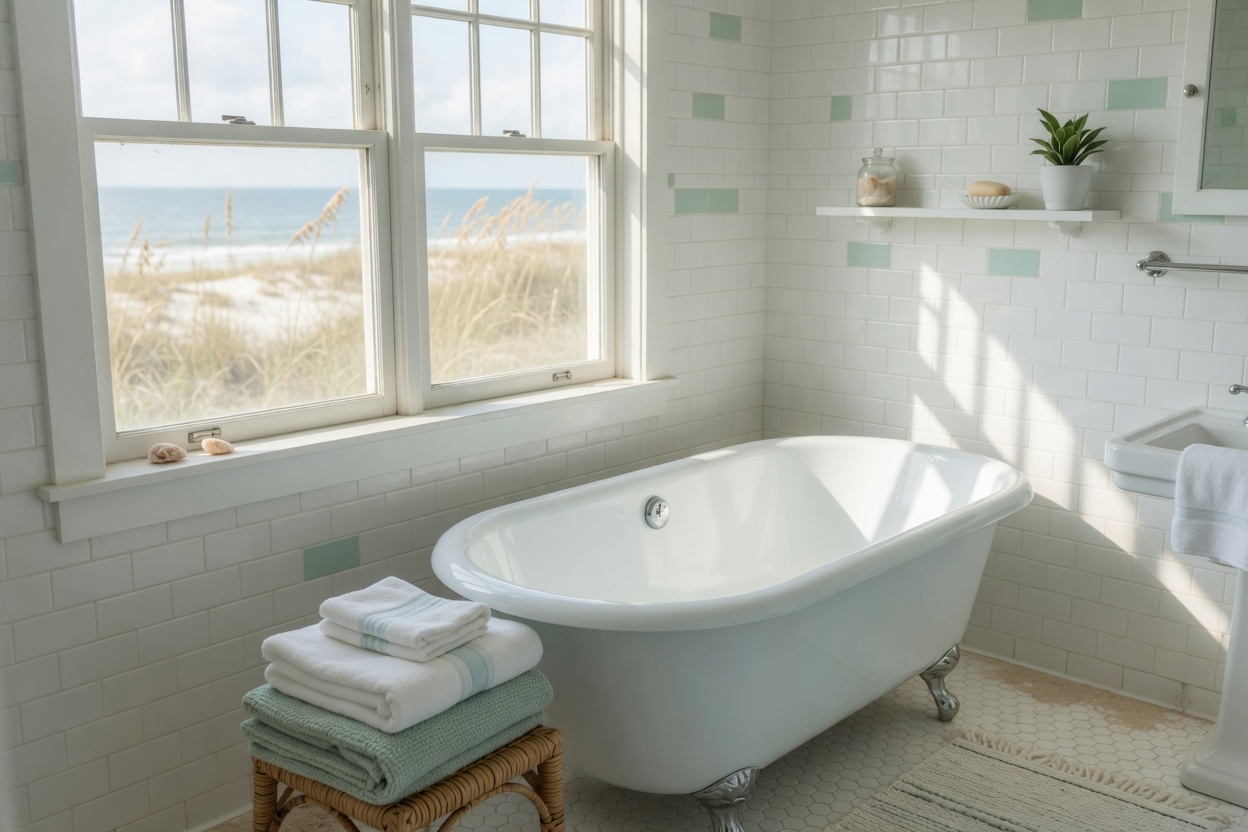
The ocean view complaint almost never starts with the ocean. It starts with a guest standing on the deck at 4pm on arrival day, phone out, comparing what they are looking at to what the listing photos promised, and finding the gap. A sliver of blue between two rooflines is not the panorama the hero shot implied. A view that requires walking half a block and craning over a fence is not a private ocean view. The photo did not lie exactly — a photographer with a long lens and a good vantage point can compress distance and make almost any coastal property look oceanfront. But the guest does not experience the listing through a 200mm lens. They experience it standing at the actual railing, at their actual eye height, on a day that might have haze, or a moored boat, or a neighbor's SUP boards blocking the same sightline the photo cropped out.
This page is about the photography choices that create that gap and the ones that close it. It is not a legal guide to fair housing or advertising law, and hosts with specific listing-accuracy or disclosure questions should confirm the current platform rules and any state-level advertising requirements with a qualified professional — this is general marketing guidance, not legal advice. What follows is a practical framework for shooting, captioning, and dating ocean and water views so the photo a guest studies before booking matches the photo they could take themselves five minutes after check-in.
None of this is an argument against beautiful photography. A well-composed, well-lit water-view photo is still one of the strongest booking drivers a coastal listing has, and there is no reason to shoot a flat, uninspired frame in the name of honesty. The distinction that matters is between composition — angle, light, timing, framing — which is a legitimate craft choice, and misrepresentation — hiding, compressing, or borrowing a view that does not belong to the actual room being booked, which is the defect this page exists to fix. This is not legal advice.
Shoot from the window a guest will actually use
The single most reliable fix is procedural, not artistic: shoot the view from the exact spot a guest will experience it. If the view lives in the primary bedroom, the photo should be taken standing at that window, at a height a seated or standing adult would actually see from, not from a ladder or a drone hovering above the roofline. If the deck view requires standing at the far corner rail and ignoring the grill and patio furniture in the middle distance, that is useful information for a caption, not a reason to crop the photo from a angle no guest will ever occupy.
Obstructions belong in the photo set, not edited out of it. A mature oak that blocks forty percent of the horizon in July and none of it in February is a seasonal fact a returning guest will notice if the June photos show a clear sightline. Photographing the view in the season closest to a guest's actual stay, or simply photographing it honestly year-round and noting when foliage changes the sightline, prevents the single most common ocean-view complaint: 'this isn't what I saw in the pictures.'
Night and early-morning conditions matter for water-adjacent listings in a way they rarely do for inland ones. A view that is idyllic at golden hour but faces a lit marina, a late-night boardwalk, or a channel with barge traffic at 5am is not dishonest to photograph at sunset — but it becomes dishonest if the listing never mentions the noise a water view often carries with it. Pair the pretty photo with an honest sentence about what that same window sounds like at 2am during peak boating season.
Say what the walk actually costs, in feet and minutes
Distance is the second-most common source of ocean-view friction, right behind the view itself. A listing five minutes' walk from the beach with a filtered glimpse of water between houses is a perfectly good listing — plenty of guests prefer the quieter street and are happy to walk. What they are not happy about is discovering the walk after they already checked in, because the listing implied 'ocean view' meant 'ocean adjacent' and never specified which.
The fix is arithmetic, not apology: state the actual distance and the actual path. 'Water visible from the primary bedroom; beach access is a four-minute walk via the public boardwalk at the end of the street' tells a guest exactly what they are booking. Compare that to a listing that says only 'steps from the water' with no further detail — a phrase that means something different to a host who walks fast and a guest with a stroller and two kids carrying beach chairs.
Photograph the path itself, not just the destination. A single photo of the boardwalk, the street crossing, or the stairs down to the sand does more to set correct expectations than another sunset shot ever will, because it shows the guest the part of the experience the hero photos always skip: how they actually get from the house to the water and back.
This matters more for guests traveling with mobility limitations, small children, or heavy beach gear than it does for a solo traveler with a towel. A path that is trivial for one guest can be a genuine barrier for another, and a listing that names the number of steps, whether there's a handrail, or whether the route is stroller-friendly is doing real accessibility work that a pretty photo alone cannot do.
The five ocean-view photography habits worth dropping
The first bad habit is the telephoto pull — shooting the view with a long lens from a rooftop or upper floor to compress distance and make a partial view look panoramic. It photographs well and disappoints in person every time, because compression is not a trick a phone camera or the human eye can replicate at the actual window.
The second is cropping out anything that competes with the water: the neighbor's second story, the utility pole, the parking pad for the unit next door. A photo that hides the obstruction does not remove the obstruction; it just moves the moment of discovery from the listing page to arrival night, which is a worse place for it to happen.
The third and fourth are borrowing someone else's view and skipping the caption. A handful of coastal listings still use stock or borrowed photography from a different, better-situated unit in the same building — a habit that reads as fraud the instant a guest checks in and looks around. And even an honest photo without a caption forces a guest to guess: is this the view from the whole house, or one window on one floor? The fifth is letting the photo go stale — a view changes when a house gets built next door, a dune fence goes up, or a tree grows in, and an un-updated hero shot from three years ago becomes inaccurate through neglect rather than intent.
A composite failure: the roofline photo and the ground-floor guest
Picture a two-story rental where the primary bedroom on the second floor has a real, unobstructed ocean view, and the ground-floor guest suite looks at a privacy fence. The listing's hero photo is the second-floor view, correctly labeled in the gallery caption as 'primary bedroom.' A guest books the listing quickly, skims past the caption, and assumes the whole house shares that view. They arrive, walk into the ground-floor suite where they are actually staying, and feel misled — not because the photo was dishonest, but because nothing in the listing structure made clear which room the photo belonged to.
This is the failure mode that pure honesty does not fully solve: accuracy at the photo level still needs to be paired with clarity at the layout level. A floor plan graphic, or even a plain sentence in the room-by-room description — 'ocean view from the upstairs primary only; ground-floor suite faces the side yard' — closes the gap that a technically true, individually accurate photo set can still leave open.
The fix costs almost nothing: one clarifying sentence, added once, tied to the actual layout of the actual house. It is the kind of small, specific correction that never shows up in a review when it is made, and shows up in almost every review when it isn't.
The same logic applies to multi-unit properties booked under one listing during off-peak months and split during peak season, or to any house where the rooms genuinely differ in what they offer. A host who treats the whole gallery as one undifferentiated pool of 'the house' is asking guests to do detective work that the listing itself should have already done for them.
When your current ocean-view photos are already honest enough
Not every listing needs a photography overhaul. If guest messages about the view are questions rather than complaints — 'is the water visible from the kitchen too?' rather than 'this isn't what we saw in the photos' — the current photo set is probably doing its job. The signal to watch for is the direction of the question: curiosity before booking is normal and healthy; disappointment after arrival is the tell that something in the photo set oversold the reality.
A simple audit is to reread the last ten reviews mentioning the view and separate genuine praise from qualified praise. 'The view was even better than the photos' is the gold standard. 'The view was nice, just not quite what we expected' is a quiet flag worth investigating even though it reads as a positive review on the surface.
If the audit comes back clean, the better use of a host's time is elsewhere — parking instructions, quiet-hours clarity, or a photo refresh of a room that has genuinely changed since the last shoot. Chasing a problem that the reviews say does not exist is its own kind of waste.
A 30- and 90-day check for water-adjacent listings
At the 30-day mark after any photo update, reread new guest messages and reviews specifically for view-related language. A drop in questions like 'can you confirm the view from the room we'd actually be in' is a good sign the caption and floor-plan fixes are working. A continued run of 'not what we expected' messages means the fix did not address the actual gap, and it is worth walking the property again with the listing photos in hand to see what a first-time guest would see.
At the 90-day mark, revisit the photos themselves against the season. Foliage, construction on a neighboring lot, a new dock, or a fence change can quietly turn an accurate spring photo into an inaccurate fall one. Water-adjacent listings age faster, photographically, than inland ones, precisely because the thing being photographed — open sightlines — is the most fragile part of the shot.
The goal across both checkpoints is not a perfect view; plenty of excellent, well-booked listings have partial or seasonal ocean views and say so plainly. The goal is a photo set a guest could reproduce standing in the same spot, on an average day, without a long lens or a generous crop doing the work the listing itself should be doing.
What editing is fair game, and what crosses the line
Color correction, exposure balancing, and straightening a crooked horizon are all standard, defensible editing — they fix how a camera sensor renders a scene, not what the scene actually contains. A slightly overcast day corrected to look like clear blue sky is still showing the same water, the same distance, the same sightline; it is closer to how the human eye remembers a good day than to fabrication.
The line gets crossed with additive or subtractive edits: removing a boat, a construction crane, or a neighboring roofline from the frame; adding saturation so aggressively that the water reads as a color it never actually is; or compositing two exposures so the sky comes from one photo and the water from another, taken on different days. These edits do not correct the camera's rendering — they change what is physically present in the frame, and that is the exact gap that produces an arrival-day complaint.
A useful test before publishing any edited view photo: would a guest standing at that window on a normal day, in normal weather, see something recognizably close to this image? If the honest answer requires an asterisk — 'well, on a clear day, from a slightly different angle, without the boat that's usually there' — the edit has moved from correction into misrepresentation, and it belongs in the reject pile, not the gallery.
Related Reading
More independent-host reading on honest listing copy, distribution, and when hiring help is worth it.
Frequently Asked Questions
What counts as an honest ocean view photo?
An honest ocean view photo is taken from the spot and approximate height a guest would actually stand or sit, without a telephoto lens compressing distance or a crop hiding an obstruction like a neighboring roofline. It should be captioned with the room it represents so a guest booking a different room in the same house does not assume they will see the same view.
Is it dishonest to shoot at golden hour if the view has an ugly angle at noon?
No — golden hour is a legitimate creative choice, not a deception, as long as the composition itself matches what's visible from that window at any time of day. The line is crossed when the photographer changes the angle, lens, or crop to remove something a guest would actually see, not when they simply pick a flattering time of day to shoot it.
How specific should distance-to-beach language be in the listing?
As specific as you can make it: a stated number of minutes and the actual path, such as 'four-minute walk via the public boardwalk,' beats a vague phrase like 'steps from the water' every time. Vague distance language is one of the most common sources of arrival-day disappointment because it lets every guest imagine their own definition of close.
Should a listing note seasonal changes to the view, like leaf-out trees?
Yes, if the change is significant enough to alter what a guest sees compared to the hero photo. A single sentence noting that a tree fills in during summer and opens up in winter costs nothing and prevents a guest who booked from a bare-branch photo from feeling misled by a leafed-out July stay, or vice versa.
What should a host do about one great room and one mediocre room in the same house?
Caption every view photo with the specific room it was taken in, and add a plain sentence in the layout description clarifying which rooms do and don't share the best view. This single fix — one clarifying line tied to the actual floor plan — resolves the most common complaint pattern, where a guest assumes a whole-house view from a single-room photo.
Is a drone shot of the coastline ever appropriate for a listing gallery?
A drone shot can be useful as a single wide establishing image clearly labeled as an aerial or neighborhood-context photo, but it should never be the primary or only representation of 'the view,' since no guest experiences the property from fifty feet in the air. Pair it, if used, with at least one ground-level photo from the actual window or deck.
How often should ocean-facing listings refresh their view photos?
At minimum once a year, and sooner after any physical change nearby — new construction, a fence, a mature tree, a dock addition. Water-adjacent sightlines change faster than most inland ones, so a photo set that was accurate at listing launch can quietly go stale within a season or two without the host noticing.
Can a host use a neighboring unit's better view in their own listing photos?
No. Even in a shared building or a duplex, the photo set must represent the specific unit being booked, not a better-situated unit nearby. Guests eventually compare notes, and a borrowed view is one of the fastest ways to generate a review that calls the listing misleading, regardless of intent.
What's the fastest way to audit whether current view photos are still accurate?
Reread the last ten reviews that mention the view and sort them into genuine praise versus qualified praise — phrases like 'nice, but not quite what we expected' are the tell. If that language shows up more than once or twice, walk the property with the actual listing photos in hand and compare them to what's visible today.
Does an honest, partial ocean view still sell as well as a full one?
Often, yes — guests who book a partial or seasonal water view with accurate expectations tend to leave better reviews than guests who booked a 'full ocean view' that turned out to be a filtered glimpse, because the first group got what they expected and the second group got a surprise. Accuracy protects booking volume more than an aggressive crop ever does.
Work with Crest & Cove Creative
A telephoto hero shot can make almost any coastal listing look oceanfront, but the guest checks in at eye level, not through a 200mm lens. The gap between those two views is where refund conversations start.
We help independent hosts audit view photography room by room and fix the captions and floor-plan notes that close the gallery-to-arrival gap. That's worth a look before your next booking cycle. Send the live listing draft and the facts you can actually cite.
Reach out at crestcove.co or (256) 998-7502.


Comments