
Outer Banks vs Emerald Coast vs Myrtle Beach a Host Market

Updated: Aug 28

Comparison-intent searchers already know the big names — they want an honest operator's verdict with real numbers, not three disconnected stat sheets. Outer Banks, Emerald Coast, and Myrtle Beach are the Southeast silo's three marquee beach brands, and they play different games on the same macro coast. OBX is premium-but-peaky large-home family reunions and weddings, built on Saturday-to-Saturday weekly contracts and the highest repeat-guest loyalty of the three. Emerald Coast is a drive-to family territory with pool homes and calmer Gulf water, trading OBX's ceiling for shoulder-season depth. Myrtle Beach and the Grand Strand are volume and breadth — the lowest entry cost and the largest visitor base, but also the most commodity risk. None of these labels is a value judgment; each is a different investor thesis, and the right one depends on the inventory you own or plan to buy, the guest you can realistically reach, and how much revenue concentration you can absorb in exchange for a lighter regulatory footprint or a lower purchase price.
Head-to-Head by the Numbers
Metric | Outer Banks (Corolla proxy) | Emerald Coast (Destin/30A) | Myrtle Beach / Grand Strand |
Active listings | ~887–1,216 (town-dependent) | ~3,000–5,000+ (market-wide) | ~8,427 Myrtle / ~4,335 NMB |
ADR (AirROI) | ~$276–$564 by town | ~$416 | ~$251 Myrtle / ~$372 NMB |
Occupancy | ~38–54% (town-dependent) | ~60% | ~36–37% |
Avg annual rev/listing | ~$33K–$53K | ~$50K+ | ~$20,946 Myrtle / ~$28,667 NMB |
Peak season | June–August (55–65% revenue) | Summer + shoulder | July apex (10×+ January) |
Revenue YoY trend | Mixed by town | Strong | +15–31% despite +50% supply |
Primary guest | VA/MD multi-gen family | SE interior drive family | Budget family, golf, events |
Regulation | Post-Schroeder permissive | FL local patchwork | Overlay protects supply |
*Source: AirROI Jun 2025–May 2026. Occupancy definitions vary by provider — name source when citing.*. AirROI — Corolla, Duck, Nags Head, Kill Devil Hills, Destin, Myrtle Beach, North Myrtle Beach market reports, Jun 2025–May 2026. Watch items for 2026 include 50%+ supply growth compressing per-listing economics, 2025 occupancy headwinds (hotel occupancy −3.3%, Q3 accommodations tax −10.8%), and Canadian visitation down ~30% heading into the year.
Outer Banks: Premium Family, Peaky Revenue
The product is large multi-family beach houses with weekly oceanfront rates in the thousands, booked Saturday-to-Saturday around wild horses, lighthouses, kiteboarding, and maritime forest — the kind of trip families repeat annually, and OBVB puts that repeat visitation at 8-in-10, the highest loyalty metric in this comparison. Corolla oceanfront homes run 60–72% in-season occupancy for established inventory, though the full-year average is only ~38.5% on AirROI, which tells the real story: Corolla posts ~$564 ADR and ~$53,259 average annual revenue on a 95-day booking lead time, Kill Devil Hills is the most liquid, value-tier market at ~1,216 listings, Duck runs ~$489 ADR on village walkability, and Nags Head runs ~$463 ADR anchored by its Seafood Festival. The catch is concentration — 55–65% of revenue comes in June through August, and Corolla's August-to-January revenue ratio is roughly 30:1, meaning hosts who merchandise only July are leaving two-thirds of the market's potential revenue on the table.
That concentration is exactly why seasonality strategy matters more here than almost anywhere else in the comparison: the apex runs July through August on the northern beaches, but October shoulder stacks Wings Over Water, the Seafood Festival, and marathon weekend into a real secondary season, which makes three-season merchandising — heated pool, hot tub, and festival copy running from October 1 forward — mandatory rather than optional. Regulation works in the operator's favor here: the post-Schroeder tailwind means no registration caps and no lotteries, just town-by-town zoning, parking, and occupancy standards layered under a combined Dare/Currituck 6% occupancy tax plus 6.75% NC sales tax (~12.75% combined) — meaningfully lighter friction than Florida's patchwork or contested Georgia markets. Entry cost is a separate story: oceanfront acquisition ranks among the highest on the Atlantic seaboard, and premium Corolla and Duck inventory only pencils out if you pair it with direct-booking infrastructure and professional photography to match the price point.
This market best fits operators who already own — or plan to buy — large oceanfront or premium soundfront homes, who can merchandise three-season revenue rather than coasting on July and August, who can capture repeat VA/MD families through direct booking, and who can absorb genuinely peaky cash flow without it breaking the business. Two watch items deserve attention heading into 2026: Corolla supply grew +108% YoY in listings on AirROI, the single biggest risk to the premium tier's per-listing economics, and Buxton/Avon nourishment construction is underway in 2026 alongside a Cape Hatteras Lighthouse closure that runs through the year — both worth modeling into any acquisition or repositioning decision.
Emerald Coast: Drive-To Family, Shoulder Strength
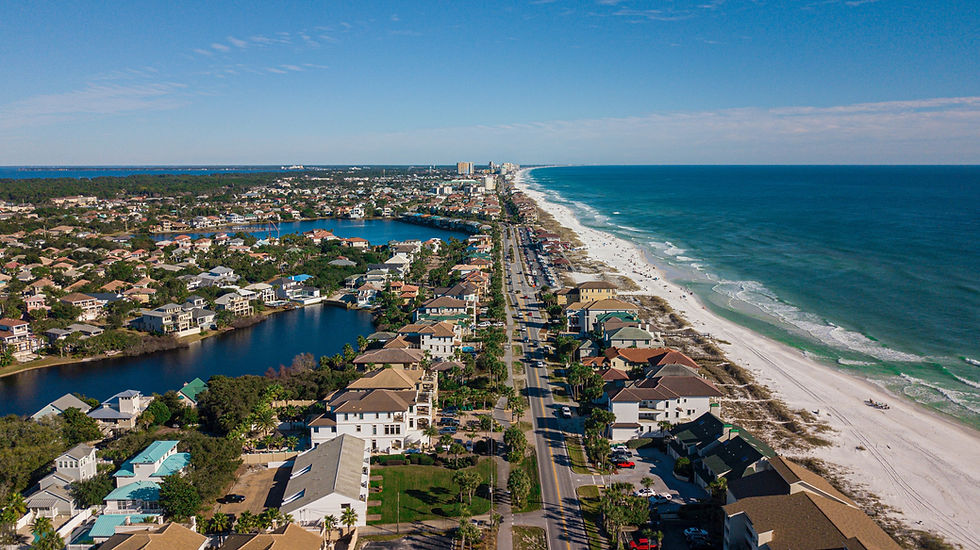
The product is a drive-to family market with a 6–8 hour feeder reach from Atlanta, Birmingham, Nashville, Memphis, and Texas, built around high-end pool homes and concierge-tier inventory set against sugar-white sand, emerald water, and calm Gulf swimming — Destin, 30A, Miramar Beach, and Panama City Beach, with market boundaries that vary by data provider. The numbers back up the shoulder-season thesis: approximately $416 ADR, ~60% occupancy, and an AirDNA market score in the low-80s on AirROI, driven by strong shoulder-season performance from remote workers and fall/spring drive trips — the key differentiator from OBX and Myrtle's summer-only concentration — while top-tier pool homes and 30A luxury command significantly above the market average. That shoulder strength shows up directly in the pricing calendar: summer is still the peak, but spring and fall shoulder price out at 70–85% of peak rather than collapsing to a January trough, so the marketing job is less about chasing a single season and more about merchandising pool amenities, beach drive times, boating, and fishing under an anti-commodity positioning built on named subdivision, pool features, and guest segment.
Regulation is the market's real complication: Florida's local patchwork survived a state preemption veto (SB 280, vetoed June 27, 2024), leaving Walton County requirements, Okaloosa and Bay County variations, and Panama City Beach's Ordinance 1632 with three-strike penalties all in force alongside a statewide DBPR license and county TDT — meaning any acquisition requires verifying the specific town's rules, not just the county's. Entry costs span a wide range, from Panama City Beach's value tier to 30A's luxury premium, and the ongoing pool-home amenity arms race keeps raising the capital bar for competitive inventory. This market suits operators with pool-home product targeting drive-market families who want shoulder revenue depth and calmer Gulf water positioning rather than OBX-style peak dependence — though Florida insurance and flood costs on canal or low-elevation inventory, Walton and Bay County regulatory tightening trends, and rising supply in popular submarkets are all worth tracking before committing capital.
Myrtle Beach / Grand Strand: Volume, Breadth, Commodity Risk
The product is sixty miles of coastline from Little River to Pawleys Island, with huge volume and rates that scale by size — approximately $95 for studios up to $529+ for 6BR+ on market surveys — and a wide occupancy spread from ~38% typical to 78%+ for best-in-class properties, serving budget-conscious families, golf groups, and event and festival travelers; the Grand Strand pulled 18.2 million visitors and $13.2 billion in direct spending in 2024. Broken down by town, Myrtle Beach proper carries ~8,427 listings at $251 ADR, 36.9% occupancy, and $20,946 average annual revenue, with +52.4% supply growth against +15.5% revenue growth; North Myrtle Beach runs ~4,335 listings at $372 ADR, 36.0% occupancy, and $28,667 revenue, with +51.8% supply growth and +31.3% revenue growth; and Cherry Grove (zip 29582) tops the corridor at ~a leftover Cherry Grove year we do not pin average revenue. July revenue runs more than 10× January revenue — an extreme concentration even by beach-market standards.
That extreme summer concentration is partly offset by a genuine golf shoulder — March–May and September–November — sustained by 80 courses and 3 million annual rounds, something beach-only markets simply don't have, while snowbirds fill October–March monthly blocks and events like CCMF (June 4–7, 2026), Sun Fun, and bike rallies anchor event-premium pricing. Regulation is in flux: Myrtle Beach's December 2024 conversion overlay protects existing STR supply east of Kings Highway, North Myrtle Beach has a proposed permit-and-local-agent requirement moving through 2025–2026 that still needs to be verified for adoption, South Carolina's statewide S.442 bill is pending, and combined guest tax runs approximately 10–13% depending on city and county. Entry cost is the lowest on the Southeast coast for condo product, which makes this the volume-and-differentiation game: oceanfront towers in commodity corridors live or die on differentiation, North Myrtle single-family houses command a premium but face their own regulatory watch, and the operators who win are either volume players with genuinely differentiated condo or family-house product, or North Myrtle premium-family operators who own a neighborhood identity and repeat-booking relationships. Watch items for 2026 include 50%+ supply growth compressing per-listing economics, 2025 occupancy headwinds (hotel occupancy −3.3%, Q3 accommodations tax −10.8%), and Canadian visitation down ~30% heading into the year.
Guest Demographics: Three Different Travelers
The OBX guest is a multi-generational family reunion traveling from Virginia, Maryland, or D.C., averaging roughly a 5-person party, planning 95 days out on a Saturday-to-Saturday cadence, and booking wild horses, lighthouses, kiteboarding, and empty September beaches — with 8-in-10 booking the same house again the following year. The Emerald Coast guest is a Southeastern drive-to family from that 6–8-hour radius who expects a pool home, calm water, kid-friendly swimming, books, boating, fishing, and 30A dining, and is increasingly including shoulder-season remote workers. The Myrtle Beach guest is more budget-conscious — a family, golf group, or event traveler with a shorter planning horizon in Myrtle proper (46-day lead time) versus North Myrtle (64 days); repeat visitation is high overall (~two-thirds) but search behavior in Myrtle condos skews commodity, while Cherry Grove and North Myrtle attract multi-gen families more like OBX, just at a lower ADR.
Your marketing must speak to the guest your market actually serves — not the guest you wish you had. Miramar Beach sits on the value-to-premium spectrum between Destin and Panama City Beach, benefiting from Sandestin golf and resort adjacency, while Panama City Beach is the higher-volume, more commodity-risk end of the market, carrying Ordinance 1632's three-strike penalties and a lower ADR tier that represents a genuinely different investor thesis than 30A luxury.
Marketing Angle Each Market Demands
OBX marketing runs on Saturday-to-Saturday title architecture, wild horse, festival, and heated-pool shoulder keywords, and email campaigns to past guests timed to the October Seafood Festival and spring wild-horse weekends — agency competition from Twiddy, Sun, and Village Realty means independents need sharper differentiation and a real direct-booking push aimed at repeat VA/MD families. Emerald Coast marketing leans on pool-home lifestyle photography, honest, named subdivisions and beach-access details, drive-time messaging from Atlanta and Birmingham, dedicated shoulder-season landing pages for fall and spring, and concierge-tier amenity merchandising on 30A. Grand Strand marketing has to fight commodity perception directly: anti-commodity tower specificity in Myrtle, section identity in North Myrtle (Cherry Grove, Ocean Drive, Crescent Beach, Windy Hill), golf-and-snowbird calendar architecture, CCMF and festival event-premium tiers, and repeat-guest email capture for North Myrtle family houses.
Town-Level OBX Breakdown: Not One Market
The Outer Banks averages an obscure town-level strategy. AirROI June 2025–May 2026 vintage:. OBX competition is dominated by scaled agency brands — Twiddy (~1,000 homes), Sun Realty (1,000+), and Village Realty — that own most of the search volume for "Outer Banks vacation rentals," leaving independents to compete through repeat-guest email, sharper photography, and town-specific landing pages. AirROI market boundaries differ from AirDNA's, so always cite town and source when comparing Emerald Coast figures to OBX or Myrtle.
OBX Town | ADR | Occ. | Avg ann. rev | Lead time | Character |
Corolla | ~$564 | ~38.5% | ~$53,259 | 95 days | Premium oceanfront, wild horses |
Duck | ~$489 | ~40% | ~$45K+ | 80+ days | Village walkability, soundfront |
Nags Head | ~$463 | ~42% | ~$40K+ | 70+ days | Seafood Festival, Jennette's Pier |
Kill Devil Hills | Lower | Higher volume | ~$30K+ | 46 days | Value tier, 1,216 listings |
Avon/Hatteras | Variable | Kiteboarding | ~$17–21K | Sport trips | Wind season shoulder |
Corolla supply grew +108.2% YoY in listings — the dominant 2026 risk on the OBX premium tier — while Kill Devil Hills competes on value and volume rather than ADR. Avon is the momentum story, posting the strongest revenue growth in the region (+47.1% YoY on AirROI) through kiteboarding shoulder merchandising, and Ocracoke is the outlier, peaking in June rather than July due to its ferry-access constraint.
Emerald Coast Sub-Market Nuance
Destin anchors the drive-to family core with harbor and beach-access pool homes and strong fishing and boating merchandising. 30A — Rosemary Beach, Seaside, WaterColor — is the premium tier, governed by architectural code and design standards that push acquisition cost and ADR ceiling higher, along with concierge-tier amenity expectations. Miramar Beach sits on the value-to-premium spectrum between Destin and Panama City Beach, benefiting from Sandestin golf and resort adjacency, while Panama City Beach is the higher-volume, more commodity-risk end of the market, carrying Ordinance 1632's three-strike penalties and a lower ADR tier that represents a genuinely different investor thesis than 30A luxury.
AirROI market boundaries differ from AirDNA's, so always cite town and source when comparing Emerald Coast figures to OBX or Myrtle. The product is a drive-to family market with a 6–8 hour feeder reach from Atlanta, Birmingham, Nashville, Memphis, and Texas, built around high-end pool homes and concierge-tier inventory set against sugar-white sand, emerald water, and calm Gulf swimming — Destin, 30A, Miramar Beach, and Panama City Beach, with market boundaries that vary by data provider.
Grand Strand Sub-Market Nuance
Myrtle Beach proper carries 8,427 listings of mostly condo towers at $251 ADR, protected in part by the December 2024 overlay east of Kings Highway and anchored by CCMF, Sun Fun, and bike rallies — but the commodity middle here is brutal, and operators either differentiate or lose. North Myrtle Beach's 4,335 listings run at a $372 ADR, with Cherry Grove (~a leftover Cherry Grove year we do not pin), Ocean Drive, Crescent Beach, and Windy Hill each attracting distinct guest segments within a repeat-family culture, though the pending NMB permit ordinance still needs verification before it's treated as settled. Surfside Beach is the family-house corridor standout, posting $43,646 in AirROI average revenue and $422 ADR — the highest RevPAR in the broader town survey — while Murrells Inlet and Pawleys (Hammock Coast) sit in a premium tier above Grand Strand commodity pricing: higher ADR, more covenants, lower volume, and effectively a parallel universe to the Myrtle condo game.
Revenue Concentration: The Risk Variable
Market | Peak months | Revenue concentration | Trough management |
OBX Corolla | June–August | ~83% in 3 summer months | October festivals, heated pool |
Emerald Coast | Summer + shoulder | More distributed | Remote-worker weekly |
Myrtle Beach | July apex | July 10×+ January | Golf, snowbird monthly |
North Myrtle | July apex | Similar, higher winter ADR | Section-specific repeat |
An investor comparing $53K OBX gross to $50K Emerald gross must model cash-flow timing, not just annual totals. OBX deposits concentrate in three months; Emerald may distribute more evenly across the shoulder. Sophisticated operators sometimes hold OBX premium for summer cash flow, an Emerald Coast pool home for shoulder stability, and a Myrtle differentiated condo for volume entry — a portfolio approach that diversifies seasonality concentration.
Competition and Agency Landscape
OBX competition is dominated by scaled agency brands — Twiddy (~1,000 homes), Sun Realty (1,000+), and Village Realty — that own most of the search volume for "Outer Banks vacation rentals," leaving independents to compete through repeat-guest email, sharper photography, and town-specific landing pages. Emerald Coast competition comes from large regional managers plus national PMs like Vacasa, with a pool-home amenity arms race and new-construction inventory raising the competitive bar every year. Grand Strand competition is fragmented — no single agency owns 1,000+ homes — but commodity condo volume poses a real race-to-the-bottom risk in undifferentiated towers, while North Myrtle's family-house managers instead compete on section identity and repeat relationships.
Operator Verdict: Which Market Fits Your Thesis?
Choose OBX if you own or will buy premium large-family oceanfront inventory, can merchandise three-season revenue, value post-Schroeder regulatory stability, and target VA/MD repeat planners. Choose Emerald Coast if you own or will buy a pool-home product, want shoulder revenue depth and ~60% occupancy, target drive-market families from interior Southeast feeders, and accept Florida's regulatory patchwork. Choose Myrtle Beach / Grand Strand if you want the lowest entry cost and highest visitor volume, can differentiate sharply in commodity markets, and are willing to commit to either the Myrtle volume game or the North Myrtle premium family game — not an average of both.
Do not choose based on ADR alone: Corolla's $564 ADR with 38.5% occupancy and heavy summer concentration behaves completely differently from Destin's $416 ADR with 60% occupancy and shoulder strength, which in turn behaves differently from North Myrtle's $372 ADR with its extreme July/January spread. The number that matters is revenue behavior over the full year, not the headline rate.
Hybrid and Portfolio Strategies
Sophisticated operators sometimes hold OBX premium for summer cash flow, an Emerald Coast pool home for shoulder stability, and a Myrtle differentiated condo for volume entry — a portfolio approach that diversifies seasonality concentration. The mistake is averaging strategy across properties: each asset needs its own marketing calendar, pricing tiers, and guest segment. A Corolla oceanfront and a Myrtle studio share a coastline but not a playbook.
Direct Booking Fit by Market
All three markets support direct booking on premium inventory, but repeat visitation rates — and therefore direct-booking ROI — differ meaningfully. OBX has the strongest case: 8-in-10 repeat per OBVB gives Corolla/Duck family homes, clearing $50K+ in gross, the highest direct-booking ROI in the comparison, with a Saturday-to-Saturday rebooking offer in the guidebook as the anchor tactic (see OBX direct-booking engine). Emerald Coast repeat visitation is growing through drive-market family tradition and pool-home guests who return annually, making them strong direct-booking prospects — launching a site in January–February ahead of summer planners captures that demand (see Emerald Coast direct booking). Grand Strand runs about two-thirds repeat visitors overall, but the experience diverges by product: North Myrtle family houses capture repeat guests well, while Myrtle condos often lose the guest relationship to tower anonymity, making section-specific branding and email capture mandatory rather than optional (see Grand Strand direct booking engine).
2026 Headwinds Affecting All Three Markets
Supply growth is the shared headwind: Corolla is up +108% YoY in listings, Myrtle is up +52%, and Emerald Coast supply is rising in premium submarkets — ADR and revenue have held up on AirROI so far, but per-listing economics are compressing everywhere. Grand Strand carries an additional demand risk in Canadian visitation, down ~30% heading into 2026 amid trade tensions, even as drive-market domestic demand strengthens per the Tripadvisor 2026 Summer Travel Index — a gap that matters most for the Grand Strand snowbird segment's winter blocks. Insurance and storm costs affect net yield on every coast, given shared hurricane exposure, and should be modeled separately from gross ADR, while regulatory watch items — the NMB permit ordinance, Florida Panhandle tightening, and OBX nourishment construction affecting Buxton/Avon access.
Keep going on Crest & Cove: Myrtle Beach against AirROI $20,946 · Destin against AirROI, not leftover year · the Crest & Cove intro · local SEO keywords that actually book · the five elements of a converting hero · how to compare STR marketing agencies · Asheville paddling spots worth the drive · Atlantic vs Gulf against AirROI pins.
Related Reading
Keep reading on same-cluster Crest & Cove pages that stay on labeled local lines without costume-corridor copy.
Emerald Isle vs Outer Banks Where the Smart Crystal Coast Investment
Beating the Outer Banks STR Seasonality Hosts Should Actually Market
OBX Direct Website: Published Fees, Not Invented Occupancy Years
How to Choose a Vacation Rental Photographer in For Your Outer Banks
Self Manage or Hire a Rental Company the Outer Banks Owner S
Outer Banks Short-Term Rental Rules for Hosts for Independent Hosts
Hatteras Island vs the Northern Beaches an Outer Banks Submarket
Matching Your Outer Banks Rental to How Guests Actually Search Wild
North Carolina Coast Vacation Rentals: The Complete Guide to the Outer
Washington Outer Coast STR Market Report for Independent Hosts
Reading the Massachusetts Outer Cape North Shore Short-Term Rental
Work with Crest & Cove Creative
Myrtle is $20,946. Destin is $41,489. Crest & Cove writes the AirROI years.crestcove.co or (256) 998-7502.
We help hosts and investors with three-way market positioning, shoulder-season calendar architecture, and anti-commodity merchandising tuned to each brand's demand profile. If you want hands-on help applying this comparison to your property, our team takes a limited number of new engagements per quarter. Reach out at crestcove.co or (256) 998-7502.
Frequently Asked Questions
Which is better for STR investment: Outer Banks, Emerald Coast, or Myrtle Beach?
It depends entirely on the product you own and the thesis you're running. Outer Banks fits premium, peaky family homes that can command $53K+ average annual revenue but concentrate 55–65% of that in June through August. Emerald Coast fits drive-to pool-home product built around shoulder-season strength — roughly 60% occupancy at $416 ADR without OBX's extreme peak-to-trough swing. Grand Strand offers volume plays at the lowest entry cost on the Southeast coast, but Myrtle condos, in particular, face a brutal differentiation requirement, given 8,427 listings competing in a commodity corridor. None of the three is universally "better" — the right choice depends on the inventory, capital, and guest segment you.
How do ADR and occupancy compare across the three markets?
OBX town-level figures span roughly $276–$564 ADR with ~38–54% occupancy depending on the specific town — Corolla runs $564 ADR at ~38.5% full-year occupancy, while Duck and Nags Head sit lower on both ends. Emerald Coast averages about $416 ADR at roughly 60% occupancy, the strongest occupancy figure of the three, thanks to shoulder-season demand. Myrtle Beach and North Myrtle Beach run at $251 and $372 ADRs, respectively, with both at around 36–37% occupancy. Because these figures come from different data providers with varying market boundaries and occupancy definitions, always cite the source and the specific town when using these numbers in a comparison.
Which market carries the most seasonality risk?
OBX and Myrtle Beach both show extreme summer concentration, with 55–65% of annual revenue landing in the June-through-August window and Corolla's peak-to-trough ratio running roughly 30:1 between August and January. Emerald Coast is the outlier of the three, with meaningfully stronger shoulder-season performance from remote workers and spring/fall drive travelers that lowers its overall concentration risk relative to the other two markets. For an investor modeling cash flow rather than just annual gross revenue, the timing of revenue matters as much as the headline ADR or occupancy number.
Which market has the best repeat guests?
Outer Banks leads this metric outright, with OBVB reporting 8-in-10 repeat visitation — families who book the same house year after year on a 95-day lead time. Grand Strand follows with roughly two-thirds repeat visitors overall, though that loyalty splits unevenly by product: North Myrtle family houses retain guests well, while Myrtle condos tend to lose the relationship to tower anonymity and commodity search behavior. Emerald Coast's repeat-guest base is smaller today but growing steadily through drive-market family tradition, particularly among pool-home guests who return annually to the same subdivision or beach access.
How does regulation compare across the three markets?
Outer Banks is the most permissive of the three post-Schroeder, with no registration caps or lotteries statewide — just town-by-town zoning and occupancy standards under a combined ~12.75% tax rate (6% occupancy tax plus 6.75% NC sales tax). Emerald Coast sits within Florida's local regulatory patchwork, which survived a state preemption veto (SB 280, June 27, 2024) and now varies significantly by county and town, including Panama City Beach's Ordinance 1632, which imposes three-strike penalties. Grand Strand has a December 2024 overlay protecting existing Myrtle Beach supply east of Kings Highway, a proposed North Myrtle Beach permit-and-local-agent requirement still awaiting adoption, and a statewide bill (S.442) pending in South Carolina.
Can Myrtle Beach condos still profit despite the commodity risk?
Yes, but only with sharp differentiation — tower identity, floor- and view-honesty, and a clearly defined guest segment rather than generic listing copy. Undifferentiated studios competing in an 8,400+ listing market face crushing compression as supply continues to grow faster than demand (Myrtle Beach proper alone saw supply grow +52.4% YoY against +15.5% revenue growth). The operators who succeed here treat their unit like a distinct product — leaning on section identity, event-premium pricing around CCMF and Sun Fun, and repeat-guest capture — rather than competing purely on rate against thousands of similar units.
Is Emerald Coast oversaturated?
Supply is rising in the most popular submarkets, particularly 30A and Destin, but the market's ~60% occupancy and genuine shoulder-season strength give new quality inventory a better chance to perform than in peaky, summer-only markets like OBX or Myrtle. The bigger risk is less about raw saturation and more about the pool-home amenity arms race — new construction keeps raising the bar for what counts as competitive inventory, so entry cost and ongoing capital investment matter more here than in a simple supply-count comparison.
Where can I find deeper per-market guides for each of these three brands?
Deeper, town-specific guides for all three markets are linked in the Related Reading section below, including dedicated market reports for the Outer Banks, Emerald Coast (Destin/30A/Miramar Beach), and Grand Strand (Myrtle Beach vs. North Myrtle Beach), along with regional guides covering the Carolinas, Florida Gulf Coast, and broader Southeast coastal strategy. Outer Banks, Emerald Coast, and Myrtle Beach are the Southeast silo's three marquee beach brands, and they play different games on the same macro coast.
About the Authors
Crest & Cove Creative is a nationwide short-term rental marketing agency founded by Thomas Garner and Jacob Mishalanie. We build direct-booking brands, listing-optimization systems, and market-specific content strategies for independent STR operators across the Gulf Coast, Appalachian Mountains, Coastal Georgia, the Carolinas, Virginia, and the Southeast lake country. This market best fits operators who already own — or plan to buy — large oceanfront or premium soundfront homes, who can merchandise three-season revenue rather than coasting on July and August, who can capture repeat VA/MD families through direct booking, and who can absorb genuinely peaky cash flow without it breaking the business.
Explore market-specific guides for all three brands:. We build direct-booking brands, listing-optimization systems, and market-specific content strategies for independent STR operators across the Gulf Coast, Appalachian Mountains, Coastal Georgia, the Carolinas, Virginia, and the Southeast lake country. Regulation is the market's real complication: Florida's local patchwork survived a state preemption veto (SB 280, vetoed June 27, 2024), leaving Walton County requirements, Okaloosa and Bay County variations, and Panama City Beach's Ordinance 1632 with three-strike penalties all in force alongside a statewide DBPR license and county TDT — meaning any acquisition requires verifying the specific town's rules, not just the county's.
Sources
AirROI — Corolla, Duck, Nags Head, Kill Devil Hills, Destin, Myrtle Beach, North Myrtle Beach market reports, Jun 2025–May 2026. AirDNA — Emerald Coast market score. OBVB — 8-in-10 repeat visitation, feeder markets. Tourism Economics — Dare County lodging revenue. Grand Strand Chamber — 18.2M visitors, $13.2B spending. Myrtle Beach Area Chamber — 2025 occupancy data. Florida Governor's Office — SB 280 veto. UNC SOG — Schroeder. Houfy — Airbnb host-only fee.


Comments