
Traverse City Remote Work Rental Guide for Independent Hosts

Updated: Aug 28
Every Traverse City host knows the shape of the calendar: a roaring summer built on Grand Traverse Bay, cherry season crowds, and wine-trail traffic, followed by a long stretch from October through April when nightly bookings thin out and rates have to come down to fill the calendar. Most owners treat that stretch as something to survive. A smaller number treat it as its own business line, and the guest who makes that pivot work is the remote worker looking for a month or six weeks somewhere quieter and cheaper than home.
This isn't a theoretical guest type. Traverse City's off-season occupancy data backs it up: winter is genuinely the market's low point, with rates and bookings falling well below the annual average and January posting the softest numbers of the year. That's a problem if your only guest is a weekend leaf-peeper or a ski day-tripper. It's an opportunity if you can convince a location-independent worker that six or eight weeks in a real lake town, at a fraction of summer rates, beats another winter staring at the same four walls of a city apartment. This guide covers what that guest actually books on, how to price the offer, and how to write listing copy that proves — rather than promises — that your unit works as a place to live and work for a month at a time.
Who This Guest Actually Is
The remote-work extended-stay guest is not the same person booking a long weekend on Front Street. They typically book 14 to 60 days out, not the day-of or week-of pattern common to short leisure stays, and they're planning a stay of two to six weeks, sometimes longer. They've usually done this before — a month in Asheville, six weeks in the Ozarks, a winter in a ski town — and they know exactly what breaks a stay: internet that's fine for browsing but chokes on a video call the desk the map names a desk that's actually a kitchen table with bad overhead light, or a thermostat that can't keep a Michigan house above 63 degrees in February.
They're not chasing beach days in January. They're chasing a lower cost of living, a change of scenery, and a workable routine — coffee shop in the morning, real work hours, a walk before dark, dinner somewhere that isn't a chain. Traverse City sells that well if you let it: it's a real town with a grocery store, a hospital, a downtown you can walk, and a lake that's beautiful even when it's not swimmable. The pitch isn't "escape to paradise." It's "live somewhere nice for six weeks instead of somewhere ordinary.".
What the Water Access Actually Adds (and Doesn't) in Winter
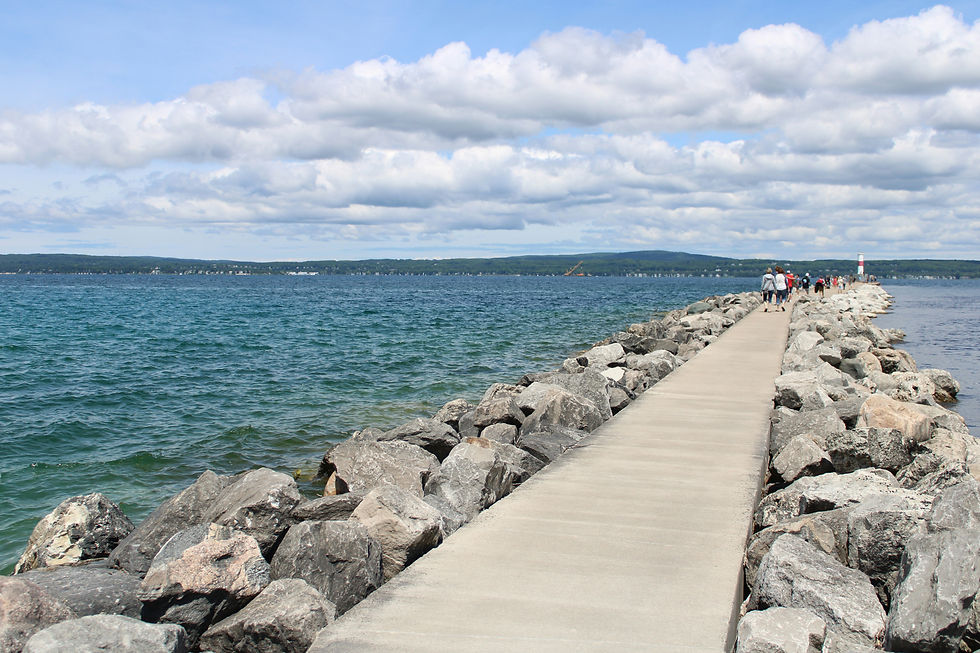
Traverse City's water access is real, not marketing gloss — the town sits directly on Grand Traverse Bay, with beach and shoreline access points like Clinch Park, West End Beach, and Traverse City State Park within an easy walk or short drive of downtown, and Lake Michigan's bigger dune-backed beaches a short drive west. In summer, that's the headline. In a remote-work listing aimed at a November or February stay, it's a supporting detail, not the hook — the guest isn't paddleboarding, and open-water swimming isn't happening.
What it still does: a frozen or ice-rimmed bay, a walk along the TART Trail with the water in view, a window that looks at something other than a parking lot — that's real value to someone doing back-to-back Zoom calls for six weeks. Use it as texture, not the sales pitch. "A five-minute walk to the bay for a lunch-break walk, ice-fringed and quiet this time of year" tells the truth and still sells the setting. Don't write copy that implies swimming, boating, or beach days in the off-season; a guest who books on that expectation and finds a frozen shoreline in January will leave a review that says so.
The Winter Demand Picture, Honestly
Here's the nuance worth getting right in your copy: Traverse City winter isn't dead. Hickory Hills, the city-owned ski hill on the west side, runs a full season with night skiing; the Vasa Pathway draws serious cross-country skiers; and the region's snowmobile trail network pulls in a real, if smaller, winter tourism crowd, on top of ice fishing on the bay in a cold enough year. Regional downhill resorts like Crystal Mountain (about 45 minutes southwest) and Shanty Creek (roughly 50 to 55 minutes east) pull some overnight traffic through the area too. That activity keeps a baseline of short winter bookings going — it's not a ghost town.
But it doesn't come close to replacing summer demand, and the occupancy data confirms it: winter remains the softest season, with bookings and rates well below the yearly mean and January the low point of the whole calendar, plus the shortest average lead times of any season. In practical terms, that means a host who prices and sets minimum stays for a 28-plus-night remote worker isn't competing against a full winter tourism market for that inventory — they're filling nights that would otherwise sit empty at a rate that would otherwise be deeply discounted anyway, only with a much lower turnover cost per night booked. The honest framing for copy: this is a real northern Michigan winter — snow, short days, a wood-burning or gas fireplace worth using — with enough going on nearby (a ski hill, groomed trails, an occasional snowmobile roar in the distance) to make it feel like a place, not a hibernation cell, but with none of the summer crowding or rate premium.
Reliable Heat and Verified Fast Wifi Beat Lake Views in January
If you write one sentence of specific, checkable detail in your listing, put it here. A remote worker skimming twenty listings in twenty minutes is not looking for "cozy retreat" language. They're looking for two things they can act on immediately: can I actually work here, and will I be warm. Internet.Don't write "fast wifi." Run a speed test from the unit itself — not from your phone in the driveway — and put the real number in the listing: "Verified 300+ Mbps fiber, speed test run [date]." If you're on a fixed wireless or satellite connection, say so honestly and note the upload speed specifically, since that's what breaks video calls.
Internet.Don't write "fast wifi." Run a speed test from the unit itself — not from your phone in the driveway — and put the real number in the listing: "Verified 300+ Mbps fiber, speed test run [date]." If you're on a fixed wireless or satellite connection, say so honestly and note the upload speed specifically, since that's what breaks video calls. A guest planning six weeks of remote work will forgive almost anything except discovering on day two that the internet can't hold a Zoom call.
Heat.Northern Michigan houses built before the 1990s can have real cold spots, especially older lake cottages winterized as an afterthought. Note the heat source specifically (forced air, boiler, heat pump with backup), confirm the whole unit — not just the main living area — holds a comfortable temperature through a hard cold snap, and mention if there's a backup source like a gas fireplace or space heaters provided. If the unit has ever had a tenant complain about cold bedrooms or an uninsulated addition, fix it before you market to this guest type — one bad heat review kills extended-stay bookings for a full season.
Workspace.A dedicated desk with a real chair, positioned near a window for daylight rather than facing a wall, photographed with the desk actually set up — laptop stand, lamp, cable within reach. If the unit doesn't have a proper desk, buy one; it's a low-cost fix relative to what a 30-plus-night booking is worth, and it's the difference between "vacation rental" and "place I could actually work from.".
The Coworking and Coffee Shop Detail Most Listings Skip
Traverse City has genuine coworking infrastructure, which is unusual for a town this size and worth naming specifically rather than gesturing at vaguely. Grove Community Incubator, downtown within walking distance of the waterfront, offers day passes and fiber internet plus phone booths for calls. SPACE Coworking is a second-floor loft right on Front Street, a short walk from the bay. 20Fathoms offers day passes and monthly memberships with high-speed internet and a mailing address. Any one of these is a legitimate backup option for a guest whose home internet has a bad day, or who just wants a change of scenery from the rental itself mid-stay.
Naming one specifically — "Grove Community Incubator is an eight-minute walk, with day passes for the days you want a change of scenery" — does two things generic listings don't. It proves you actually know the town rather than running a copy-paste template, and it removes a real anxiety this guest carries: what happens if something goes wrong with my workspace here. Most Traverse City listings skip this entirely because most hosts are writing for a leisure guest who doesn't care. For the guest you're targeting in this guide, it's one of the highest-value sentences in the whole listing.
Pricing the Extended Stay Correctly
The standard lever for this guest type is a 30 to 40 percent discount off your peak summer nightly rate for stays of 28 nights or more, applied through your platform's monthly-stay discount setting rather than negotiated ad hoc in messages. That range reflects two things: your actual off-season cost of turnover (a stay that runs six weeks costs you one cleaning and one set of guest communications instead of eight), and the reality that you're competing against this guest's other option, which is often a furnished apartment lease with a far higher barrier to entry than a rental booking. Price too close to your leisure winter rate and you'll lose this guest to a market that discounts harder. Price too low and you're leaving margin on inventory that would otherwise sit empty anyway.
Set your minimum stay explicitly for the shoulder and winter months — 21 or 28 nights, not your summer 2- or 3-night minimum — so the platform's search filters surface your listing to guests already searching in that stay-length range. Update your calendar and monthly-discount settings before October, not after your first empty November week makes it obvious you need to.
Writing Copy That's Specific Instead of Generic
The failure mode in this niche is generic retreat language — "cozy hideaway," "peaceful escape," "unplug and recharge" — that could describe any cabin in any state. It doesn't answer the two questions this guest actually has: can I work here, and is it actually comfortable in the season I'm booking. Specific, honest copy outperforms atmospheric copy every time with this audience.
Say what the season is really like: "Fall color through the front window in October, a real gas fireplace running most evenings by November, quiet streets with none of the summer bay traffic." Say what the workspace actually offers: verified speed, a real desk, daylight. Say what's nearby that has nothing to do with vacation activities: the closest grocery store, the nearest coworking space, how far to a pharmacy. That's the copy that converts a six-week booking, because it reads like it was written by someone who actually knows what a month here feels like — not someone optimizing for search keywords.
Keep going on Crest & Cove:the Crest & Cove intro·local SEO keywords that actually book·the five elements of a converting hero·how to compare STR marketing agencies·OTA fees without leftover occupancy lifts·this cluster against named-town AirROI pins·Destin against AirROI, not leftover year·prior cluster against AirROI pins. They've usually done this before — a month in Asheville, six weeks in the Ozarks, a winter in a ski town — and they know exactly what breaks a stay: internet that's fine for browsing but chokes on a video call the desk the map names a desk that's actually a kitchen table with bad overhead light, or a thermostat that can't keep a Michigan house above 63 degrees in February.
Related Reading
Keep reading on same-cluster Crest & Cove pages that stay on labeled local lines without costume-corridor copy.
Traverse City Leelanau STR Market Report for Independent Hosts
How to Market STR Traverse City Leelanau for Independent Hosts
DIY vs Hire Marketing for Traverse City Leelanau STR Marketing
Traverse City Leelanau STR Investment 2026 for Independent Hosts
Traverse City Leelanau Marketing Agency Worth It for Independent Hosts
DIY vs. Hire in Many, LA: Why Independent Hosts Still Run Most Listings
DIY or Hire in Depoe Bay: What the Numbers Say for STR hosts
DIY vs Hire in Seattle: Independents Still Write Most Listings
Financing a Springfield, MA Rental Without a Neighbor City Year
Financing a Grove, OK Rental: What a DSCR Underwriter Actually Wants
What It Actually Costs to Start a Grove OK STR: The One Published Fee
Work with Crest & Cove Creative
Peak occupancy is not the year. Named-town AirROI pins only.crestcove.coor(256) 998-7502.
Peak occupancy is not the year. Named-town AirROI pins only.crestcove.coor(256) 998-7502.
Peak occupancy is not the year. Named-town AirROI pins only.crestcove.coor(256) 998-7502.
Peak occupancy is not the year. Named-town AirROI pins only.crestcove.coor(256) 998-7502.
If your Traverse City listing is optimized for a July weekend guest and empty from November through March, you're leaving a real revenue stream on the table — one that doesn't require new inventory, just different positioning for months you already own. We build the specific, checkable copy, page structure, and off-season strategy that turns quiet-season nights into booked ones. Start with a free listing audit atcrestcove.coto see exactly where your current copy is losing this guest. Reach out at crestcove.co or (256) 998-7502.
Frequently Asked Questions
Does Traverse City actually have direct water access, or is that mostly a summer marketing claim?
The town sits directly on Grand Traverse Bay, with beach and shoreline access points like Clinch Park, West End Beach, and Traverse City State Park within walking or short driving distance of downtown, and Lake Michigan's larger beaches a short drive west. In winter, the value shifts from swimming and boating to walkable shoreline views and trail access — real, but a supporting detail rather than the headline for a remote-work stay.
Is Traverse City actually quiet in winter, or is there real competing tourism demand?
Hickory Hills ski area, the Vasa Pathway for cross-country skiing, a regional snowmobile trail network, and nearby downhill resorts Crystal Mountain and Shanty Creek keep a real, smaller winter tourism crowd moving through. But market occupancy data shows winter remains the softest season overall, with rates and bookings well below the annual average and January the low point of the year — so a host targeting a 28-plus-night remote worker isn't competing against a full winter market for that inventory.
What discount should I offer for a 28-night-plus stay?
The standard range is 30 to 40 percent off your peak summer nightly rate, set through your platform's monthly-discount tool rather than negotiated manually. That reflects your lower turnover cost on a long stay and keeps you competitive against furnished-apartment alternatives this guest is also considering. The standard lever for this guest type is a 30 to 40 percent discount off your peak summer nightly rate for stays of 28 nights or more, applied through your platform's monthly-stay discount setting rather than negotiated ad hoc in messages.
What matters more in my listing copy: lake views or wifi speed?
For this guest, verified internet speed and confirmed reliable heat matter far more than lake views, especially for a winter or shoulder-season stay. Run an actual speed test from inside the unit and put the number in your listing. Lake and trail access are good supporting details, not the primary sell. Internet.Don't write "fast wifi." Run a speed test from the unit itself — not from your phone in the driveway — and put the real number in the listing: "Verified 300+ Mbps fiber, speed test run [date]." If you're on a fixed wireless or satellite connection, say so honestly and note the upload speed specifically, since that's what breaks.
Are there real coworking spaces in Traverse City I can reference in my listing?
Grove Community Incubator and SPACE Coworking are both downtown near the waterfront, and 20Fathoms offers day passes and monthly memberships elsewhere in town. Naming one specifically, with distance from your unit, is a detail most competing listings skip entirely. Naming one specifically — "Grove Community Incubator is an eight-minute walk, with day passes for the days you want a change of scenery" — does two things generic listings don't.
How far out does this guest typically book?
Extended-stay remote workers targeting Traverse City's off-season commonly book 14 to 60 days ahead of arrival, planning a stay of two to six weeks or longer — a very different booking pattern from the last-minute or week-ahead pattern typical of short leisure stays. They typically book 14 to 60 days out, not the day-of or week-of pattern common to short leisure stays, and they're planning a stay of two to six weeks, sometimes longer.
What minimum-stay setting should I use for the off-season?
Set an explicit 21- or 28-night minimum for fall and winter months rather than leaving your summer 2- or 3-night minimum in place. Platform search filters use minimum-stay settings to surface listings to guests already searching for month-length stays, so this isn't just a policy — it affects who sees your listing at all. Set your minimum stay explicitly for the shoulder and winter months — 21 or 28 nights, not your summer 2- or 3-night minimum — so the platform's search filters surface your listing to guests already searching in that stay-length range.
Should I mention my own pricing or rates in the listing description?
No — pricing belongs in your platform's rate calendar and monthly-discount settings, not narrative listing copy. Focus the description on verified specifics: internet speed, heat reliability, workspace setup, and what the season genuinely looks and feels like. Say what the season is really like: "Fall color through the front window in October, a real gas fireplace running most evenings by November, quiet streets with none of the summer bay traffic." Say what the workspace actually offers: verified speed, a real desk, daylight.
About the Authors
This guide was produced by the Crest & Cove Creative editorial team, which researches and writes short-term rental marketing content for hosts and property managers across Michigan's lake towns and beyond. Our team specializes in listing strategy, seasonal positioning, and copy that's built to convert specific guest types rather than generic search traffic. This guide covers what that guest actually books on, how to price the offer, and how to write listing copy that proves — rather than promises — that your unit works as a place to live and work for a month at a time.
Sources
Traverse City Beaches | Lake Michigan & Grand Traverse Bay — Traverse City Tourism
Traverse City, MI Airbnb Market Data, Statistics, and Occupancy Rates — Rabbu
Traverse City, Michigan Airbnb Data: Occupancy, Revenue & STR Market Report — AirROI
Coworking Day Pass in Traverse City — Grove Community Incubator



Comments