
Airbnb's Limits on Guest Contracts and Personal Data, From Nov 20


On October 20, 2026, Airbnb told hosts that a new house rules policy "takes effect November 20, 2026." Most coverage has been about checkout chores. A quieter part of the same update limits two things many hosts rely on: a separate rental agreement for guests, and requests for guests' personal data. Airbnb's Help Center article "Limiting host-imposed contracts and other requirements" says home hosts may not ask guests to sign contracts, collect personal information or impose certain other requirements, "except in limited circumstances."
We re-read that article and Airbnb's Resource Center post "Important changes to house rules." This post sticks to what they say, says plainly where they are silent, and ends with questions worth asking about your own listing. This is not legal advice, and it does not tell you whether any contract or form you use is valid or enforceable. Check the current policy before you act.
For every dated fall change on both platforms in one place, see our hub overview of the fall 2026 changes. For the broader house rules update, see Airbnb's new house rules policy, explained.
Which bookings the updated policy covers
The article opens with a notice that the updated policy applies to "reservations booked on or after November 20, 2026." Reservations booked before that date are "covered by the previous policy," which Airbnb keeps at the bottom of the same page under the heading "Off-Platform Policy."
The dividing line is the date the reservation was booked, according to the article. It is not the stay date. A guest who books on November 19 for a December stay falls under the previous policy, based on the article's wording. A guest who books on November 20 for the same stay falls under the updated one.
One thing is not stated. The article does not say whether the updated policy reaches any booking made outside Airbnb, and this post makes no claim either way.
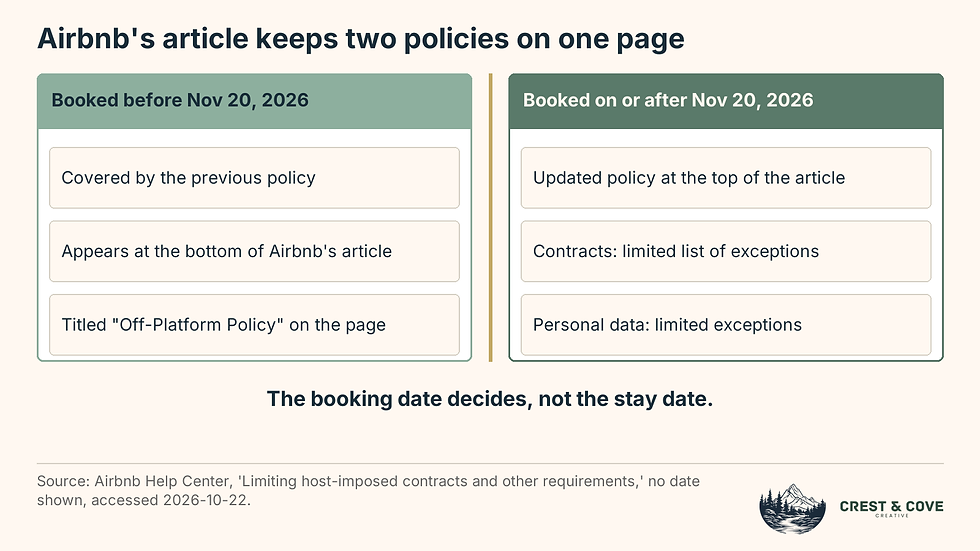
Airbnb's article keeps the previous policy below the updated one; the booking date decides.
Contracts: what the article says hosts may and may not ask
The article says "Hosts generally may not ask guests to sign a separate contract or rental agreement." It then lists four exceptions, where the contract is:
Required by law or community association rules, with HOA or building security requirements given as examples.
Necessary to facilitate access to an optional amenity, such as a golf cart rental.
"Requested in connection with a monthly stay (28 nights or more)".
Related to a stay at a Luxe listing.
The Resource Center post describes the same list in looser words: legal requirements, homeowners association rules, rental agreements for monthly stays, Luxe listings, and coverage for optional amenities like golf carts. The Help Center article is the more precise source for the 28-night figure.

The four situations Airbnb's article lists for a separate guest contract.
Conditions that come with an allowed contract
The article attaches conditions even when an exception applies:
The terms must comply with Airbnb's policies and terms of service, and be relevant to the stay, or to the optional amenity where that applies.
Hosts "must always disclose the terms of the contract in the designated section of their listing" and may be asked to provide evidence that the contract meets one of the criteria.
Hosts "should not include personal information in their contracts, which are publicly visible."
The host is responsible for collecting the guest's signature.
The Resource Center post adds that an allowed contract is uploaded "under Contracts in your listing settings." On enforcement of the contract itself, the Help Center article says Airbnb does not require guests to sign host-imposed contracts and "doesn't help enforce" their terms. The Resource Center post says it in nearly the same words. Whatever a contract says, the article gives no indication that Airbnb will back it.
What the article does not say about contracts
It does not name any rental agreement software, e-signature service or damage-waiver product, so it does not say whether any of them are fine or not. The test it states is the content of the contract and whether an exception applies.
It does not say what happens to a contract already uploaded to a listing, or whether Airbnb will review existing contracts.
It does not define "monthly stay" beyond the 28-night figure, or say how a stay that is extended past 28 nights is treated.
It does not say whether a contract that fits an exception is valid or enforceable anywhere. That is a legal question and outside this post.
Personal data: the limit on what hosts may ask for
The updated section is headed "Collection of personal data or registration on a separate website or app." Its core sentence says that, with limited exceptions, hosts "may not solicit personal data at any point during the booking process or stay."
The article lists what that includes:
Contact information, such as a phone number, home address or email address.
Identification details or documents, such as a passport, driver's license, social security number or photo.
Credit card numbers, bank account information or other financial data, "except where permitted under our Pricing and payment transparency policy."
Background check information or credit history.
Biometric or health data, such as fingerprints, facial recognition or medical records.
Two points stand out. First, "at any point during the booking process or stay" covers both the booking process and the stay. Second, the previous policy was worded differently: it listed specific behaviors such as asking for contact information before booking or running credit and background checks. The updated section names categories of data instead.
ID checks in person
The article includes a note on ID. Hosts "may physically check a guest's ID" in person at check-in if they disclose the requirement in the requests section of their listing. They may not "retain a digital or physical copy of the ID," except as outlined in the exceptions the article gives. The article does not say what counts as retaining a copy beyond that wording, so read it directly if you have a check-in routine that involves ID.
Apps, registration and Wi-Fi portals
The same section limits registration on another website or app. With limited exceptions, hosts also may not require a third-party app or registration on another website "to gain entry to a listing or access a critical amenity." The article's notes say:
Keyless entry apps that require registration are allowed, but the host must provide an alternate access method if the guest asks.
Optional apps that improve the stay are allowed. The article's examples are Sonos, Nest and concierge apps.
Wi-Fi portals that ask for a guest's email address or other personal information are not allowed unless the listing is a hotel or resort, or one of the exceptions below applies.
The two exceptions for collecting data
Airbnb allows personal information or registration on a separate site or app where necessary to:
Comply with applicable law or a documented community association rule, or
Facilitate signature of an allowed contract.
When an exception applies, the article says the host must clearly disclose what information is required and why in the requests section of the listing, so guests can review it before booking. Hosts "may not collect more data than the law or rule calls for" or than is necessary for the permitted contract. Hosts are also "responsible for securely storing and disposing of any sensitive data," and Airbnb may ask for evidence that an exception applies.

The categories of personal data and the stated exceptions in Airbnb's updated article.
What the article does not say about personal data
It does not name any guest screening, ID verification or check-in software. If a tool you use collects data at booking, the article does not tell you how it is treated; the article's own wording is the test.
It does not explain how this rule interacts with Airbnb's rules about pricing, payments and keeping communication on Airbnb. This post does not merge them.
Separate activity and reviews
The article's last substantive section covers other requirements. Hosts may not "require or pressure guests to engage in activity unrelated to the stay," with a timeshare presentation or a subscription or membership purchase as examples. Hosts may still recommend local experiences, restaurants or businesses, "as long as they are optional and any direct financial benefit to the host" is disclosed. Hosts also may not ask guests to review an Airbnb stay, or fill out a survey, on a separate website, unless the listing is a hotel.
Enforcement
The article says that if Airbnb determines a host violated the policy, it takes "appropriate action": educating the host, issuing warnings, suspending or removing listings, or suspending or removing the account "for repeat offenses." It states no schedule, no appeal process for this policy and no list of which violation leads to which step. The Resource Center post describes highlighting and appeals for house rules requests that do not follow the new policy; it does not say the same process covers contracts or data requests. For how Airbnb describes enforcement of house rules, see our post on enforcement.
What to review in your own listing and tools
This is a reading checklist built only from the two pages, not instructions to change anything.
Which bookings are affected. Note that the booking date, not the stay date, decides which policy applies.
Any contract uploaded to the listing. Ask whether it fits one of the four exceptions, and whether the terms are disclosed in the designated section.
Personal information inside a contract. The article says the contract is publicly visible and should not contain any.
Forms and messages. List every question you ask a guest, in a form, a tool or a message. Compare each with the five categories in the article.
Check-in routine. If it involves ID, read the in-person check note and the no-copy wording.
Entry and Wi-Fi. See whether guests must register on an app or portal, and whether there is an alternative.
Software. Ask your software provider what it collects from guests and when, so you can compare that with the article.
Disclosure. If an exception applies, the article says the requirement and the reason belong in the requests section of the listing.
Your own advisor. For questions about contracts, privacy law or HOA rules, ask a qualified professional. This post cannot answer them.
For the rules-and-requests side of the update, see rewriting your house rules in plain language.
What this post does not cover
This post covers Airbnb's updated policy for reservations booked on or after November 20, 2026, as written on the two pages above. It does not say whether the policy reaches bookings made outside Airbnb, because the pages do not. It does not cover Vrbo, other platforms or any law on contracts, privacy or data security. It does not cover checkout requests or fines; those are in the house rules posts. And it gives no view on whether any contract or data practice is lawful.
Frequently asked questions
Can Airbnb hosts still require a rental agreement?
Airbnb's Help Center says hosts generally may not ask guests to sign a separate contract, with four exceptions: law or community rules, an optional amenity, monthly stays (28+ nights) and Luxe listings.
Which bookings does the updated policy cover?
Airbnb says it applies to reservations booked on or after November 20, 2026. Reservations booked before that date are covered by the previous policy, which stays at the bottom of the article.
What counts as a monthly stay for a contract?
Airbnb's article says a contract may be requested in connection with a monthly stay (28 nights or more). It does not say how an extended stay is treated.
Can hosts still ask guests for a phone number or email?
Airbnb's article says that with limited exceptions, hosts may not solicit personal data at any point during the booking process or stay. It lists contact information, such as phone or email.
Can a host check a guest's ID?
Airbnb's article says hosts may physically check ID in person at check-in if they disclose it in the listing's requests section. They may not keep a digital or physical copy, except as the exceptions allow.
What exceptions allow collecting personal information?
Airbnb lists two: complying with law or a documented community association rule, and facilitating signature of an allowed contract. The host must disclose what is required and why in the listing.
Does Airbnb enforce a host's contract?
No. Airbnb's article says it does not require guests to sign host-imposed contracts and does not help enforce their terms. Hosts collect the signature themselves.
Can a host contract include a guest's personal information?
Airbnb's article says hosts should not include personal information in their contracts, because contracts are publicly visible in the listing.
Does the policy apply to bookings made outside Airbnb?
The pages we read do not say either way, so we make no claim about bookings made elsewhere. Check Airbnb's current pages if you need certainty.
What can happen if a host breaks the policy?
Airbnb's article says it may educate the host, issue warnings, suspend or remove listings, or suspend or remove the account for repeat offenses. It gives no schedule or step order.
Sources
Every official page used for this post, read in full on 2026-10-22. Quotes in the post are 15 words or fewer and attributed inline. Last checked 2026-10-22; Airbnb's pages can change without notice.
Limiting host-imposed contracts and other requirements (Airbnb Help Center, article 4169). https://www.airbnb.com/help/article/4169. Date: no date shown (footer shows only "© 2026 Airbnb, Inc."). The article states the updated policy applies to reservations booked on or after November 20, 2026. Accessed 2026-10-22.
Important changes to house rules (Airbnb Resource Center). https://www.airbnb.com/resources/hosting-homes/a/important-changes-to-house-rules-21. Date: byline "By Airbnb on Oct 20, 2026". Accessed 2026-10-22.
This post is not legal advice. Check the current policy on the pages above before you act.
Featured photo: Photo by Robin Jonathan Deutsch on Unsplash (stock photo).
Related Reading
More on Airbnb's November 20 policy and platform terms.
Airbnb and Vrbo's Fall 2026 Changes: What Independent Hosts Need to Know
Airbnb's New House Rules Policy, Explained: What Changes for Bookings From Nov 20
How Airbnb Will Enforce House Rules: Editor Flags, Appeals and the Listing Alert
Airbnb Checkout Requests After Nov 20: What You Can Still Ask Guests
Rewriting Your Airbnb House Rules: A Plain-Language Worksheet
Fall 2026 Host Checklist: What to Review Before Oct 29 and Nov 20
Work with Crest & Cove Creative
Selling on Vrbo, Airbnb and your own channels is a lot easier when your marketing works the same way every week.
Crest & Cove Creative helps independent hosts build marketing that holds up when platform rules change. Visit https://www.crestcove.co or call (256) 998-7502.


Comments