
Airbnb's New House Rules Policy, Explained: What Changes for Bookings From Nov 20


Airbnb's new house rules policy applies to reservations booked on or after November 20, 2026, and it changes how hosts set rules and requests for their guests. According to Airbnb's Resource Center article "Important changes to house rules," dated Oct 20, 2026: "We're also introducing a new house rules policy that takes effect November 20, 2026." The same article describes a redesigned place in the Listing editor where rules and requests now live, and the policy itself sits in a Help Center article.
We re-read four official Airbnb pages: the Resource Center announcement, the Help Center policy "Reasonable house rules and requests," the how-to "Add house rules and requests to your listing," and the contracts policy "Limiting host-imposed contracts and other requirements." Below is what they say, where they are silent, and what to review. This is not legal advice; check the current policy before you act.
For every dated fall change on both platforms in one place, see our hub overview of the fall 2026 changes.
What Airbnb announced on October 20
The Resource Center article is a byline from Airbnb dated Oct 20, 2026, and it does two separate things.
First, a redesign that the article describes as already in place. It says "Starting today" house rules are easier to set and for guests to read. Hosts "choose from 7 standard rules and add reasonable requests" in one place in the Listing editor. The article adds that checkout instructions "no longer appear in a separate tab." It also says house rules are "now displayed more prominently on your listing," and that guests can read them in their Trips tab and in reservation reminders from Airbnb.
Second, a policy with a later date. The "new house rules policy" takes effect November 20, 2026. The article's "Read the policy" button leads to the Help Center article "Reasonable house rules and requests," which is where the booking-date rule and the requirements are written down.
Airbnb's page carries its own caution: "Information contained in this article may have changed since publication." That is one more reason to re-read the pages on the day you make changes.
The seven standard rules and the single section
Airbnb's announcement lists the seven standard rules a host can set in the Listing editor:
Maximum overnight guests: how many people can stay in the home.
Quiet hours: when noise should be kept to a minimum.
Events: whether events are allowed.
Pets: whether pets are allowed and, if so, how many.
Smoking: whether smoking, including vaping and e-cigarettes, is permitted.
Commercial photography: whether commercial photography and filming is allowed.
Lock up at checkout: whether this is required, with optional details about where to return keys.
The article calls maximum overnight guests and the lock-up rule "new options." Our how-to source, Help Center article 472 "Add house rules and requests to your listing," lists the same set of areas and also includes an item about allowing all, some or none of the Airbnb Service categories in your home. Airbnb says that item is handled by contacting Airbnb, so it is not one of the seven standard rules in the announcement.

The seven standard rules Airbnb's Oct 20, 2026 announcement lists.
Rules versus requests
Airbnb separates two things. The Help Center policy says: "Guests must follow hosts' house rules, and are encouraged to comply with hosts' requests."
House rules are the standard rules above.
Requests are everything else a host adds, in the Listing editor under "Requests." The announcement says they can cover instructions "during a stay" and "before checkout."
Airbnb's article 472 gives an example of a request: asking guests to remove their shoes indoors. If a guest does not follow a rule or request, the policy says the host can contact Airbnb "for help with the appropriate next steps." The Resource Center adds that a host can cancel a reservation "without fees or other consequences" if a guest breaks one of the house rules during the stay or says before check-in that they intend to. That sentence refers to house rules, and the pages do not say the same about requests.
Which bookings the policy covers: booking date, not stay date
The Help Center policy opens with the line that matters most for planning: "This policy applies to all reservations booked on or after November 20, 2026."
That wording refers to when a reservation is booked. It does not refer to check-in or checkout dates. One note on sources: the Resource Center announcement gives the Nov 20 date but does not itself say whether the date turns on booking or stay. The booking-date wording comes from the Help Center policy.
Illustrative example. Not real bookings. Applying the policy's own wording to four made-up reservations:
Booked Oct 28, 2026; stay Nov 22 to Nov 25. Booked on or after Nov 20, 2026? No. The stay falls after Nov 20, but the booking was made before it.
Booked Nov 19, 2026; stay Dec 12 to Dec 15. Booked on or after Nov 20, 2026? No.
Booked Nov 20, 2026; stay Nov 25 to Nov 28. Booked on or after Nov 20, 2026? Yes.
Booked Nov 25, 2026; stay Jan 10 to Jan 13. Booked on or after Nov 20, 2026? Yes.
The list shows how the booking-date wording reads. It does not tell you what rules govern the "No" rows. Article 4168 does not say. Airbnb's separate contracts policy does state it for its own subject: "Reservations booked before that date are covered by the previous policy." For house rules and requests, the closest statement is in article 472: changes you make "will only apply to future reservations received after the changes," and the rules on the listing when you received a reservation "will still apply to that reservation." Article 472 is about edits you make to your listing, not about the Nov 20 policy, so read it as context rather than as an answer.
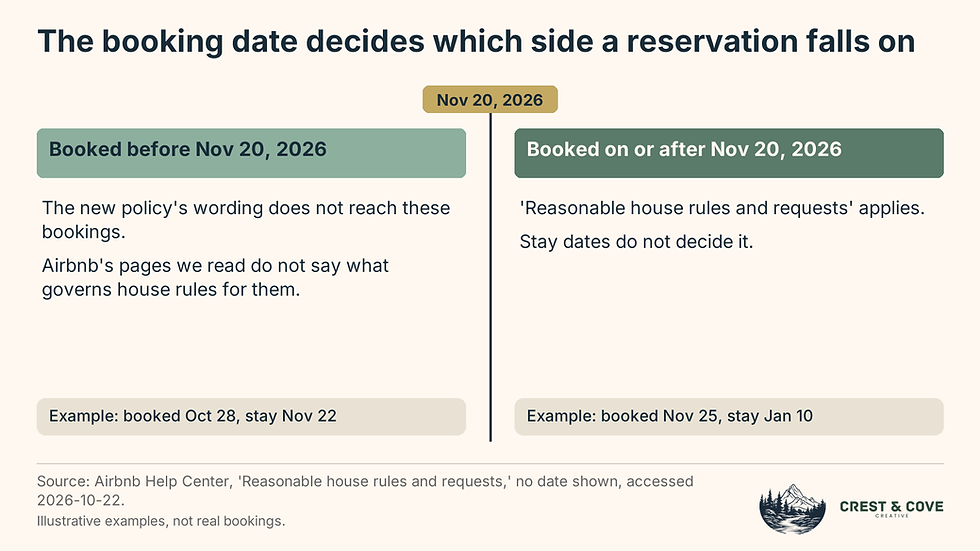
Airbnb's Help Center ties the policy to when a reservation is booked, not when the guest stays.
What every rule and request has to meet
Article 4168 lists what "all house rules and requests must" do. In plain terms:
Be disclosed at booking time, in the right place. They must be "disclosed in the designated section of the listing page at the time of booking," so guests can judge fit before they book.
Be stated before the booking, not added afterward. Hosts may not communicate new house rules or requests elsewhere on the listing page or "after booking, including by message, signs in the home, or in person." The Resource Center says the same thing from the other side: all rules and requests should appear in the "House rules and requests" section, not "in messages, or on signs in your home."
Be consistent with the rest of the listing. The policy asks that they "be consistent with information found elsewhere on the listing page."
Comply with Airbnb's policies and Terms of Service. The policy's own example is that hosts may not ask guests to sign separate contracts or solicit personal information such as a government ID, except where required by law and in other limited circumstances. We cover that in Airbnb's limits on guest contracts and personal data.
Be reasonable. The policy gives examples of what hosts are "generally not allowed" to do. Three are listed: ask guests for tasks needing significant effort or time, restrict access to an advertised feature, and impose fines or other penalties on guests.
The first of those examples is the one that drew attention. Airbnb's wording is tasks that "would typically be performed by a cleaner," and the examples named are stripping the bed, taking trash offsite, and washing and putting away dishes. We sort Airbnb's allowed and not-allowed examples line by line in what you can still ask guests at checkout.
The second and third examples also touch money. Article 4168 says any fees for an advertised part of the listing must be included in the price shown at booking, and that hosts may still describe fees for optional add-ons, such as breakfast service, in their requests. We take that rule and the fines ban one at a time in Airbnb's fines ban and fee-in-price rule.
Airbnb also says reasonableness depends on context. The policy says Airbnb looks at "the listing's context, including the type of listing or stay and any relevant local considerations," and may grant exceptions. Its two examples are drought-related shower limits and animal-proof trash containers in bear country.
What Airbnb says happens if a rule does not fit
Two Airbnb pages describe the process, and they overlap. The Resource Center says requests that do not follow the policy "will be highlighted in the Listing editor," along with a tip. Airbnb says it will also send an email and "give you an opportunity to submit an appeal." Article 472 adds that if you save without fixing a flagged request, it is "subject to further review."
On what can follow, the two pages use different wording. The Resource Center says guests "may see an alert on your listing, such as 'includes cleaning requests,'" if an issue goes unresolved. The Help Center policy says Airbnb "may take appropriate action," including educating the host, asking for a listing update and issuing warnings. Then: "If a violation persists, it may result in a notice on the listing page," and the policy goes on to list reduced listing visibility in search and other action under the Terms of Service.
We stop there on purpose. Airbnb's pages do not give an appeal deadline, a definition of "persists," or the placement and duration of the alert. Press coverage has described further consequences; we did not find them on the Airbnb pages we read, so we leave them out. Step by step, with documented and undocumented steps separated, in how Airbnb will enforce house rules.
What the official pages do not say
Reading all four pages, these points are silent or open:
Bookings made outside Airbnb. The pages say nothing, either way, about bookings made elsewhere. This post does not claim that the policy does or does not reach them.
What governs earlier bookings. Article 4168 does not say what rules apply to reservations booked before Nov 20. The contracts policy says the previous policy covers them, for contracts only.
Timing of fixes. No deadline for editing flagged requests or for filing an appeal appears on the pages we read.
"Persists." The pages do not define when a violation "persists."
Alert details. Where the "includes cleaning requests" alert would appear, for how long, and what clears it, are not described. The Resource Center gives it as an example ("such as").
What to review before November 20
Built only from what the pages say:
Open the Listing editor and find the "House rules and requests" section. Airbnb says that is where all rules and requests belong.
Check your seven standard rules against what you actually want. Two are marked as new options: maximum overnight guests and lock up at checkout.
Read every request as a guest would before booking. The policy asks that requests be reasonable and disclosed at the time of booking.
Look for rules living elsewhere: in listing descriptions, saved messages, or signs in the home. Airbnb says additional rules should not be written there.
Check any contract or personal-data step against the contracts policy. Our post on Airbnb's contract and personal-data limits walks through it.
Note your booking dates. The policy turns on when a reservation was booked.
Re-read the policy before changing anything. Airbnb's own page says its information may have changed since publication.
A worksheet for the rewrite itself is in rewriting your Airbnb house rules. Airbnb does not promise that any particular wording will pass its review, and neither do we.
Frequently asked questions
What is Airbnb's new house rules policy?
Airbnb's Help Center policy "Reasonable house rules and requests" sets requirements for hosts' house rules and requests. Airbnb's Resource Center says it takes effect November 20, 2026.
Which bookings does the policy apply to?
The Help Center says it applies to all reservations booked on or after November 20, 2026. The wording refers to when a reservation is booked, not to the stay dates.
When did Airbnb announce it?
Airbnb's Resource Center article "Important changes to house rules" is dated October 20, 2026. It describes new Listing editor options as available that day and the policy as taking effect November 20.
What are the seven standard house rules?
Airbnb lists maximum overnight guests, quiet hours, events, pets, smoking (including vaping and e-cigarettes), commercial photography and filming, and lock up at checkout.
What is the difference between a house rule and a request?
Airbnb says guests must follow house rules and are encouraged to comply with requests. If a guest does not comply, the host can contact Airbnb for next steps.
Can I add a new rule after a guest books?
Not under this policy. Article 4168 says hosts may not communicate new house rules or requests after booking, including by message, signs in the home, or in person.
Do changes to my rules affect existing reservations?
Airbnb's article 472 says changes apply only to future reservations received after the change. Pending or confirmed reservations keep the rules that were on the listing when received.
What happens if my rules or requests do not comply?
Airbnb says non-compliant requests are highlighted in the editor, with an email, tips and an appeal option. If a violation persists, a listing notice or reduced search visibility may follow.
Can hosts fine guests under the policy?
Generally not. Article 4168 lists imposing fines or other penalties on guests among things hosts are generally not allowed to do, and says fees for advertised parts of the listing belong in the price.
Does the policy cover bookings made outside Airbnb?
The Airbnb pages we read do not say either way, so we make no claim about bookings made elsewhere. Check Airbnb's current pages if you need certainty.
Sources
Every official page used for this post, read in full on 2026-10-22. Quotes in the post are 15 words or fewer and attributed inline. Last checked 2026-10-22.
Important changes to house rules (Airbnb Resource Center). https://www.airbnb.com/resources/hosting-homes/a/important-changes-to-house-rules-21. Date: byline "By Airbnb on Oct 20, 2026"; the page says it may have changed since publication. Accessed 2026-10-22.
Reasonable house rules and requests (Airbnb Help Center, article 4168). https://www.airbnb.com/help/article/4168. Date: no date shown (footer shows only "© 2026"). Accessed 2026-10-22.
Add house rules and requests to your listing (Airbnb Help Center, article 472). https://www.airbnb.com/help/article/472. Date: no date shown. Accessed 2026-10-22.
Limiting host-imposed contracts and other requirements (Airbnb Help Center, article 4169). https://www.airbnb.com/help/article/4169. Date: no date shown. Accessed 2026-10-22.
This post is not legal advice. Check the current policy on the pages above before you act.
Featured photo: Photo by Josh Lemmon on Unsplash (stock photo).
Related Reading
More on Airbnb's Nov 20 policy, enforcement and the wider fall 2026 changes.
Airbnb and Vrbo's Fall 2026 Changes: What Independent Hosts Need to Know
Airbnb Checkout Requests After Nov 20: What You Can Still Ask Guests
Can Airbnb Hosts Fine Guests? What Airbnb Says About Fines, Fees and Add-Ons
Airbnb's Limits on Guest Contracts and Personal Data, From Nov 20
How Airbnb Will Enforce House Rules: Editor Flags, Appeals and the Listing Alert
Rewriting Your Airbnb House Rules: A Plain-Language Worksheet
Work with Crest & Cove Creative
Selling on Vrbo, Airbnb and your own channels is a lot easier when your marketing works the same way every week.
Crest & Cove Creative helps independent hosts build marketing that holds up when platform rules change. Visit https://www.crestcove.co or call (256) 998-7502.


Comments