
Chattanooga Short Term: Host Copy, Not a Visitor Brochure

Updated: Aug 28
Chattanooga guests almost always arrive with the same short list in their heads: the Aquarium, the Incline, Rock City or Ruby Falls, maybe a float down the river. That list is useful to a host, not just a tourist. Every one of these attractions is a real, specific place a guest will search for before they book — and naming it correctly in your listing does more for conversion than another photo of your living room.
This guide covers the attractions guests actually visit, what they cost, how far they sit from the neighborhoods where most Chattanooga STRs cluster, and — for each one — the specific thing a host should do with that information. It's a companion to our piece on Chattanooga's scenic overlooks and viewpoints; that post covers where to look, this one covers where to go and what to do once you're there. Neither is a substitute for checking current hours and prices yourself before you print anything for a guest binder — attraction pricing and schedules shift year to year, and the outfitters and operators covered here update their own sites faster than any blog post can.
Treat everything below as a starting framework, not a finished welcome guide. The distances are approximate from the neighborhood clusters where Chattanooga STRs concentrate, not from any single address, so the honest move is to confirm drive time from your own listing before you print it for a guest.
Tennessee Aquarium — What Every Guest Googles First
The Tennessee Aquarium sits downtown at 1 Broad Street on the riverfront, split into two buildings — River Journey and Ocean Journey — connected by a plaza. As of 2026 it's open daily from 10 a.m. to 5 p.m., with general admission running roughly $39.95 for adults and $29.95 for kids 5–17; tickets are sold in timed-entry slots, and advance booking is worth telling guests about since walk-up slots can sell out on weekends. Plan on two to three hours inside.
For distance, this is the one attraction almost no Chattanooga STR is genuinely far from. Downtown and Southside condos are a 5–10 minute walk or rideshare. Northshore and North Chattanooga listings are about 10 minutes, often walkable across the Walnut Street pedestrian bridge. St. Elmo and Lookout Mountain properties run 15–20 minutes by car. Parking is paid, in downtown garages and lots near the riverfront, and it fills on weekends and school breaks.
Families with younger kids tend to spend the most time here relative to other attractions on this list, partly because the aquarium is indoor, air-conditioned, and forgiving of a rained-out afternoon in a way that Rock City or the Riverwalk aren't. If your listing tends to book families, that's worth knowing — the Aquarium is the fallback plan guests reach for when the weather doesn't cooperate, and it's worth flagging in your guide as the rain-day option, not just the headline attraction.
What to do with this: name "Tennessee Aquarium" explicitly in your listing description rather than a vague "steps from downtown attractions." Guests search for the attraction by name, and so do the AI trip-planning tools now summarizing listings. In your welcome guide, add one line about timed-entry tickets — it's a small detail that makes you look like a host who actually knows the city, not one who copy-pasted a template.
The Incline Railway — Lookout Mountain's Easiest Win
The Lookout Mountain Incline Railway has run since 1895 and climbs the mountain on a grade that gets steep enough near the top that the ride itself is the attraction, not just the transportation. The lower station sits in the St. Elmo neighborhood; the upper station puts riders out near Point Park. It's a round-trip ticket, and current hours and pricing shift seasonally, so point guests to the operator's site rather than quoting a fixed number in your guide.
From St. Elmo, the lower station is a short walk or drive — that's the neighborhood's single biggest selling point for STR guests who don't want to drive up the mountain themselves. From downtown, it's roughly a 10-minute drive to the lower station. Parking at the lower station is limited, so guests arriving by car should plan to arrive early or use rideshare.
It's also worth telling guests that the upper station view is free to look at even without continuing on to Point Park or Rock City — plenty of visitors ride up, take in the overlook, and ride back down as a self-contained hour-long activity. That's a useful thing to mention for guests with limited time or younger kids who won't make it through a full mountain-top itinerary.
What to do with this: if your listing is in or near St. Elmo, this is a differentiator worth a full sentence in your title or first description paragraph — "walk to the Incline Railway" is a claim most Chattanooga listings can't make. For listings elsewhere, mention the Incline in your welcome guide as the easiest way to see the mountain without driving it, especially useful for guests planning a Rock City or Ruby Falls day.
The Riverwalk and Northshore — Where Guests Actually Walk
The Tennessee Riverwalk is a paved, free, always-open path that runs roughly 13 miles along the river, linking Coolidge Park in Northshore to downtown via the Walnut Street pedestrian bridge and continuing toward the Chickamauga area. Northshore itself is the walkable retail and restaurant corridor across the river from downtown — Frazier Avenue is the main strip, and it's the kind of place guests screenshot before they book.
Coolidge Park adds a carousel and a splash pad that make it a legitimate stop for families traveling with kids, not just a scenic pass-through, and it sits directly on the Riverwalk path itself. Weekend mornings bring a steady stream of walkers and runners, which is worth mentioning to guests who exercise on vacation and are looking for a safe, obvious route rather than guessing at one.
What to do with this: if your listing sits in Northshore or North Chattanooga, walkability to the Riverwalk and Coolidge Park is worth leading with — it's a genuine amenity, not marketing filler, and it photographs well for your listing gallery. For downtown listings, mention the river view or the bridge walk specifically rather than a generic "near the river" line.
St. Elmo — The Neighborhood at the Base of the Mountain
St. Elmo is the historic neighborhood tucked at the foot of Lookout Mountain, with a walkable Main Street corridor of restaurants and a brewery or two, the Incline Railway's lower station, and access to the South Chickamauga Creek Greenway and connecting bike trails. It reads less "tourist strip" and more "actual neighborhood," which is part of its appeal to guests who've already done a downtown Chattanooga trip before.
The housing stock in St. Elmo skews toward early-1900s bungalows, which shows up in the character of the STRs there too — guests booking in this neighborhood are often specifically choosing it over a downtown high-rise or a generic cabin, because they want walkable local character with mountain access attached. That's a distinct guest intent worth writing to directly rather than folding St. Elmo into a generic "Chattanooga area" description.
What to do with this: St. Elmo listings should lead with proximity to the Incline over generic downtown proximity — it's the more specific, more searchable claim, and it's true. If you're not in St. Elmo but are hosting guests who mention Lookout Mountain plans, this neighborhood is worth a line in your guide as where to grab lunch before or after the mountain.
Rock City, Ruby Falls, and Point Park — The Lookout Mountain Triple
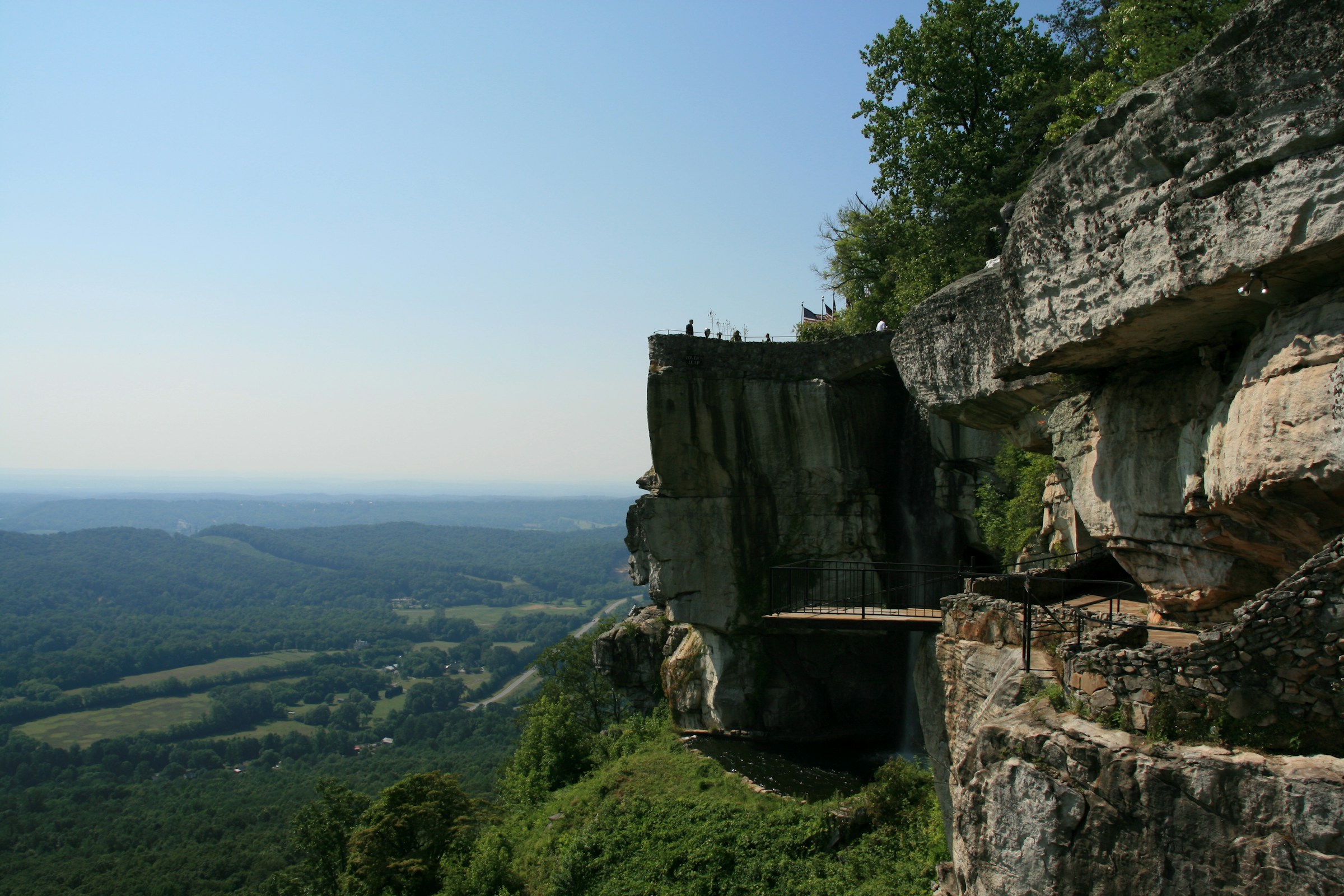
These three sit close together on and around Lookout Mountain but are entirely separate operations, each with its own ticket. Rock City is on the Georgia side of the mountain — a rock-garden walking trail known for its cross-state overlook and a gnome-themed trail that's genuinely popular with families. Ruby Falls, on the Tennessee side, is a guided cave tour ending at an underground waterfall; it runs on timed tours and its parking lot fills fast on summer weekends. Point Park is the third piece — a National Park Service unit that's part of Chickamauga and Chattanooga National Military Park, covering the Civil War's Battle Above the Clouds, with a small NPS entrance fee and a short walk from the Incline's upper station.
Because they're privately operated (Rock City and Ruby Falls) and federally operated (Point Park), guests routinely assume one ticket covers all three, or that they can walk between them quickly. Neither is true — figure roughly 15 minutes of drive time between each, and budget separate admission for each stop.
Morning arrivals tend to beat the worst of the parking crunch at both Rock City and Ruby Falls, particularly in summer and around fall foliage weekends when day-trip traffic from Atlanta and Nashville both converge on the mountain. Guests who ask for a suggested order generally do best starting at whichever attraction is closest to their lodging and saving Point Park, which requires the least advance planning, for whenever the schedule has a gap.
What to do with this: this is the single highest-value paragraph you can add to a welcome guide for a Lookout Mountain-adjacent listing. Spell out that these are three separate businesses, note that each needs its own ticket, and suggest a sensible order based on where your guests are staying. That one paragraph resolves a real point of guest confusion before it becomes a message to you at 8 a.m. asking why the Rock City ticket didn't get them into Ruby Falls.
An Ocoee River Day Trip — For the Adventure-Seeking Guest
The Ocoee River sits in the Cherokee National Forest about 45–50 minutes east of Chattanooga along the Ocoee Scenic Byway (US-64). The Upper Ocoee section hosted the 1996 Olympic whitewater slalom course; the Middle Ocoee is the section most commercial outfitters run for guided rafting. Because the river's flow is controlled by scheduled TVA dam releases, trips run on a fixed calendar — typically weekends only in early spring, expanding to most days once Memorial Day hits, and continuing into the fall before the season closes. Upper Ocoee trips are generally weekends-only throughout their season.
Not every guest wants whitewater, and the drive out is worth mentioning even to those who don't — the Ocoee Scenic Byway itself is a legitimate half-day trip for guests who just want a mountain drive with river views and don't need to book an outfitter at all. That's a useful lower-commitment alternative to suggest for guests asking about the Ocoee but hesitant about a full rafting booking.
Because this is genuinely a day trip and not a quick errand, it's worth setting expectations on total time: figure on 45–50 minutes each way plus however long the outfitter's trip runs, which typically means guests should plan to leave a Chattanooga listing by mid-morning to make a booked departure time comfortably, especially if they're unfamiliar with the winding sections of the byway.
What to do with this: this isn't a same-day, walk-up activity, and your guide should say so plainly. If your listing is east of Chattanooga toward the Cleveland or Ocoee corridor, or if you tend to host adventure travelers, add a line noting that rafting requires booking with an outfitter in advance, tied to the release schedule — not something to plan the morning of.
Turning This Into Your Listing's Advantage
Scroll through Chattanooga STR listings and the same phrase shows up over and over: "close to downtown attractions." It's true of almost every listing in the market, which means it differentiates none of them. Naming the actual attraction — Tennessee Aquarium, the Incline, Ruby Falls, the Ocoee — does two things a generic line can't: it matches what a guest is actually typing into a search bar or asking an AI trip-planning tool, and it signals you know the area well enough to be specific.
The most useful version of this guide isn't the one you publish once and forget — it's the one you build into your own welcome guide, attraction by attraction, in the same format used above: name, distance and travel time from your specific address, whether it's free or ticketed, and one practical tip a first-time visitor wouldn't know. That structure is repeatable for every new attraction you add, and it's the kind of detail that turns a one-time booking into a five-star review that mentions your guide by name.
None of this requires guessing. Drive the route from your own listing to each attraction once, time it honestly rather than trusting a map estimate, and note where parking actually gets tight versus where the map says it should. That firsthand detail is what separates a host-written guide from a tourism-board pamphlet, and it's the kind of specificity guests mention in reviews.
It also compounds. A guest who reads a listing description naming the Incline Railway by address, then opens a welcome guide with the same level of specificity about Rock City parking or Ocoee release schedules, arrives already trusting the host's judgment on everything else in the guide — restaurant picks, checkout instructions, the works. Specificity in the parts guests can verify builds trust in the parts they can't.
Related Reading
Keep reading in the Chattanooga market spine and nearby towns in the same region: same-cluster pages hosts can use without costume-corridor copy.
Rising Fawn Chattanooga Weekend: How Hosts Should Sell the Drive
Chattanooga STR Occupancy by Season: A Guide for Independent Hosts
The 2026 Chattanooga Corridor STR Marketing State of the Region
Every Kayaking Spot in Chattanooga We'd Actually Recommend to a Friend
Chattanooga Worth Drive Overlooks: What to Put in the Listing
Chattanooga vs. Asheville: Why a Rivalry Headline Isn't a Pro Forma
Chattanooga vs. Lookout Mountain: What the AirROI Numbers Say About
Chattanooga City Hamilton Co Rules: Clerks, Not Occupancy Ranking
Frequently Asked Questions
How far is the Tennessee Aquarium from most Chattanooga STRs?
Most downtown, Southside, and Northshore listings are within a 5–10 minute walk or drive. Elmo and Lookout Mountain listings run closer to 15–20 minutes by car. Elmo, this is a differentiator worth a full sentence in your title or first description paragraph — "walk to the Incline Railway" is a claim most Chattanooga listings can't make.
Do Rock City, Ruby Falls, and Point Park require separate tickets?
Rock City and Ruby Falls are separately operated private attractions, and Point Park is a National Park Service site with its own small entrance fee. None of the three tickets covers the others. Because they're privately operated (Rock City and Ruby Falls) and federally operated (Point Park), guests routinely assume one ticket covers all three, or that they can walk between them quickly.
Is the Incline Railway walkable from downtown Chattanooga?
Not comfortably — the lower station is in St. Elmo, about a 10-minute drive from downtown. Elmo itself, which is why STRs in that neighborhood can genuinely market Incline access as a feature. Elmo skews toward early-1900s bungalows, which shows up in the character of the STRs there too — guests booking in this neighborhood are often specifically choosing it over a downtown high-rise or a generic cabin, because they want walkable local character with mountain access attached.
What's the best neighborhood for guests who want to walk to the Riverwalk?
Northshore and North Chattanooga sit right along the Riverwalk near Coolidge Park, with the Walnut Street pedestrian bridge connecting across to downtown. The Tennessee Riverwalk is a paved, free, always-open path that runs roughly 13 miles along the river, linking Coolidge Park in Northshore to downtown via the Walnut Street pedestrian bridge and continuing toward the Chickamauga area.
When is the Ocoee River open for whitewater rafting?
The season generally runs from late March through early November, with releases scheduled by TVA. Early and late season trips tend to run weekends only; the Middle Ocoee expands to most days after Memorial Day. Because the river's flow is controlled by scheduled TVA dam releases, trips run on a fixed calendar — typically weekends only in early spring, expanding to most days once Memorial Day hits, and continuing into the fall before the season closes.
Is parking free at the Lookout Mountain attractions?
No — Rock City, Ruby Falls, and the Incline Railway all have paid parking, and it fills up on summer weekends. Point Park has NPS-managed parking that can also fill during peak season. Morning arrivals tend to beat the worst of the parking crunch at both Rock City and Ruby Falls, particularly in summer and around fall foliage weekends when day-trip traffic from Atlanta and Nashville both converge on the mountain.
Should hosts mention Point Park differently than Rock City or Ruby Falls?
Yes — it's worth noting that Point Park is a federally operated National Park Service site with Civil War history, distinct from the two privately operated attractions nearby. Guests appreciate knowing which is which before they book tickets. It's also worth telling guests that the upper station view is free to look at even without continuing on to Point Park or Rock City — plenty of visitors ride up, take in the overlook, and ride back down as a self-contained hour-long activity.
Should hosts name specific attractions in their listing description instead of general phrases?
Naming the Tennessee Aquarium, the Incline, or Ruby Falls directly matches what guests actually search for and differentiates a listing from the many that only say "near downtown attractions.". Naming the actual attraction — Tennessee Aquarium, the Incline, Ruby Falls, the Ocoee — does two things a generic line can't: it matches what a guest is actually typing into a search bar or asking an AI trip-planning tool, and it signals you know the area well enough to be specific. Keep going on Crest & Cove:the Crest & Cove intro·local SEO keywords that actually book·the five elements of a converting hero·how to compare STR marketing agencies·Asheville paddling spots worth the.
Work with Crest & Cove Creative
Want a Chattanooga listing description that actually names what's nearby?
Reach out at crestcove.co or (256) 998-7502.


Comments