
Forgotten Coast STR Market Report for Independent Hosts

Updated: Aug 28

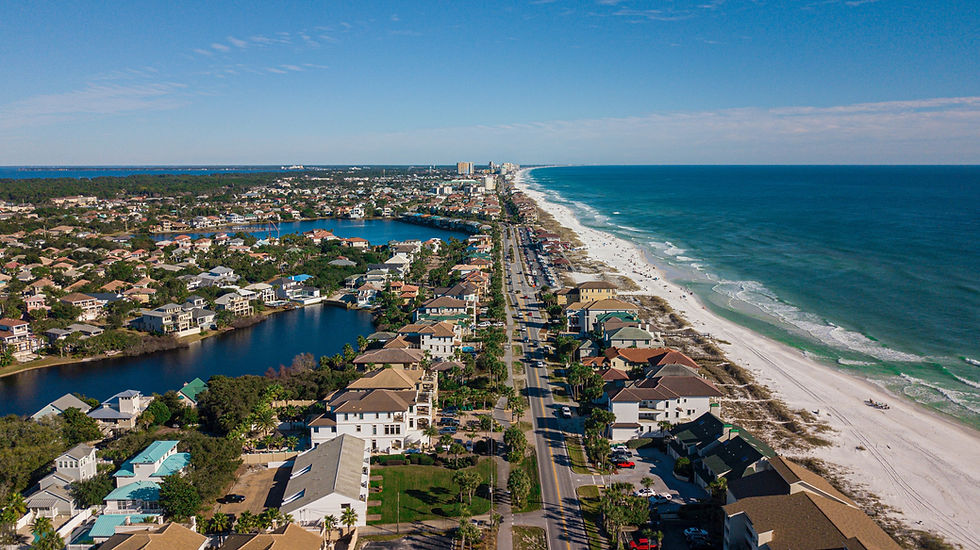
The Forgotten Coast is not the Emerald Coast, and that is the entire investment thesis. Gulf County's Cape San Blas, Port St. Joe, Indian Pass, and Mexico Beach sit roughly an hour east of the Destin-30A corridor on the Florida Panhandle — close enough to share the same sugar-white Gulf beaches and the same Southeast drive-to feeder markets, but far enough removed to operate as a fundamentally different vacation rental market. Where Destin has 7,700 STR units and a $460 ADR in a condo-heavy, professionally managed, high-saturation environment, the Forgotten Coast has approximately 2,300 to 2,600 total STR units — almost entirely single-family beach houses rather than condos — commanding a $490 to $566 ADR with lower density, fewer competitors, and a guest who chose this market specifically because it is not built up. The beaches are uncrowded. The dogs are welcome.
The state park is world-class. And the market is in the midst of a post-Hurricane Michael supply expansion, creating both opportunity and pressure for existing operators.
This report covers current performance data, supply dynamics, sub-market structure, the regulatory environment, and demand drivers to determine whether the Forgotten Coast is a good fit for your next investment or your current operation's marketing strategy. All figures carry named sources and reconciled ranges where providers disagree. The Forgotten Coast is thinly covered by the major STR data platforms — the numbers below represent the best available synthesis, with data gaps flagged where they exist.
The Sub-Market Structure: Four Distinct Characters
The Forgotten Coast is not one market. It is four sub-markets with different physical characteristics, guest profiles, and risk exposures, all within a 30-minute drive of one another in Gulf County.
Cape San Blas is the premium submarket — a roughly 15-mile barrier peninsula extending into the Gulf of Mexico, with the northern half occupied by T.H. Stone Memorial St. Joseph Peninsula State Park and the southern half developed with single-family vacation homes. The peninsula has only approximately 622 year-round residents. AirROI tracks 87 active Airbnb listings on the peninsula proper, commanding the market's highest ADR of $566, with peaks reaching $610-$614 in June and July. Properties here are overwhelmingly large single-family homes: 62.1% have three or more bedrooms, the average property sleeps 7.5 guests, and 74.7% sleep 8 or more. Cape San Blas is the Forgotten Coast's signature product — gulf-front and bay-side beach houses on a secluded peninsula with state-park access and dog-friendly beaches. It is also the sub-market most exposed to erosion risk, which is being addressed by a $34.5 million beach renourishment and breakwater project currently under construction.
Port St. Joe is the county seat and Cape San Blas's service hub — a small working town of approximately 3,500 residents with a walkable downtown along Reid Avenue, bay-front dining, and the infrastructure that Cape San Blas guests depend on for their week-long stays. The broader Port St. Joe market (ZIP 32456, which encompasses Cape San Blas) shows 810 active Airbnb listings on the AirROI basis and approximately 2,607 active rentals on the AirDNA cross-platform basis. ADR for the broader market clusters around $490 to $500. Port St. Joe proper attracts guests who want walkable-town character with bay access — a different experience from the secluded peninsula.
Indian Pass is the raw, remote western edge of the Forgotten Coast — a stretch of undeveloped Gulf coastline known for the Indian Pass Raw Bar, a Florida institution, and a handful of secluded vacation homes. This is the lowest-density submarket, attracting guests who want genuine isolation rather than merely reduced density. Supply is thin and unlikely to grow materially given the limited developable land.
Mexico Beach sits at the eastern edge of Gulf County — a small incorporated city that was devastated by Hurricane Michael in October 2018 as a direct-hit Category 5 storm. Mexico Beach's rebuilding has been ongoing for eight years, with new construction gradually replacing the destroyed housing stock. The city markets itself as "the unforgettable Forgotten Coast" and targets family-friendly beach vacations. Mexico Beach's recovery status is a material market factor: the rebuild has created newer, code-compliant, storm-hardened housing stock, but the community's infrastructure and commercial amenities are still being rebuilt. Investors should verify the current state of commercial services, dining options, and beach-access infrastructure before committing to the market.
Performance Data: What the Numbers Show
The Forgotten Coast's performance data must be read through two lenses: the Cape San Blas peninsula sub-market (AirROI's tight 87-listing universe) and the broader Port St. Joe market (AirROI's 810-listing and AirDNA's 2,607-listing universes).
ADR is strong by any standard. Cape San Blas commands $566 on the AirROI basis; the broader Port St. Joe market clusters around $490 to $500 (AirROI $500, AirDNA $498). Top-10% homes command $852 to $859 or more per night. These rates are competitive with the Emerald Coast's 30A corridor ($542 to $699) and well above Destin's blended average — remarkable for a market with a fraction of the infrastructure and brand recognition.
Occupancy splits by methodology. Airbnb-only occupancy runs 32.4% (Cape San Blas) to 37% (Port St. Joe) on the AirROI all-listings basis. AirDNA's blended Airbnb-plus-Vrbo occupancy reports 54% with plus-4% year-over-year growth. The gap is structural: Vrbo carries a disproportionately large share of bookings in this market (local property managers list approximately 885 houses and 74 condos on Vrbo for Cape San Blas alone), and 54.9% to 63.2% of listings have 30-plus-night minimum stays that depress the nightly-rental occupancy calculation. The honest range is approximately 37% on a nightly basis on Airbnb to 54% on a blended available-nights basis.
Annual revenue per listing ranges from $42,133 (Cape San Blas, AirROI) to $46,732 (Port St. Joe, AirROI) to $43,900 (AirDNA blended). The revenue distribution is steep: the top 10% of Port St. Joe listings earn $12,581 or more per month ($150,000-plus annually) while the bottom 25% earn $2,351 per month ($28,000 annually). A well-positioned, well-marketed large beach house on Cape San Blas operates in a fundamentally different revenue tier than a smaller inland property in the broader market.
RevPAR runs $195 to $196 (AirROI, Airbnb-only) to $267 (AirDNA, blended). Use $196 to $267 as the working range.
Seasonality: The Summer Spike and the Winter Question
The Forgotten Coast's seasonal pattern is a single-peak summer-beach curve with a 3.7-times peak-to-trough revenue swing — severe but slightly less extreme than the Emerald Coast's 3.8-times.
Peak month is July: the broader Port St. Joe market generates approximately $10,434 in average monthly revenue at 58.7% occupancy and $567 ADR. Cape San Blas peaks at $9,362 monthly revenue with 47.3% occupancy and $610 ADR — lower occupancy but higher rate, reflecting the peninsula's premium positioning and longer minimum stays. The secondary peak runs through June, with April providing a spring-break shoulder.
Through the month of January, Port St. Joe drops to approximately $2,828 monthly revenue at 20.7% occupancy and $432 ADR. The December-through-February trough is deep, with limited demand drivers beyond a snowbird long-stay segment, as evidenced by the high percentage of 30-plus-night minimum-stay listings.
The shoulder-season opportunity centers on two demand drivers that the Emerald Coast does not share. Scalloping season runs from approximately August 16 through September 24 in St. Joseph Bay — a genuine recreational draw that attracts a specific, motivated guest segment. The broader fall fishing and outdoor season creates a regional demand layer that benefits Gulf County operators who market to the nature-and-fishing traveler.
The booking lead time is long: 98 days for Cape San Blas and 76 days for the broader Port St. Joe market. This means June marketing captures September and October bookings, and September marketing captures December and January bookings, planners. Average length of stay runs 5.6 to 5.8 nights — full-week family beach vacations, not weekend trips.
Supply Growth: The Post-Michael Expansion
The most significant market dynamic on the Forgotten Coast is the supply expansion driven by Hurricane Michael rebuilding and new construction. AirROI reports plus-79.6% listing supply growth year-over-year in the Port St. Joe market, against plus-22.3% revenue growth — supply is growing nearly four times faster than revenue. AirDNA shows a more modest plus-3% on its broader base, reflecting a different counting methodology.
The supply story has two chapters. On Cape San Blas, the mature premium peninsula sub-market is showing revenue pressure: per-listing revenue declined 7.3% year-over-year even as the broader market grew. This is classic supply-saturation pressure — more homes competing for a demand pool that is growing but not fast enough to maintain per-unit revenue. For existing Cape San Blas operators, this is the signal that marketing differentiation, direct-booking capture, and shoulder-season demand generation are no longer optional — they are the margin-preservation strategy.
In the broader Gulf County market, the supply expansion reflects post-Michael reconstruction (particularly in Mexico Beach) and new-construction investment on Cape San Blas and the surrounding coast. The new homes entering the market are generally larger, better-appointed, and more storm-resilient than the pre-Michael housing stock — which means they compete effectively for the premium guest but also raise the quality bar that existing operators must meet.
The $34.5 million Cape San Blas beach renourishment and breakwater project, under construction from December 2025 through May 2026, is the most important infrastructure investment for the peninsula's STR asset base. Funded by $15.5 million from the Florida Department of Environmental Protection, $3.6 million in RESTORE Act funds, $3 million from the Tourist Development Council, and $1.5 million from the National Fish and Wildlife Foundation, the breakwaters are designed to reduce wave-driven erosion by 60% to 80%. For investors and operators, this project directly addresses the peninsula's primary physical risk and signals institutional commitment to protecting the beachfront that supports the entire vacation rental economy.
The Dog-Friendly Premium
Dog-friendliness is not a minor amenity detail on the Forgotten Coast — it is a primary booking filter and a measurable rate premium. Cape San Blas's beaches are dog-friendly (dogs are allowed on most Cape San Blas beaches, with Gulf County's leash law applying; note that the beachside of St. Joseph Peninsula State Park restricts dogs). The Forgotten Coast's dog-friendly identity is a structural market advantage because the supply of genuinely dog-welcoming beach vacation rentals in the Southeast is far smaller than the demand.
The pet-traveling family or couple who searches for "dog friendly beach rental Florida" encounters a market where most premium beach destinations either prohibit dogs on beaches, restrict them to off-peak hours, or impose cleaning fees and pet deposits that signal tolerance rather than welcome. Cape San Blas and the broader Forgotten Coast genuinely welcome dogs as part of the beach experience — and the guest who finds this knows they have found something rare. Properties that lead with pet-friendliness in their listing title, first photo, and amenity description access a motivated, underserved segment that books with less price sensitivity and higher loyalty than the general family-beach market.
The Regulatory Advantage
Gulf County's regulatory environment is one of the Forgotten Coast's competitive advantages relative to the heavily regulated Emerald Coast markets. AirROI rates regulation as "Low," and the county is explicitly positioned as business-friendly with minimal restrictions compared to Walton County's 2023 certificate regime, Destin's size-tiered registration and occupancy caps, and Bay County's Panama City Beach ordinance.
The permitting stack requires a Florida DBPR vacation-rental dwelling license (state level), a Gulf County Short-Term Rental Business License under Ordinance 2020-04 (including a code-enforcement land-use review and inspection checklist), a City of Port St. Joe business license for in-city properties (approximately $25 to $50 per year), and Gulf County TDT registration with the Tax Collector. There is no countywide cap on STR licenses, no explicit occupancy cap beyond zoning and life-safety inspection requirements, and Florida state law preempts local STR bans.
The total tax stack is 11% on gross transient rental receipts: 6% Florida state sales tax plus 5% Gulf County Tourist Development Tax. This is one percentage point lower than the 12% total in Walton County (30A, Miramar Beach) and Okaloosa County (Destin).
One critical operator note: Gulf County does not have a tax-collection agreement with Airbnb or Vrbo. Owners and managers must collect and remit the 5% county TDT directly to the Gulf County Tax Collector. The platforms handle only the 6% state sales tax portion. This is a recurring compliance burden that catches new operators off guard and creates a genuine service opportunity for property managers and marketing partners who can help operators navigate the direct-remittance requirement.
Comparable Markets: The Forgotten Coast in Context
Cape San Blas / Port St. Joe: ADR $490–$566, approximately 2,300–2,600 total units, house-dominant 90%+, 57–59% managed, 3.7x seasonal swing, 11% tax, low regulation. 30A / Santa Rosa Beach: ADR $542–$699, approximately 6,800–7,600 total units, house-dominant 69%, 66% managed, 3.8x swing, 12% tax, moderate regulation. Destin: ADR $305–$470, approximately 7,700 total units, condo-dominant 67%, 67% managed, 3.8x swing, 12% tax, moderate regulation. The Forgotten Coast competes on seclusion, dog-friendliness, and the nature-first identity that the built-up Emerald Coast cannot offer. Its competitive disadvantages are lower brand recognition, a thinner commercial infrastructure, and hurricane exposure.
Keep going on Crest & Cove: Cape San Blas against AirROI · Destin against AirROI, not leftover year · the Crest & Cove intro · local SEO keywords that actually book · the five elements of a converting hero · how to compare STR marketing agencies · Santa Rosa Beach against AirROI · Asheville paddling spots worth the drive.
Frequently Asked Questions
What is the core investment thesis for the Forgotten Coast versus the Emerald Coast?
It operates as a fundamentally different market despite sharing the same beaches and feeder markets — Destin has 7,700 STR units at a $460 ADR in a high-saturation environment, while the Forgotten Coast has only 2,300 to 2,600 units, mostly single-family houses, commanding a $490 to $566 ADR. Where Destin has 7,700 STR units and a $460 ADR in a condo-heavy, professionally managed, high-saturation environment, the Forgotten Coast has approximately 2,300 to 2,600 total STR units — almost entirely single-family beach houses rather than condos — commanding a $490 to $566 ADR with lower density, fewer competitors, and a guest who chose this market specifically because it is not built.
What are the Forgotten Coast's four sub-markets?
Joe, Indian Pass, and Mexico Beach — each with different physical characteristics, guest profiles, and risk exposures, all within a 30-minute drive of one another in Gulf County. It is four sub-markets with different physical characteristics, guest profiles, and risk exposures, all within a 30-minute drive of one another in Gulf County. Joe, Indian Pass, and Mexico Beach sit roughly an hour east of the Destin-30A corridor on the Florida Panhandle — close enough to share the same sugar-white Gulf beaches and the same Southeast drive-to feeder markets, but far enough removed to operate as a fundamentally different vacation rental market.
What makes Cape San Blas the premium sub-market?
A roughly 15-mile barrier peninsula with only about 622 year-round residents, commanding the market's highest ADR of $566 (peaking at $610-$614 in June and July), with 62.1% of properties having three or more bedrooms. AirROI tracks 87 active Airbnb listings on the peninsula proper, commanding the market's highest ADR of $566, with peaks reaching $610-$614 in June and July.
What erosion risk does Cape San Blas face, and how is it being addressed?
It's the sub-market most exposed to erosion risk, currently being addressed by a $34.5 million beach renourishment and breakwater project under construction. It is also the sub-market most exposed to erosion risk, which is being addressed by a $34.5 million beach renourishment and breakwater project currently under construction. The $34.5 million Cape San Blas beach renourishment and breakwater project, under construction from December 2025 through May 2026, is the most important infrastructure investment for the peninsula's STR asset base.
What role does Port St. Joe play in the Forgotten Coast market?
It's the county seat and Cape San Blas's service hub — a small working town of about 3,500 residents with a walkable downtown along Reid Avenue that supplies the infrastructure Cape San Blas guests rely on for their week-long stays. Joe is the county seat and Cape San Blas's service hub — a small working town of approximately 3,500 residents with a walkable downtown along Reid Avenue, bay-front dining, and the infrastructure that Cape San Blas guests depend on for their week-long stays.
Does a 30-night setting fill the slow month?
A 30-night minimum is a platform filter. Typical stay on these extracts is still a short trip. The filter is not a filled slow month and it is not a remote-work product you did not photograph. The December-through-February trough is deep, with limited demand drivers beyond a snowbird long-stay segment, as evidenced by the high percentage of 30-plus-night minimum-stay listings.
Do short-term rental licenses transfer with the deed?
Do not invent a town permit fee this page did not confirm. Gulf County — Short-Term Rental Business License (Ordinance 2020-04). The permitting stack requires a Florida DBPR vacation-rental dwelling license (state level), a Gulf County Short-Term Rental Business License under Ordinance 2020-04 (including a code-enforcement land-use review and inspection checklist), a City of Port St.
How should a host read this: The Sub-Market Structure: Four Distinct Characters?
The Sub-Market Structure: Four Distinct Characters. This report covers current performance data, supply dynamics, sub-market structure, the regulatory environment, and demand drivers to determine whether the Forgotten Coast is a good fit for your next investment or your current operation's marketing strategy. The Forgotten Coast's performance data must be read through two lenses: the Cape San Blas peninsula sub-market (AirROI's tight 87-listing universe) and the broader Port St.
Related Reading
Keep reading on same-cluster Crest & Cove pages that stay on labeled local lines without costume-corridor copy.
Apalachicola St George Island STR Market Report for Independent Hosts
How to Choose a Vacation Rental Photographer in Florida Nature
Should You Build a Direct Booking Site for a Florida Nature or
How Florida Nature Forgotten Coast Owners Can Win Direct Bookings
Best Florida Nature and Forgotten Coast Markets for Short-Term Rental
What What Guests Search Before Booking an Old Florida Coastal Stay
DIY vs. Hire in Many, LA: Why Independent Hosts Still Run Most Listings
DIY or Hire in Depoe Bay: What the Numbers Say for STR hosts
DIY vs Hire in Seattle: Independents Still Write Most Listings
Work with Crest & Cove Creative
Write this town's year. Do not file another market's number as this stay.
Reach out at crestcove.co or (256) 998-7502.


Comments