
Florida Gulf Coast Vacation Rentals for Independent Hosts

Updated: Aug 28
The Florida Gulf Coast is the most diverse short-term rental landscape in the United States, and it is routinely misunderstood as a single market. It is not. The roughly 770 miles of coastline from Pensacola to the tip of the peninsula contain at least five structurally distinct beach economies, each with its own sand, its own water, its own guest, its own seasonal curve, its own regulatory framework, and its own investment thesis. A sugar-white quartz beach on 30A and a mangrove-and-shell barrier island in Lee County are both "the Florida Gulf Coast," and almost nothing about how you market, price, or operate a rental transfers from one to the other.
This guide is the comprehensive reference for the entire coastline — built to be the most complete, accurate, and up-to-date explanation of how Florida Gulf Coast vacation rentals actually work. It maps the five regions and every major beach community within them, explains the demand drivers and seasonal patterns that determine revenue, lays out Florida's distinctive state-preemption regulatory framework and the county-by-county rules that sit beneath it, summarizes performance benchmarks by sub-market, and synthesizes the strategic implications for owners, buyers, and operators. Every performance figure, tax rate, and regulatory statement should be re-verified against current sources before relying on it for a financial or compliance decision; Florida's STR regulation, in particular, is governed by a mix of state law and local ordinances that change, and the figures here are directional rather than definitive.
If you operate or are considering a Florida Gulf Coast rental, the single most important idea in this guide is this: the Gulf Coast is not one coast. The Panhandle peaks in summer and the Paradise Coast peaks in winter. Walton County welcomes short-term rentals and Pinellas County beach towns restrict them sharply. Sugar-white quartz sand defines the northern beaches and shell-and-mangrove barrier islands define the south. Understanding which Florida Gulf Coast you are operating in is the entire game.
The Five Coasts: A Map of the Florida Gulf
Before any market, regulatory, or strategic detail, you need the geography. The Florida Gulf Coast divides into five distinct regions, each a different product:
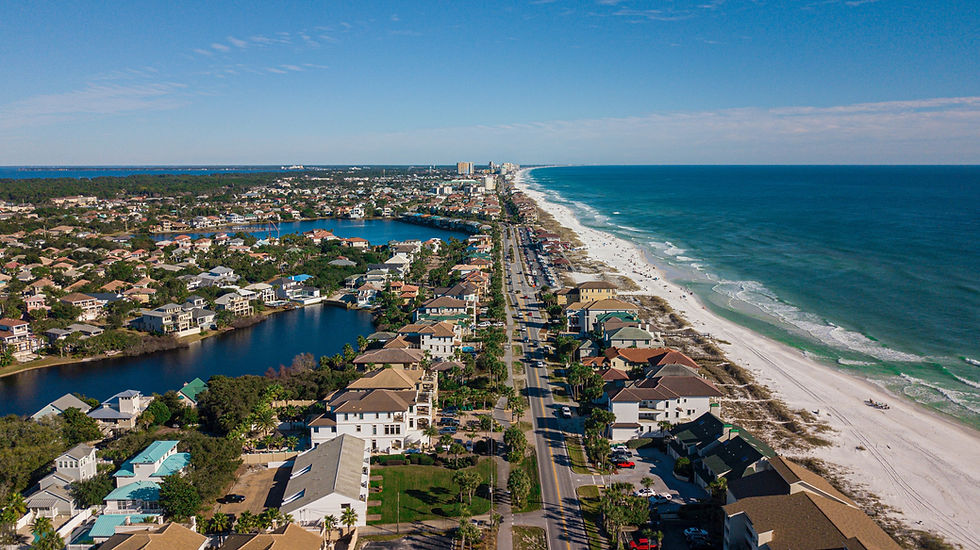
The Emerald Coast (the Panhandle's western beaches). Pensacola Beach through Panama City Beach, including Destin, Miramar Beach, and the entire 30A corridor. Famous for sugar-white Appalachian quartz sand and emerald-green water. A drive-to family-vacation economy with a single dominant summer peak. The most premium, most developed, and most STR-friendly stretch of the Gulf Coast.
The Forgotten Coast (the Panhandle's eastern beaches). Mexico Beach, Cape San Blas, Port St. Joe, Apalachicola, and St. George Island. Old Florida — uncrowded, dog-friendly, anchored by state parks and the wild Apalachicola estuary. Lower density, lighter regulation, a specialty-and-nature guest.
The Big Bend and Nature Coast. Steinhatchee, Cedar Key, Crystal River, and Homosassa — the marsh-and-spring coast where the peninsula curves. Critically, this is not a white-sand beach coast; it is a fishing, scalloping, manatee, and natural-spring economy. A distinct product that should never be marketed as a beach destination.
The Central Gulf Coast and Tampa Bay Beaches. Anna Maria Island, the Pinellas barrier islands (Clearwater Beach, St. Pete Beach, Treasure Island, Madeira Beach, Indian Rocks Beach), and the broader Tampa-St. Petersburg metro beaches. A balanced, year-round, fly-in-and-drive-to market with the most fragmented and restrictive municipal regulatory patchwork on the entire coast.
Southwest Florida and the Paradise Coast. Sarasota and Siesta Key, Venice, Fort Myers Beach, Sanibel and Captiva, Naples, and Marco Island. The affluent, fly-in, snowbird-and-international market — and the one region of the Gulf Coast whose season is inverted, peaking in winter and spring rather than summer.
The rest of this guide takes each region in turn, then layers the cross-cutting frameworks — regulation, taxes, demand, seasonality, performance, and strategy — over the whole coast.
The Emerald Coast: Sugar-White Sand and the Summer-Peak Economy
The Emerald Coast is the most recognized and most premium stretch of the Florida Gulf Coast, and its brand rests on a genuine geological fact. The sand is not crushed shell or coral; it is fine Appalachian quartz, washed down the Apalachicola River system over millennia, producing the squeaky, blinding-white, cool-to-the-touch beaches that define the region. The water reads emerald green because the white quartz bottom reflects sunlight up through clear, low-sediment Gulf water. This sand-and-water combination is the single most valuable marketing asset on the northern Gulf Coast, and it is why the Emerald Coast commands premium rates.
Pensacola Beach and Navarre Beach (Escambia and Santa Rosa Counties). The westernmost Emerald Coast beaches sit on Santa Rosa Island, a barrier island shared with the Gulf Islands National Seashore. Pensacola Beach is anchored by the Pensacola Beach Gulf Pier, the Blue Angels (the Naval Air Station Pensacola flight demonstration squadron, whose air shows drive significant summer demand), and Fort Pickens. Navarre Beach, just east, markets itself as quieter and more family-oriented, with the longest fishing pier in Florida. A regulatory note specific to these beaches: much of Pensacola Beach and Navarre Beach is leasehold land administered by the Santa Rosa Island Authority and the Navarre Beach leaseholds rather than fee-simple ownership — a critical due diligence item for buyers.
Okaloosa Island and Fort Walton Beach (Okaloosa County). Between Navarre and Destin, Okaloosa Island and Fort Walton Beach offer a more value-oriented, family-vacation Emerald Coast experience without the premium associated with Destin or 30A. Anchored by the Gulfarium, the Okaloosa Island Pier, and proximity to Eglin Air Force Base and Hurlburt Field, which add a military-and-government demand layer.
Destin (Okaloosa County). "The World's Luckiest Fishing Village." Destin is the Emerald Coast's deep-water fishing capital, home to the largest charter fishing fleet in Florida, the Destin Harbor and HarborWalk, and the October Destin Fishing Rodeo, a month-long tournament that drives a genuine fall shoulder demand window. Destin's inventory skews toward gulf-front condo towers (the inverse of the single-family-home pattern further east), which shapes both its guest profile and its operating economics. Destin's blended ADR runs lower than the 30A premium tier, but its occupancy depth and brand recognition are among the strongest on the coast.
Miramar Beach and Sandestin (Walton County). Just east of Destin, Miramar Beach and the Sandestin Golf and Beach Resort offer the Emerald Coast's strongest value-and-amenity play — resort-style pools, golf, and the Baytowne Wharf village without the 30A rate ceiling. Miramar Beach is in Walton County, so it operates under Walton County's short-term rental registration program rather than Okaloosa's.
The 30A Corridor (Walton County). Scenic Highway 30A is the most premium stretch of the entire Florida Gulf Coast and one of the most distinctive vacation-rental markets in the country. The corridor is a string of distinct New Urbanist and beach-neighborhood communities, each with its own architectural identity and guest brand: Dune Allen, Santa Rosa Beach, Blue Mountain Beach, Grayton Beach (Old Florida, anchored by Grayton Beach State Park and Western Lake), WaterColor and WaterSound (resort-amenity communities), Seaside (the original New Urbanist town, the filming location of The Truman Show), Seagrove, Seacrest, Alys Beach (the white-walled luxury enclave), Rosemary Beach (the European-village-style luxury community), and Inlet Beach at the eastern end. The 30A corridor is also defined by its 15 rare coastal dune lakes — a globally unusual feature found in only a few places on earth — and its golf-cart culture, walkable town centers, and the Timpoochee Trail bike path. ADR on premium 30A gulf-front homes runs the highest on the northern Gulf Coast, commonly several hundred to well over a thousand dollars per night in peak summer.
Panama City Beach (Bay County). The largest-volume Emerald Coast market and the most complex regulatory environment. PCB offers 27 miles of beach, a high-rise condo-dominated inventory, and a family-vacation-plus-spring-break demand profile that the city has worked to reposition toward families (including spring-break alcohol restrictions on the beach in March). Panama City Beach operates under Bay County and city short-term rental ordinances (including the certificate framework hosts reference as Ordinance 1632), making it the most regulation-heavy Emerald Coast market — verify the current PCB and Bay County registration, certificate, and inspection requirements before operating.
Emerald Coast demand and seasonality. The Emerald Coast is a drive-to market. Its feeder geography is the Southeast interior — Atlanta (roughly 5 hours), Birmingham, Nashville, Memphis, and the broader Tennessee-Georgia-Alabama-Mississippi corridor. Historically nicknamed the "Redneck Riviera" for this drive-to Southern family base, the corridor has moved sharply upscale, particularly along 30A. The season is a single dominant summer peak (Memorial Day through early August), with a fall shoulder driven by the Destin Fishing Rodeo and warm-water "secret season," a snowbird winter (monthly stays), and a spring break and Easter window. The peak-to-trough revenue swing is steep, commonly 3.5 to 4 times.
The Forgotten Coast: Old Florida and the Specialty Guest
East of Panama City Beach, the character of the coast changes completely. The Forgotten Coast — a marketing name embraced by the region itself — is the low-density, undeveloped, Old Florida Panhandle: state parks instead of condo towers, working seafood towns instead of resort villages, and a specialty guest who is there precisely because it is not crowded.
Mexico Beach (Bay County). A small, quiet beach town that was the landfall point of Hurricane Michael in October 2018 (a Category 5 storm that devastated the community) and has been rebuilding since. Mexico Beach markets a low-key, family-and-fishing experience distinct from PCB to its west.
Cape San Blas and Port St. Joe (Gulf County). Cape San Blas is a slender barrier peninsula anchored by the T.H. Stone Memorial St. Joseph Peninsula State Park, with dog-friendly beaches, scalloping season in St. Joseph Bay (roughly mid-August to late September, verify current dates), and a gulf-front-home inventory that commands a high ADR for the region from a fraction of the competition of the Emerald Coast. Port St. Joe is the nearby county-seat service hub. Gulf County operates one of the lightest STR regulatory frameworks on the coast — a DBPR vacation rental license plus a county business license, with no municipal certificate regime — but note that Gulf County does not have a tax-collection agreement with Airbnb or Vrbo, meaning operators must collect and remit the county Tourist Development Tax directly.
Apalachicola, St. George Island, and Carrabelle (Franklin County). Apalachicola is a historic working seafood town at the mouth of the Apalachicola River, famous for its oyster heritage and its preserved 19th-century downtown. St. George Island is the barrier island off Apalachicola, anchored by Dr. Julian G. Bruce St. George Island State Park, and home to a dog-friendly, low-density beach-home inventory. Carrabelle and Alligator Point round out Franklin County's quiet Forgotten Coast beaches. The entire Franklin County market is a nature, heritage, and fishing economy — the Apalachicola Bay estuary is one of the most productive in North America.
Forgotten Coast demand and seasonality. The Forgotten Coast draws the same Southeast drive-to feeder geography as the Emerald Coast, plus a meaningful nature tourism and dog-friendly travel segment. Its seasonality leans toward spring and fall (mild weather, scalloping, paddling, birding) alongside summer, with a quiet winter. The investment thesis is comparable rates to the Emerald Coast at a lower acquisition cost, offset by higher hurricane exposure, thinner year-round demand, and more remote operations.
The Big Bend and Nature Coast: The Coast Without a Beach Brand
Where the Florida peninsula curves from its Panhandle east-west orientation to its north-south orientation lies the Big Bend, also called the Nature Coast — and this region requires a critical reframing for any operator. This is not a sugar-white-beach coast. It is a salt marsh, seagrass, natural spring, and river-mouth coast, and marketing a Nature Coast rental as a beach destination sets guest expectations that the geography cannot meet.
Steinhatchee (Taylor and Dixie Counties). A small fishing-and-scalloping village at the mouth of the Steinhatchee River, drawing anglers and summer scallopers to the seagrass flats of the Big Bend.
Cedar Key (Levy County). A historic island fishing village and artist community, accessible by causeway, known for clamming, birding, and an Old Florida pace entirely unlike the rest of the Gulf Coast. A specialty heritage-and-nature destination.
Crystal River and Homosassa (Citrus County). The manatee capital of Florida — the springs of Kings Bay and the Crystal River National Wildlife Refuge draws a globally significant manatee-tourism economy, with winter (when manatees congregate in the warm springs) as the peak season. This is a spring-and-wildlife economy, not a beach economy.
Nature Coast demand and seasonality. The Nature Coast is a fishing, scalloping, manatee, paddling, and natural-spring market. Summer scalloping season and winter manatee season produce two distinct peaks driven entirely by the natural calendar. The guest is a nature-and-outdoor-recreation traveler, not a beach-vacation family. An operator in this region wins by leaning fully into the spring, river, and wildlife positioning — never by pretending to be a beach.
The Central Gulf Coast and Tampa Bay Beaches: The Year-Round Market and the Regulatory Patchwork
The barrier-island beaches of the Tampa Bay metro and the Sarasota-Manatee line represent the Gulf Coast's most balanced demand and its most fragmented regulation. Sand here transitions: the famously fine white quartz of Siesta Key (regularly ranked among the best beaches in the United States) gives way to the shell-and-quartz mixes of the Pinellas beaches.
Anna Maria Island (Manatee County). A seven-mile barrier island comprising three communities — Anna Maria, Holmes Beach, and Bradenton Beach — that has cultivated an Old Florida, low-rise, family-friendly brand and is one of the strongest dedicated vacation-rental markets on the central coast. Anna Maria Island has also been a focal point of Florida's STR regulatory tension, with municipalities (particularly Holmes Beach) pursuing registration and rental-standards programs; verify current municipal STR rules before operating.
The Pinellas County beaches (Tampa-St. Petersburg metro). A 35-mile string of barrier-island beach towns: Clearwater Beach (the highest-profile, a major tourism anchor), St. Pete Beach, Treasure Island, Madeira Beach, Redington Beach, Indian Rocks Beach, Indian Shores, and Pass-a-Grille. This is the most regulatorily fragmented market on the Gulf Coast — each municipality sets its own short-term-rental rules, and several Pinellas beach communities impose minimum-rental-duration requirements (in some residential zones, minimum stays of 30 days or longer, or limits on rental frequency) that effectively prohibit traditional nightly short-term rentals. The Pinellas regulatory patchwork is the single most important due diligence item on the central coast: two properties a mile apart can be subject to completely different rental rules.
Central Coast demand and seasonality. The Tampa Bay beaches are the Gulf Coast's most balanced year-round market, drawing fly-in traffic through Tampa International (TPA) and St. Pete-Clearwater (PIE), drive-to traffic from across Florida and the Southeast, a winter snowbird layer, a summer family layer, and a substantial international and convention-spillover segment. This balance produces steadier occupancy than the single-peak Panhandle.
Southwest Florida and the Paradise Coast: The Inverted-Season Luxury Market
The southwest Florida coast — the Paradise Coast — is the affluent, fly-in, snowbird-and-international counterpart to the drive-to Panhandle, and its defining strategic feature is that its season is inverted. Where the Emerald Coast peaks in July, the Paradise Coast peaks from January through April, when northern snowbirds, international visitors, and spring-season travelers fill the market, and summer (hot, humid, and storm-prone) becomes the softer shoulder.
Sarasota, Siesta Key, Lido Key, and Longboat Key (Sarasota and Manatee Counties). Sarasota anchors the upper Paradise Coast with an arts-and-culture brand. Siesta Key's Crystal Beach is famous for its 99%-pure quartz sand and is regularly ranked the best beach in the United States. Lido Key and Longboat Key add upscale barrier-island inventory. Sarasota County imposes minimum-rental-duration rules in many zones (commonly one-week or one-month minimums depending on zoning), a critical constraint on nightly STR operation.
Venice, Nokomis, and Casey Key (Sarasota County). Quieter, more residential beach communities south of Sarasota, Venice, known for its shark-tooth-hunting beaches and a more retiree-oriented demographic.
Fort Myers Beach, Sanibel, and Captiva (Lee County). Fort Myers Beach (on Estero Island) and the shelling-famous islands of Sanibel and Captiva were among the hardest-hit areas of Hurricane Ian in September 2022 and have been in extended recovery and rebuilding; any investment or operating analysis here must account for the post-Ian rebuilding trajectory, insurance environment, and changed inventory. Sanibel and Captiva are nationally famous for shelling and the J.N. "Ding" Darling National Wildlife Refuge.
Naples, Marco Island, and Bonita Springs (Collier and Lee Counties). The luxury anchor of the entire Gulf Coast. Naples combines high-end beaches, the Naples Pier, world-class golf, and an affluent fly-in-and-second-home market. Marco Island is a large barrier island south of Naples with a resort-and-residential profile. Collier County and the City of Naples impose meaningful short-term rental restrictions in many areas (including minimum rental and registration requirements); verify current Collier County and Naples rules, which are among the most restrictive on the coast.
Paradise Coast demand and seasonality. The Paradise Coast is a fly-in market (Southwest Florida International / RSW in Fort Myers, Sarasota-Bradenton / SRQ, and Naples) drawing affluent Midwest and Northeast snowbirds, international travelers, and a substantial second-home and luxury segment. Its winter-and-spring peak inverts the Panhandle calendar — a fact that makes a two-region Florida Gulf Coast portfolio (one Panhandle property, one Paradise Coast property) a genuinely counter-seasonal hedge.
The Regulatory Map: Florida's Preemption Framework and the County Patchwork
Florida short-term rental regulation is uniquely structured, and understanding it is essential to any Gulf Coast investment. The framework is a two-layer system: a state preemption law on top, and a fragmented patchwork of local ordinances beneath it.
The state preemption framework. Florida law preempts local governments from prohibiting short-term rentals outright or from regulating the duration or frequency of rentals — but this preemption is anchored to a grandfather date. Local rental-regulation ordinances adopted on or before June 1, 2011, are generally grandfathered and remain enforceable (which is why some municipalities, particularly older beach towns, can impose minimum-rental-duration rules that newer ordinances could not), while local governments are otherwise limited in their ability to ban or restrict rental duration. Local governments retain authority to require registration, licensing, inspections, and to enforce noise, parking, occupancy, and life-safety standards through generally applicable ordinances. This is why the regulatory experience varies so dramatically across the coast: a grandfathered Pinellas beach town can require a 30-day minimum stay, while Walton County cannot impose such a duration limit but can run a registration-and-certificate program.
The state has repeatedly considered legislation to create a statewide vacation-rental registry and standardize the framework (the SB 280 vacation-rental bill is the most prominent recent example). The status and content of statewide STR legislation change from session to session — verify the current state of Florida STR law before relying on any specific statutory claim, as this is one of the most actively legislated areas affecting Gulf Coast operators.
The Florida DBPR vacation rental license. Statewide, properties rented more than three times per year for periods of less than 30 days, or advertised as such, generally require a vacation rental license from the Florida Department of Business and Professional Regulation (DBPR), in addition to any local requirements. This is the baseline statewide license that sits beneath all the local frameworks.
The county-by-county reality (Emerald and Forgotten Coast). Walton County (Miramar Beach and the 30A corridor) runs a short-term rental registration program with an annual certificate, a responsible-party requirement, and life-safety standards. Okaloosa County (Destin, Fort Walton Beach, Okaloosa Island) runs a size-tiered registration framework. Bay County and the City of Panama City Beach run the most regulation-heavy Emerald Coast framework, including the certificate regime, referenced as Ordinance 1632. Gulf County (Cape San Blas, Port St. Joe, Mexico Beach areas within the county) is among the lightest — a DBPR license plus a county business license with no municipal certificate regime. Franklin County (Apalachicola, St. George Island) is similarly light-touch. Escambia and Santa Rosa Counties (Pensacola Beach, Navarre Beach) add leasehold land considerations on top of standard requirements.
The county-by-county reality (Central and Southwest Coast). This is where regulation tightens sharply. Many Pinellas County beach municipalities, Sarasota County, Collier County, and the City of Naples enforce minimum-rental-duration requirements (frequently grandfathered under the 2011 preemption date) that restrict or prohibit traditional nightly short-term rentals in residential zones. Manatee County's Anna Maria Island municipalities run registration-and-standards programs. The practical rule for the central and southwest coast: never assume a property can operate as a nightly STR until you have verified the specific municipality's and zone's rules, because the answer changes block by block.
The Tax Stack: What Guests Actually Pay
Florida Gulf Coast short-term rentals carry a layered tax stack that operators must collect and remit. Verify all current rates, as county rates change: 6% Florida state sales tax on transient rentals (collected on all short-term stays); a county discretionary sales surtax (varies by county, commonly 0.5% to 1.5%); and a county Tourist Development Tax (TDT), or "bed tax" (commonly 5%, in some counties up to 6%), levied on transient accommodations to fund local tourism.
The combined guest-paid tax rate typically ranges from 11% to 13%, depending on the county. Walton County (30A) runs approximately 12% combined; Gulf County (Cape San Blas) approximately 11%. Critically, the collection mechanics vary: Airbnb and Vrbo collect and remit Florida state sales tax on the operator's behalf and have agreements with many counties to collect the county TDT — but not all counties. Notably, Gulf County does not have a platform TDT collection agreement, so operators there must collect and remit the county bed tax directly. Always verify which taxes your booking platforms collect for your specific county and which you are responsible for remitting yourself.
Demand Drivers and Feeder Markets Across the Coast
The Florida Gulf Coast is fed by two fundamentally different traveler flows, split roughly at the Big Bend.
The northern Gulf Coast is a drive-to market. The Emerald Coast and Forgotten Coast draw overwhelmingly from the Southeast interior — Atlanta, Birmingham, Nashville, Memphis, and the Tennessee-Georgia-Alabama-Mississippi corridor — by car, for week-long family beach vacations. Drive-to economics shape everything: the seven-night Saturday-to-Saturday booking pattern, the multi-generational family guest, the summer peak aligned to school calendars, and the sensitivity to fuel prices and drive distance.
The southern Gulf Coast is a fly-in market. The Paradise Coast and Tampa Bay beaches draw from the Midwest and Northeast by air (through RSW, SRQ, TPA, PIE, and Naples), plus international travelers and a large second-home and snowbird segment. Fly-in economics shape the inverted winter peak, the longer average stays (snowbirds book monthly), the higher willingness to pay at the luxury tier, and the year-round balance of the Tampa Bay market.
The cross-cutting segments. Snowbirds (winter monthly stays, strongest on the Paradise Coast but present coast-wide), spring break (the Panhandle's March window, with Panama City Beach the historic anchor now repositioned toward families), the sugar-sand brand traveler (drawn specifically by the white-quartz beaches of the Emerald Coast and Siesta Key), the dog-friendly traveler (Cape San Blas, the Forgotten Coast, St. George Island), and the nature-and-wildlife traveler (the Nature Coast manatee and scalloping economy).
Seasonality: The Inverted Coast
The single most important strategic insight about the Florida Gulf Coast — and the one most often missed — is that its two ends run on opposite calendars.
The northern Gulf Coast peaks in summer. The Emerald Coast and Forgotten Coast see their peak season from Memorial Day through early August, driven by drive-to family beach vacations aligned with the school calendar. Their winter is the structural trough, partially smoothed by snowbird monthly stays. Peak-to-trough revenue swings of 3.5 to 4 times are typical.
The southern Gulf Coast peaks in winter and spring. The Paradise Coast (Naples, Marco Island, Sanibel, Sarasota, Fort Myers Beach) runs its dominant peak from January through April, driven by snowbirds and seasonal residents escaping northern winters, with summer (hot, humid, and in hurricane season) as the softer shoulder, partially supported by lower-rate family and regional travel.
The beaches in Tampa Bay are the most balanced. The central coast blends a winter snowbird peak, a summer family peak, and year-round fly-in and international demand into the steadiest occupancy curve on the Gulf Coast.
The Nature Coast runs on the wildlife calendar. The Big Bend peaks twice — summer scalloping season and winter manatee season — on a calendar driven entirely by the natural world rather than the school or snowbird patterns.
The portfolio implication is significant: an operator who holds one Emerald Coast property and one Paradise Coast property owns a genuinely counter-seasonal pair, with the Panhandle property carrying the summer and the southwest property carrying the winter — a structural hedge unavailable to single-region operators.
Performance Benchmarks by Sub-Market
The following ranges are directional and source-dependent; verify current AirDNA, AirROI, or Rabbu data for any specific market before financial modeling. They are included to convey relative position, not precise values. The 30A premium corridor (Walton) carries the highest ADR on the northern Gulf Coast, with premium gulf-front homes commonly several hundred to well over $1,000 per night in peak summer. Destin (Okaloosa) offers strong brand and occupancy depth on condo-weighted inventory with a blended ADR below the 30A premium tier. Miramar Beach / Sandestin (Walton) is the Emerald Coast value-and-amenity tier. Panama City Beach (Bay) is the highest-volume Emerald Coast market, high-rise-condo-weighted, with family and spring-break demand. Cape San Blas and the Forgotten Coast (Gulf, Franklin) offer comparable rates to the Emerald Coast at lower acquisition cost, with higher hurricane exposure and thinner year-round demand.
On the central and southern coast, Anna Maria Island (Manatee) is a strong, dedicated vacation-rental market. Siesta Key and Sarasota (Sarasota) form a premium central-coast beach market constrained by minimum-rental-duration rules in many zones. Naples and Marco Island (Collier) are the luxury tier of the entire coast, winter-peaked, with meaningful rental restrictions in many areas. The Tampa Bay beaches (Pinellas) offer balanced year-round demand under a fragmented municipal regulation that varies block by block.
The Investment and Strategy Synthesis
Pulling the entire coast together yields a few strategic conclusions that apply across the Gulf of Florida.
Regulation is now a primary investment variable. The single largest difference between two otherwise similar Gulf Coast beach properties is often regulatory: a Walton County 30A home operates under a clear, host-friendly registration program, while a Pinellas beach condo a few hundred miles south may be entirely barred from nightly rental by a grandfathered minimum-stay ordinance. Verify the regulatory framework before the rate and occupancy, because regulation determines whether the rate and occupancy are even achievable.
Hurricane exposure and the insurance environment are coast-wide underwriting factors. Hurricane Michael (2018, Mexico Beach and the Panhandle), Hurricane Ian (2022, Fort Myers Beach, Sanibel, and southwest Florida), and Hurricane Idalia (2023, the Big Bend) are recent reminders that the entire Gulf Coast carries tropical-storm exposure, and Florida's property-insurance market has been under severe stress. Wind and flood insurance costs — and their availability — must be underwritten before, not after, the revenue projection. A property that pencils on gross revenue alone can fail entirely on insurance costs.
The tier structure runs the length of the coast. Every region offers a premium tier (30A, Naples, Siesta Key), a value tier (Okaloosa Island, Miramar Beach, the Forgotten Coast, parts of Pinellas), and a specialty tier (dog-friendly Cape San Blas, the Nature Coast, the arts-and-culture Sarasota market). Match your investment thesis and operating capacity to the tier, not to the region.
Counter-seasonal diversification is uniquely available here. Because the Florida Gulf Coast contains both a summer-peak northern market and a winter-peak southern market, it is one of the only coastlines in the country where an operator can build a genuinely counter-seasonal two-property portfolio within a single state.
What This Means for Marketing Your Florida Gulf Coast Rental
The coast's strategic diversity translates directly into marketing strategy. A successful Florida Gulf Coast listing is built around the specific identity of its sub-market, not a generic "Florida beach" frame: the sugar-white sand and emerald water and named-community brand (Seaside, Rosemary Beach, Grayton) on the Emerald Coast; the dog-friendly, uncrowded, Old Florida positioning on the Forgotten Coast; the manatee-spring-and-scalloping nature positioning on the Big Bend; the year-round, walkable, Old-Florida-island positioning on Anna Maria; and the luxury, fly-in, winter-season positioning on the Paradise Coast. The seasonal listing strategy must match the region's actual calendar — leading with summer family on the Panhandle and with snowbird-season luxury on the Paradise Coast.
And the compliance framing — accurate, jurisdiction-specific, certificate-referenced — has become a genuine trust signal as guests grow more aware of STR regulatory uncertainty.
Crest & Cove Creative builds market-specific marketing systems for independent short-term rental operators across the Florida Gulf Coast — visual-first photography and listing optimization, Google Vacation Rentals and OTA distribution, and independent direct-booking sites — anchored in the sub-market identity that makes each property distinct. The Gulf Coast rewards operators who understand exactly which of its five coasts they are in; our work is building the marketing that reflects that understanding.
Keep going on Crest & Cove: Destin against AirROI, not leftover year · Santa Rosa Beach against AirROI · Cape San Blas against AirROI · the Crest & Cove intro · local SEO keywords that actually book · the five elements of a converting hero · how to compare STR marketing agencies · Pensacola Beach against AirROI.
Frequently Asked Questions
How long is the Florida Gulf Coast, and how many distinct beach economies does it contain?
Roughly 770 miles from Pensacola to the tip of the peninsula, containing at least five structurally distinct beach economies, each with its own sand, water, guest base, seasonal curve, and regulatory framework. A generic 'Florida beach' marketing frame misreads all five of them.
What are the five regions of the Florida Gulf Coast?
The Emerald Coast (Pensacola Beach through Panama City Beach and 30A), the Forgotten Coast (Mexico Beach, Cape San Blas, St. George Island), the Big Bend and Nature Coast, the Central Gulf Coast and Tampa Bay beaches, and Southwest Florida's Paradise Coast, each a fundamentally different product with its own identity and demand curve.
Why is treating the Florida Gulf Coast as one market a mistake?
Because the Panhandle peaks in summer while the Paradise Coast peaks in winter, Walton County welcomes short-term rentals while many Pinellas County beach towns restrict them sharply, and sugar-white quartz sand in the north gives way to shell-and-mangrove barrier islands in the south. A single coast-wide pricing or compliance assumption breaks in at least one of those directions.
What defines the Emerald Coast sub-market?
Sugar-white Appalachian quartz sand and emerald-green water anchoring a drive-to family-vacation economy with a single dominant summer peak, the most premium, developed, and STR-friendly stretch of the Gulf Coast. Demand layers snowbirds, spring break, the sugar-sand brand traveler, and the dog-friendly traveler drawn to nearby Cape San Blas on top of that core summer season.
What defines the Forgotten Coast sub-market?
Old Florida character across Mexico Beach, Cape San Blas, and St. George Island, uncrowded, dog-friendly, anchored by state parks and the wild Apalachicola estuary, with lower density and lighter regulation than the Emerald Coast just to its west.
Why is Pinellas County the most regulatorily fragmented part of the Gulf Coast?
Each municipality sets its own short-term-rental rules, and several Pinellas beach communities impose minimum-rental-duration requirements, in some residential zones, minimum stays of 30 days or longer, or limits on rental frequency, that effectively prohibit traditional nightly short-term rentals. That makes Pinellas the most regulatorily fragmented market on the entire Gulf Coast.
What do guests actually pay in taxes on Florida Gulf Coast rentals?
A layered tax stack: 6% Florida state sales tax, plus a county discretionary sales surtax, plus a county bed tax that varies by jurisdiction. The combined guest-paid rate typically runs 11% to 13% depending on the county, with Walton County (30A) at roughly 12% and Gulf County (Cape San Blas) at roughly 11%.
Why does the Paradise Coast run an inverted season compared to the rest of the Gulf Coast?
Where the Emerald Coast peaks in July, Southwest Florida's Paradise Coast, Naples, Marco Island, Sarasota, and the surrounding barrier islands, peaks from roughly January through April, driven by affluent snowbird and international fly-in demand through Southwest Florida International, Sarasota-Bradenton, and Naples airports rather than a drive-to summer family crowd.
How did Hurricane Ian affect Fort Myers Beach, Sanibel, and Captiva?
Fort Myers Beach, on Estero Island, along with the shelling-famous islands of Sanibel and Captiva, were among the hardest-hit areas of Hurricane Ian in September 2022 and have been in extended recovery and rebuilding since. Any investment or listing decision in these specific markets should account for that ongoing rebuild timeline rather than treating them as fully recovered by default.
Related Reading
Keep reading on same-cluster Crest & Cove pages that stay on labeled local lines without costume-corridor copy.
How to Choose a Vacation Rental Photographer in Florida Gulf Coast St
Central Florida Non Disney DIY Ceiling: AirROI Pins, Not Leftover
How to Market a Short-Term Rental in Grayton Beach FL Old Florida
How to Market a Short-Term Rental in Homosassa FL the Quiet Manatee
How to Market a Short-Term Rental in Cedar Key FL the No Chains Old
Central Florida Lake Country Report: AirROI Pins, Not Leftover
Florida Nature Coast STR Market Report for Independent Hosts
Is an STR Marketing Agency Worth It for Northeast Florida Hosts
Is an STR Marketing Agency Worth It for South Florida the Florida
Is an STR Marketing Agency Worth It for Southwest Florida Naples
Florida Vacation Rental Marketing: A Role Map, Not a Ranked List
Florida Short-Term Rental Marketing Beyond the Trophy Coasts
Work with Crest & Cove Creative
A single Gulf Coast marketing template can't cover this region. Walton County peaks in July while Naples peaks in January, and some Pinellas towns require 30-night minimums that block nightly stays entirely.
We write market-specific listing copy for each Gulf Coast town's own season and tax stack, instead of one Florida-wide script. Send us the listing and we'll rebuild the calendar and pricing story around this county's own numbers.
Reach out at crestcove.co or (256) 998-7502.


Comments