
Reading the Whitefish Flathead Lake, MT Short-Term Rental Market in 2026

Updated: Aug 27
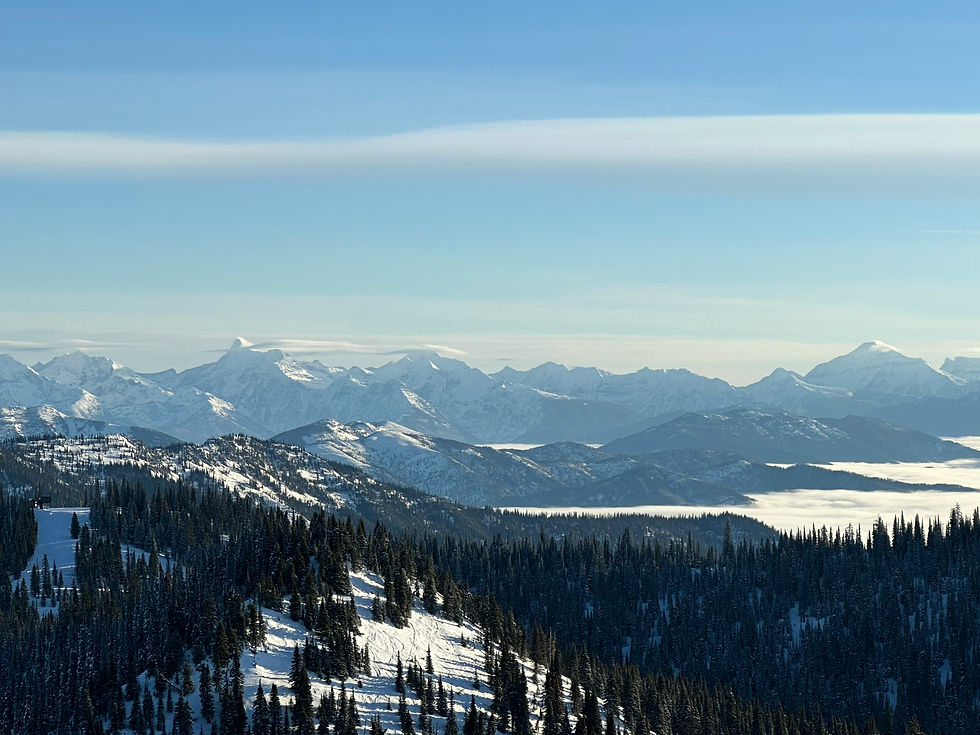
Most short-term rental markets in the United States run on one dominant season, maybe two if a host is lucky. Northwest Montana's Whitefish and Flathead Lake corridor runs on two , and unlike a lot of two-season markets, they reinforce each other instead of competing for the same calendar. A summer engine combines Glacier National Park tourism with lake boating season, and a separate winter engine belongs entirely to Whitefish Mountain Resort's ski calendar. Glacier's west entrance sits a half-hour from downtown Whitefish and pulls in millions of visitors chasing Going-to-the-Sun Road and alpine lakes, and that same June-through-September window is peak season for boating on both Whitefish Lake , the smaller lake Whitefish itself sits on , and Flathead Lake, the much larger lake (the largest natural freshwater lake west of the Mississippi) roughly 40 minutes south near Somers, Lakeside, Bigfork, and Polson, where dock access and lake proximity command a premium that has nothing to do with park visitation. Winter belongs entirely to Whitefish Mountain Resort, whose ski crowd books on a completely different calendar, length-of-stay pattern, and price sensitivity than the summer visitor.
That two-engine structure , a reinforced summer surge plus a wholly separate winter surge , is still less common than the single-season markets most STR Keep-ups cover, and it's why this corridor deserves a longer look than the standard "mountain town STR market" treatment. It's also a market with real regulatory teeth that varies block by block depending on whether a property sits inside Whitefish city limits, in unincorporated Flathead County, or inside a covenant-restricted subdivision , a distinction that recently cost one Flathead County owner their short-term rental use entirely in Montana's highest court. Below is what the data actually shows for Whitefish, Bigfork, and Columbia Falls heading into the 2026 season, along with the regulatory landscape operators need to understand before buying or listing.
Two Demand Engines, Not Three
The Summer Engine: Glacier National Park and Lake Season
Glacier National Park closed out 2025 with an estimated 3,136,931 visitors , its third-busiest year on record and the second consecutive year over the 3-million mark, a threshold the park has only crossed five times in its 115-year history. The park's West Entrance, the gateway most directly tied to Whitefish and Columbia Falls traffic, logged more than 1.63 million vehicles on its own in 2025. That's the single biggest demand engine in the entire corridor: national and international visitors booking multi-night stays timed to the Going-to-the-Sun Road season, which typically runs roughly Memorial Day through mid-October depending on snowpack.
Lake season runs on the same calendar and reinforces park traffic rather than competing with it. Whitefish itself sits on its own, much smaller Whitefish Lake , a popular local boating and beach spot inside city limits, and a genuinely different body of water from Flathead Lake, the much larger lake (and the largest natural freshwater lake west of the Mississippi) roughly 40 minutes south near Somers, Lakeside, Bigfork, and Polson. Both lakes see their heaviest boating traffic June through September, the same window as Glacier's peak season, so the corridor doesn't really have a gap between "park tourism" and "lake tourism" , it's one long, mutually reinforcing summer surge that shows up in both occupancy and rate.
This combined summer guest is a fundamentally different booker than the ski crowd , longer average length of stay, more families and multi-generational groups, heavier reliance on rental cars and gear storage, and a booking window that opens months in advance given the park's own timed-entry and lodging constraints.
The Winter Engine: Whitefish Mountain Resort's Ski Calendar
Whitefish Mountain Resort just wrapped its 2025-26 season with roughly 457,000 skier visits , its fifth-busiest winter ever, even with total snowfall landing at 207 inches against a typical seasonal average closer to 300 inches. The resort still kept over 90% of its terrain open through the season, and its busiest single day (December 27, 2025) drew more than 9,600 skier visits.
The ski guest profile diverges sharply from the summer visitor: shorter average trips, weekend and holiday-week concentration (Christmas/New Year's, MLK, Presidents' Day), higher price tolerance for ski-in/ski-out or near-mountain proximity, and a booking curve that skews later and more weather-reactive than the summer booking window. A property optimized purely for summer Glacier and lake traffic will miss this pattern entirely if its listing, photos, and pricing calendar aren't rebuilt for winter.
Flathead Lake's Waterfront Economics
Beyond timing, Flathead Lake adds a distinct value layer to the summer engine rather than a calendar of its own , its premium shows up in rate, not in a booking window separate from the broader summer surge. Waterfront and near-water properties around the lake (concentrated around Bigfork, Lakeside, Somers, and Polson) carry a real price premium over inland comparables, driven by dock access, private beach frontage, and lake views rather than proximity to either the park or the ski hill. On the real estate side, that premium is stark: the median price for Flathead Lake waterfront homes was around $1.79 million in 2025, with many active 2026 listings priced in the $2-3 million range and the average lakefront asking price around $3 million , premium land economics that flow directly into nightly rate potential for lake-adjacent STRs, even as they raise the acquisition bar considerably.
Submarket Breakdown: Whitefish, Bigfork, and Columbia Falls
Whitefish Town & Resort , The Highest-Amenity, Highest-Visibility Play
Whitefish itself is the corridor's flagship submarket: walkable downtown, direct resort proximity, Amtrak stop, and the deepest concentration of dining, retail, and guest-facing infrastructure. It's also the most tightly regulated submarket in this report (more below) and, by the numbers, the most saturated. Third-party STR data trackers show meaningfully different figures depending on methodology , AirROI puts Whitefish's average daily rate around $466 with roughly 40% occupancy across an estimated 1,050 listings (AirROI Whitefish as of 2026-07-31); AirDNA's Market Minder data shows a higher $563 average daily rate with about 52% occupancy; StaySTRA reports a lower $390 ADR but higher 60% occupancy. All three agree on the underlying trend: active supply grew sharply , AirROI cites 47.4% year-over-year growth , while revenue and nightly rates have continued trending upward rather than getting diluted, suggesting demand is still absorbing new inventory. July is consistently cited as the strongest month for occupancy, April as the softest (the mud-season gap between ski closing and Going-to-the-Sun Road opening).
Bigfork & Lakefront , The Waterfront-Premium Play
Bigfork sits directly on Flathead Lake's northeast shore and is the corridor's clearest lakefront-premium submarket. Rabbu's data shows roughly 78 active Airbnb listings in Bigfork carrying a $290 average daily rate and about $45,273 in average annual revenue , but occupancy is notably softer than Whitefish, sitting around 25% versus a cited Montana statewide average near 47%. Occupancy varies significantly by unit size: 2-bedroom properties perform best around 38%, while studios (13%) and 4-bedroom units (11%) lag well behind. Seasonality is sharp and concentrated , June through August is peak, with July averaging roughly $9,620 in monthly revenue per listing, August around $8,006, and June around $5,163. Supply growth here is the most aggressive in the corridor: active listings reportedly surged 167% year-over-year, a pace that outstrips Whitefish's already-fast growth and raises real questions about occupancy compression if visitor demand doesn't scale proportionally. Combined with median home values above $1.4 million in the immediate area, Bigfork is a premium-rate, premium-cost, occupancy-constrained submarket best suited to well-differentiated, genuinely waterfront or water-view properties rather than generic inland listings riding the Bigfork name.
Columbia Falls , The Value Entry Point
Columbia Falls, sitting closest to Glacier's West Entrance along US-2, is the corridor's most accessible entry point by both price and occupancy. Reported figures vary by source and time window, but converge on a healthier occupancy story than Bigfork: figures range from roughly 50% to 61% occupancy with average daily rates in the mid-$300s (sources cite figures between $335 and $354) and average annual revenue in the low-$30,000s per listing. Supply grew about 35.2% year-over-year , still fast, but slower than Bigfork or Whitefish , and, notably, one source characterizes Columbia Falls' regulatory environment as comparatively low-friction with minimal registration requirements, which tracks with its position in unincorporated Flathead County outside Whitefish's city permit system (though operators should verify parcel-specific zoning directly with the county, not assume blanket permissiveness , see below). Columbia Falls is the corridor's clearest value-and-volume play: lower acquisition costs, strong occupancy tied directly to Glacier's West Entrance traffic, and a shorter, simpler regulatory path than Whitefish city limits.
The Regulatory Picture: A Genuine Patchwork
This is the part of the market that gets glossed over in generic Keep-ups, and it matters more here than in most STR markets because the rules genuinely differ by jurisdiction and even by subdivision.
Inside Whitefish city limits, short-term rentals require a formal Short-Term Rental Permit and Business Registration through the City of Whitefish, and are only allowed in specific zoning districts , WB-3, WRR-1, WRR-2, WRB-1, and WRB-2. Permitted properties must pass an initial and then annual Fire Marshal inspection, provide proof of a State of Montana public accommodation license (the "tourist home" designation), and register separately for the city's resort tax. Whitefish also levies a 3% local resort tax on lodging on top of Montana's 8% state lodging/sales tax combination, putting the effective lodging tax burden around 11% , and critically, Airbnb and Vrbo collect and remit the state's 8% automatically but donotcollect Whitefish's 3% resort tax, meaning hosts are responsible for registering and filing that portion themselves monthly.
Outside city limits, in unincorporated Flathead County, the rules run through the Flathead County Zoning Regulations (and, in the canyon corridor near the park, a separate set called the Canyon Area Land Use Regulations). Most zoning districts require an administrative conditional use permit to operate an STR , a process that can take up to six weeks and includes notification to neighbors within 150 feet and a roughly two-week comment period. A smaller set of districts (including RR, B-2, B-4, BM-1, BM-2, BR-2, BR-4, CVR, SC, and NF) allow STRs as a permitted use without that extra step. The county has also been actively tightening rules: draft regulations cap most agricultural and lower-density residential zones at no more than two short-term rentals per property, add quiet-hours and off-street parking requirements, restrict signage to one square foot, and give the county authority to suspend or revoke permits administratively.
Subdivision covenants are the wildcard, and they're not theoretical here.In *Brandt v. R&R Mountain Escapes, LLC*, decided by the Montana Supreme Court on July 22, 2025, the court ruled that a Flathead County subdivision's 1990-era covenants , which required "country residential living" and barred commercial activity , unambiguously prohibited short-term rentals, even though the covenants never used the words "short-term rental" directly. This decision sits alongside the court's 2020 ruling in *Craig Tracts v. Brown Drake*, where a bare "residential purpose only" covenant was found ambiguous and didnotbar STR use. The practical takeaway for buyers: covenant language matters enormously, a property's zoning approval does not override a restrictive HOA or subdivision covenant, and any Flathead County purchase intended for STR use needs its actual recorded covenants read in full , not just its zoning designation , before closing.
On taxes, Montana's property tax structure is shifting for 2026 under HB 231 and SB 542: second homes and short-term rentals are taxed at a flat rate of 1.90% of assessed value, while primary residences and long-term rentals (occupied at least seven months of the year) qualify separately as "homesteads" and get a tiered rate that starts at 0.76% and only climbs to that same 1.90% on the portion of a property's value above roughly four times the statewide median residential value. In practice, that means an STR carries a meaningfully higher effective property tax rate than a comparable long-term rental or primary residence next door , a change operators and buyers should factor into acquisition underwriting alongside the lodging/resort tax stack described above.
What This Means for Operators
The two-engine structure is this market's biggest structural advantage and its biggest operating complexity. A listing built only around the summer Glacier-and-lake surge is leaving a real winter ski-market rate premium on the table; a listing pitched purely to skiers misses a much larger, longer-staying summer audience. The corridor rewards operators who actually rebuild their listing positioning, photography, and pricing calendar twice a year rather than running one static strategy , and, in the Bigfork submarket specifically, rewards genuine waterfront differentiation over generic "near the lake" claims, given how directly dock access and lake frontage show up in both real estate pricing and STR rate potential. Fast year-over-year supply growth across all three submarkets , most aggressively in Bigfork , means the corridor is getting more competitive by the month, which raises the bar on direct-booking visibility and differentiated positioning rather than relying on platform search alone.
the Crest & Cove intro·local SEO keywords that actually book·the five elements of a converting hero·how to compare STR marketing agencies·Asheville paddling spots worth the drive·Montana gateways against AirROI pins·Destin against AirROI, not leftover year·Livingston against AirROI $32,534.
Related Reading
Keep reading in the Whitefish market spine and nearby towns in the same region: same-cluster pages hosts can use without costume-corridor copy.
Is Whitefish Flathead a Good Short Term Rental Investment in 2026
Is an STR Marketing Agency Worth It for Whitefish Flathead Hosts
DIY vs Hire Marketing for Should Whitefish Flathead Lake Hosts Manage
DIY vs Hire Marketing for Should Red Lodge Hosts Manage Their Own STR
DIY vs Hire Marketing for Should Livingston Hosts Manage Their Own
Wyoming Independent Yellowstone Wind River Gateways STR Market Report
Frequently Asked Questions
Is Whitefish, Montana a good market for short-term rental investment in 2026?
Whitefish offers a two-engine demand base, a reinforcing summer surge from Glacier National Park traffic plus boating season on both Whitefish Lake and Flathead Lake, and a separate winter engine from Whitefish Mountain Resort's ski season. It's also seeing fast supply growth, reported around 47% year-over-year though third-party trackers vary, and requires a city permit, zoning compliance, a Fire Marshal inspection, and a state public accommodation license. It rewards well-differentiated, well-permitted properties more than generic entries chasing the market's reputation alone.
Do I need a permit to operate a short-term rental in Whitefish city limits?
Yes. The City of Whitefish requires a Short-Term Rental Permit and Business Registration, and STRs are only allowed in specific zoning districts: WB-3, WRR-1, WRR-2, WRB-1, and WRB-2. Properties must pass an initial and then annual Fire Marshal inspection, and the owner must show proof of a Montana public accommodation, or 'tourist home,' license.
What taxes apply to a Whitefish short-term rental?
Montana's state lodging/sales tax of 8% is generally collected and remitted automatically by platforms like Airbnb and Vrbo. Whitefish's separate 3% resort tax on lodging is not collected by those platforms, so hosts must register with the city and file resort tax returns monthly themselves. Combined, that puts the effective lodging tax burden around 11% within city limits.
Are short-term rentals allowed in unincorporated Flathead County outside Whitefish?
It depends on the specific zoning district. Most districts require an administrative conditional use permit, a process that can take up to about six weeks and includes a neighbor notification and comment period within 150 feet. A smaller set of districts, including RR, B-2, B-4, BM-1, BM-2, BR-2, BR-4, CVR, SC, and NF, allow STRs as a permitted use without that extra approval step. The county has also been tightening rules, including caps on the number of STRs per property in many residential and agricultural zones.
Can a homeowners association or subdivision covenant block a short-term rental even if zoning allows it?
Yes, and this is a live issue in Flathead County specifically. In the July 2025 case Brandt v. R&R Mountain Escapes, LLC, the Montana Supreme Court ruled that a subdivision's 'country residential living' covenants, read together, unambiguously barred short-term rental use, even though zoning would have otherwise allowed it. Anyone buying for STR use should read the actual recorded covenants in full, not just confirm zoning.
How does Bigfork's lakefront rental market differ from Whitefish or Columbia Falls?
Bigfork commands a real rate premium tied to Flathead Lake waterfront access, with an average daily rate around $290 per Rabbu data, but reported occupancy runs lower, around 25% versus a cited Montana statewide average near 47%, and supply has grown extremely fast, reportedly 167% year-over-year in one dataset. It's a premium-rate, premium-cost, occupancy-constrained submarket best suited to genuinely differentiated waterfront or water-view properties rather than generic inland listings riding the Bigfork name.
What drives peak season in this market, is it the same for skiing and Glacier National Park visits?
No, and that's the market's defining feature, but it's two engines, not three. Summer is when Glacier National Park's peak, roughly Memorial Day through mid-October tied to the Going-to-the-Sun Road season, overlaps with peak boating season on both Whitefish Lake and Flathead Lake, drawing longer-staying national and international visitors. Winter is entirely separate: Whitefish Mountain Resort's ski season runs roughly late November through early April with a shorter-stay, weekend- and holiday-concentrated guest profile.
Is Columbia Falls a cheaper way to get exposure to Glacier National Park demand?
Yes, on the numbers reported here. Columbia Falls sits closest to Glacier's West Entrance along US-2 and shows stronger reported occupancy, roughly 50-61% depending on source, at a lower average daily rate in the mid-$300s than Whitefish, with comparatively lower acquisition costs and a regulatory environment generally described as lower-friction than Whitefish's city permit system. Every parcel's specific zoning and any covenants should still be verified directly with Flathead County before purchase.
How does Montana's 2026 property tax change affect short-term rental owners?
Under HB 231 and SB 542, second homes and short-term rentals are taxed at a flat 1.90% of assessed value starting in 2026, while primary residences and qualifying long-term rentals get a tiered 'homestead' rate that starts at 0.76% and only climbs to 1.90% on the portion of a property's value above roughly four times the statewide median residential value. In practice, an STR carries a meaningfully higher effective property tax rate than a comparable primary residence or long-term rental next door, a change worth factoring into acquisition underwriting.
What's the biggest operating challenge for a two-season market like this one?
Running one static listing strategy all year. A listing built only around the summer Glacier-and-lake surge leaves a real winter ski-market rate premium on the table, and a listing pitched purely to skiers misses a much larger, longer-staying summer audience. The corridor rewards operators who rebuild their listing positioning, photography, and pricing calendar twice a year, and in Bigfork specifically, rewards genuine waterfront differentiation over generic 'near the lake' claims.
Work with Crest & Cove Creative
Whitefish and Flathead Lake run two separate demand engines, summer and winter, but most listings here still market to one season and leave the second engine's guests unaddressed.
We build listing copy and a content calendar around both of Whitefish's demand seasons instead of the single-season pitch most competitors default to.
Reach out at crestcove.co or (256) 998-7502.



Comments