
Who Actually Books a Copper Harbor Rental for STR hosts

Updated: Aug 27

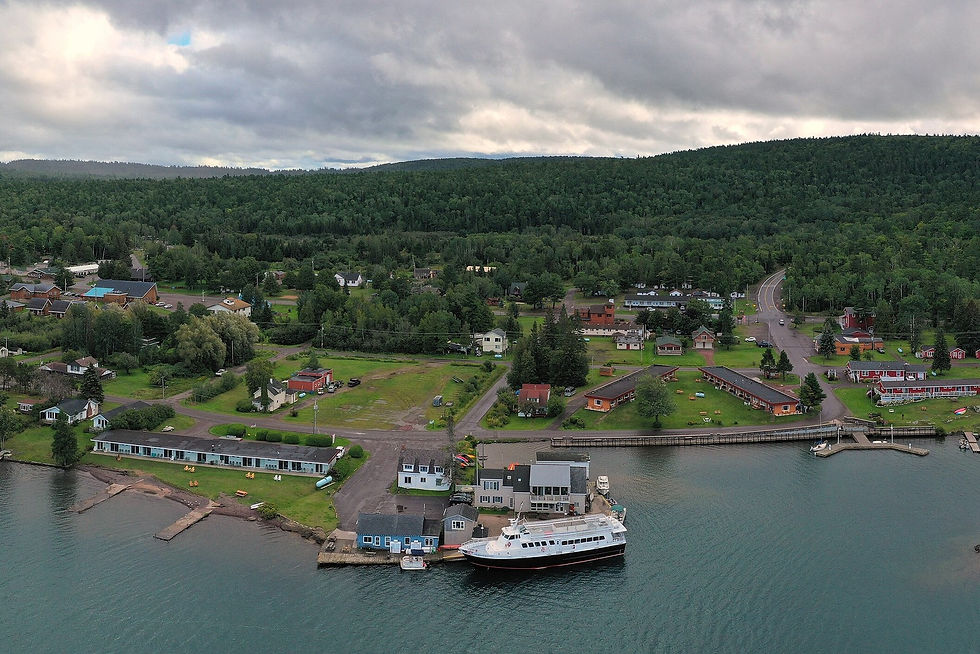
Copper Harbor is not a town people stumble into. Highway 41 ends there. Past that point there's Lake Superior and, twenty-two miles offshore, Isle Royale. That geography does most of the marketing work for you, but only if the listing photos and copy actually match the reason someone typed "Copper Harbor" into a search bar instead of "Upper Peninsula cabin" or "Lake Superior rental."
The market itself is small and specific: a typical year across the 11 listings tracked in this market runs about $41,088, with an average daily rate near $308 and occupancy around 47 percent. That's a short, intense season built around a narrow window - July through September carries the year, and November is the clear low point. A host who understands who is actually booking that window can price and photograph toward it instead of guessing.
This piece is about the guest, not the spreadsheet. Three distinct reasons bring someone to Copper Harbor specifically, and each one wants to see something different in the listing before they book.
One more note on the numbers before getting into who's actually booking: $308 is a blended, year-round average daily rate, and 47 percent is a blended, year-round occupancy figure. Neither one describes any single month - they describe a season that runs hot from July through September and falls off hard by November. A host who reads $308 as "what I should charge in November" or 47 percent as "how often I should expect to be booked in February" is misreading the number. The average only makes sense once you know it's carrying a short, intense peak on its back. This is not legal advice.
The Isle Royale Ferry Guest Books the Night Before and After
Copper Harbor is one of the mainland departure points for the Isle Royale ferry, and that single fact shapes a real slice of demand. A guest heading to the island needs a place to sleep the night before an early departure and, often, a place to land after a multi-day backcountry trip when they want a shower and a bed more than anything else on earth.
This guest isn't browsing for ambiance. They're solving a logistics problem: where do I sleep near the dock. A listing that leads with the walk to the harbor, parking for an early morning departure, and a low-key place to crash after days of hiking is speaking directly to this booking. Don't bury that information three paragraphs into an about section - it's the reason this particular guest chose this particular town over anywhere else on the peninsula.
It's worth being precise about what this demand is and isn't. The ferry is a real reason people type "Copper Harbor," but it is not a occupancy statistic this research pack can quantify - there's no ferry headcount tied to the $41,088 typical year above, and a host shouldn't imply one. Name the ferry as a reason to book. Don't guess a passenger count to back it up.
Think about the shape of that guest's stay in practice. A one-night pre-ferry stay and a one-night post-ferry stay are two separate booking decisions, not automatically one longer reservation - which matters for how a host thinks about minimum-night rules set against the ferry schedule. A blanket multi-night minimum that ignores this pattern can quietly turn away exactly the guest most likely to book at both ends of an Isle Royale trip. None of this shows up as its own line in the revenue numbers above; it's a pattern a host has to reason toward from the geography itself, not from a stat sitting in the dataset.
This guest also isn't comparison-shopping the way a leisure traveler comparison-shops. They're solving logistics: which reasonable option sits closest to the dock, whether check-in works without a host meeting them in person before an early-morning departure, and whether parking is clearly explained for a vehicle that might sit for several days while they're on the island. A listing that answers those three questions plainly, near the top of the description, does more for this guest than another round of interior styling photography ever will.
The Fort Wilkins and Brockway Mountain Guest Is on a Scenic Loop
A second, very different guest is doing a Keweenaw road trip - Brockway Mountain Drive for the overlook, Fort Wilkins Historic State Park for the fort and the campground history, and Copper Harbor as the base for both. This guest cares less about a dock and more about whether the listing is a reasonable drive from those two stops and whether the photos show the actual landscape they're chasing.
This is where photo accuracy matters more than almost anything else in the listing. If the gallery shows Brockway, it needs to be Brockway that was actually shot from this property's vantage point or a genuinely nearby overlook - not a stock image of a different Lake Superior bluff. If Fort Wilkins is described as a short walk, it needs to be a short walk from this specific address, not a general claim about the town.
The road-trip guest is also the guest most likely to cross-shop nearby towns before landing on Copper Harbor. Eagle Harbor, a different Keweenaw community, ran about $34,109 across 19 listings in this same dataset - a different hall entirely, with its own supply and its own pricing. A photo that quietly borrows an Eagle Harbor pier to fill out a Copper Harbor gallery isn't a shortcut, it's a way to lose the guest the moment they notice the mismatch on arrival.
Picture the actual three-stop version of this trip: the overlook at Brockway, a stretch of hours or an overnight anchored around Fort Wilkins, and Copper Harbor itself as the home base between the two. None of that requires the property to sit next door to either landmark - it requires the listing to state real drive time to each, in minutes, instead of soft language like "close to" or "near." A guest planning a loop is already doing that math on their own before they click book, and a host who states the actual number removes a step that guest would otherwise have to look up somewhere else - a small trust signal that adds up over the length of a listing.
A guest cross-shopping Eagle Harbor's $34,109 against Copper Harbor's $41,088 isn't purely price shopping, either. The two towns offer genuinely different bases for a Keweenaw loop, and a Copper Harbor host who understands why their own listing sits at a higher price point - tighter supply, higher ADR, closer proximity to both the ferry and Brockway - can defend that price on its merits instead of discounting to chase a different market's number.
The End-of-Season Guest Books Around the November Hole
The data shows a clear soft spot in November. That's useful information for a host, but it's also useful for a specific kind of guest: the one who wants Copper Harbor without the July crowds and is willing to trade summer warmth for quiet roads and open tables at the two or three places still serving that time of year.
This guest reads a listing differently than the ferry guest or the road-trip guest. They want honesty about what's actually open in the shoulder season, what the drive looks like without leaf color, and whether the house itself holds heat well once the lake effect sets in. A listing that only ever shows July photography is telling this guest nothing useful about the trip they're actually planning.
Pricing into that November gap honestly - rather than papering over it with a flat year-round rate - tends to serve both the host's occupancy and the guest's expectations. A guest who books a discounted, honestly-described November stay and gets exactly what they were promised is a five-star review. A guest who books a full-price November stay expecting July and gets a quiet, half-shuttered town is not.
Remember that the $308 ADR is a blended figure weighted heavily toward the July-through-September window that carries the season. A flat November rate anywhere near $308 is almost certainly priced for a guest who isn't actually shopping that month - the shoulder-season guest already expects a different number, and pricing honestly below the summer average should be read less as a concession and more as simple accuracy. A rate that reflects the season it's actually selling tends to outperform a flat number that doesn't.
The same math cuts the other way on occupancy. A 47 percent average across the year, concentrated into three strong months with a visible hole at the other end, implies long stretches of the calendar sitting well under that average the rest of the time - which is exactly the room a shoulder-season guest is trying to book into. Treating November as dead listing stock instead of an honest, differently-priced product is how a host leaves that booking on the table.
Don't Let Houghton or Minneapolis Do the Talking for this market
Houghton, the larger mainland gateway city with the airport and Michigan Tech, is a genuinely different market from Copper Harbor, roughly a 45-minute-plus drive up the peninsula. A guest who wanted Houghton's amenities would have searched Houghton. Pasting a Houghton waterfront photo into a Copper Harbor gallery to make the town look bigger or busier than it is misleads exactly the guest this listing is trying to win - someone who wants the end of the road, not a college town.
The research behind this piece flags something specific worth repeating for any host tempted to generalize: the Minneapolis origin data in this dataset is tied to Eagle Harbor, not to Copper Harbor. It would be easy to assume the two nearby Keweenaw towns share an origin market and market accordingly, but that's not what the numbers actually show here. Keep Copper Harbor's own guest story on its own line rather than borrowing a neighboring town's demand profile to fill a gap.
The broader Keweenaw area - the wider dataset this market sits inside - runs a typical year near $31,015 across 68 listings, a useful backdrop for understanding how Copper Harbor's smaller, higher-ADR market fits into the peninsula overall. It's context, not a number to blend into Copper Harbor's own figures.
Consider the practical version of the Houghton mistake: a listing description that opens with something like "minutes from Houghton's shops and Michigan Tech energy," when the actual drive runs 45 minutes or more each way. A guest who read that line, booked on the strength of it, and then made the drive has grounds to feel misled before they've even unpacked - and the review that follows tends to say so in plain language. The fix is simple: state the real number of highway miles or minutes to Houghton if it's mentioned at all, and let Copper Harbor's own geography - the ferry, Brockway, Fort Wilkins - do the actual selling.
The same discipline applies to the Minneapolis data point. It's tempting for a host managing more than one Keweenaw listing to fold every regional origin-market detail into one shared narrative - "guests come from Minneapolis" - because it sounds specific and useful. But specific-sounding isn't the same as accurate, and a fact borrowed from a neighboring town's dataset doesn't become true for this one just because the two towns sit twenty minutes apart on a map.
What a Short-Term Rental Permit Confirmation Looks Like Here
Grant Township, which covers Copper Harbor, and Keweenaw County both have a role in whether a specific parcel can legally operate as a short-term rental - and that detail sits at the property level, not the town level. A host should confirm current zoning and any conditional use permit status for their exact address before assuming a listing is compliant just because a similar house down the road already operates.
Grant Township can be reached at (906) 337-3471 to confirm a specific parcel's status; the exact address in question - in this research, 5095 Fourth Street - should be part of that call, not left to assumption. This is a compliance question first and a marketing question second: a beautifully photographed listing built on an unconfirmed permit is a liability, not an asset.
Two houses on the same road in Grant Township can carry different permit histories - one grandfathered under an older zoning designation, one requiring a fresh conditional use application under current rules - which is exactly why confirming 5095 Fourth Street's own status isn't a formality. A host who assumes compliance because "the house three doors down runs bookings fine" is making a bet on paperwork they've never actually seen.
Putting the Three Guests Back Together in One Listing
None of this means a Copper Harbor listing needs three separate versions of itself. It means the photos, the about section, and the house rules all need to hold up under scrutiny from whichever of the three guests actually clicks in. The ferry guest should be able to tell at a glance how close the property sits to the dock and whether an early checkout works. The road-trip guest should see real, on-location photography of Brockway and Fort Wilkins if those landmarks are genuinely nearby. The shoulder-season guest should find honest language about what November in Copper Harbor actually looks like, rather than a single set of July photos stretched across all twelve months.
A small, 11-listing market like this one doesn't have room for a listing that tries to be everything to everyone. The hosts who do best here are the ones who pick their strongest true story - dock proximity, scenic-loop base camp, or quiet shoulder-season retreat - and tell it accurately, with their own house's photos and their own confirmed permit status, rather than borrowing a neighboring town's numbers or images to look more finished than the driveway actually is.
Run the logic forward for a moment. If this listing set's $41,088 typical year holds and a given property performs at or above that average, the difference between telling the right guest the right story and pasting in a neighboring town's numbers or photos isn't cosmetic. In a market this small, it's plausibly the difference between landing near that $308 ADR and undershooting it because the wrong guest clicked through, toured the gallery, and booked something that actually matched what they were looking for instead. A market with only eleven listings doesn't have the slack to absorb that kind of mismatch.
Related Reading
More Copper Harbor, Michigan reading already live on Crest & Cove.
Frequently Asked Questions
Who is the typical guest booking a Copper Harbor rental?
The research behind this piece points to three distinct guests rather than one generic profile: travelers connecting to the Isle Royale ferry who need a bed the night before or after their crossing, road-trippers doing the Brockway Mountain and Fort Wilkins loop who chose Copper Harbor as their base, and shoulder-season travelers deliberately booking around the quieter November window. Each wants different information up front in the listing.
Does Copper Harbor's Isle Royale ferry connection actually drive bookings?
The ferry is a genuine, geography-based reason guests choose Copper Harbor over other Keweenaw towns, and it's worth naming clearly in listing copy - proximity to the dock, easy early-morning access, a place to decompress after a multi-day trip. What the research doesn't support is turning that into a specific passenger count or occupancy percentage; there's no ferry headcount tied to this cell's numbers, so don't invent one.
What's the typical annual revenue for a Copper Harbor short-term rental?
The research pack shows a typical year of about $41,088 across the 11 listings in this dataset, with an average daily rate near $308 and occupancy around 47 percent. That's a specific, small-sample figure for this particular cell - it shouldn't be blended with Eagle Harbor's or the wider Keweenaw's numbers, which are meaningfully different. It's also worth remembering that $308 and 47 percent are year-round averages carried heavily by the July-through-September peak; neither number describes a typical week in November.
How is Eagle Harbor different from Copper Harbor for STR guests?
Eagle Harbor is a separate Keweenaw community with its own listings and its own typical year, about $34,109 across 19 listings in this dataset - lower revenue on more supply than Copper Harbor's smaller, higher-ADR cell. They're two different halls with two different guest profiles, and Copper Harbor listings shouldn't borrow Eagle Harbor's photography, origin-market data, or pricing patterns.
Is Minneapolis a major origin market for Copper Harbor guests?
The Minneapolis origin data available in this research is specifically tied to Eagle Harbor's guest base, not Copper Harbor's. It's a nearby town, but the two shouldn't be assumed to share the same feeder market without separate confirmation - keep that data point on its own labeled line rather than applying it here.
What time of year is slowest for Copper Harbor rentals?
November stands out as the soft point in this dataset, with the peak season concentrated in July, August, and September. A host can use that honestly - either by pricing November to attract the shoulder-season guest who wants quiet over crowds, or by being upfront in the listing about what's open and what isn't that time of year.
Do I need a permit to run a short-term rental in Copper Harbor?
Copper Harbor sits within Grant Township, Keweenaw County, and both may have a role in whether a specific parcel can legally operate short-term. This is address-specific, not town-wide - confirm current status for the exact parcel with Grant Township directly at (906) 337-3471 rather than assuming based on a neighboring property.
Should my Copper Harbor listing photos include Fort Wilkins or Brockway Mountain?
If those landmarks are genuinely a short drive or walk from the property, and the photos are actually taken there or of that specific view, yes - they answer exactly what the road-trip guest is looking for. What matters is accuracy: don't use a stock image of a different overlook or a different fort to imply proximity that doesn't exist.
Is Houghton the same market as Copper Harbor?
No. Houghton is the larger mainland gateway city with the airport and Michigan Tech, a meaningfully different drive and a meaningfully different guest experience than the end-of-the-road setting in Copper Harbor. A guest who wanted Houghton's amenities searched for Houghton; don't use Houghton photography or claims to make a Copper Harbor listing seem bigger or busier than the town actually is.
How does Copper Harbor compare to the wider Keweenaw Peninsula market?
The broader Keweenaw dataset this cell sits within shows a typical year near $31,015 across 68 listings - useful as context for how the peninsula performs overall, but Copper Harbor's own smaller, higher-ADR cell should be marketed and priced on its own numbers, not blended into the wider regional average.
Work with Crest & Cove Creative
The highway ends in Copper Harbor. That single geographic fact tells you more about who's booking than any generic Up North listing template ever will.
## Work with Crest & Cove Creative If your Copper Harbor listing is still leaning on stock photography or a neighboring town's guest data to fill in the gaps, we can help you rebuild the story around who's actually typing this town's name into a search bar. Reach out at crestcove.co or (256) 998-7502 for a listing audit built on your own market's numbers, not a blended average.
Reach out at crestcove.co or (256) 998-7502.


Comments