
Melbourne Beach vs Indialantic: Two Towns, Two Sets of Numbers

Updated: Aug 28

Melbourne Beach and Indialantic sit directly adjacent on the same barrier island, close enough that a guest, or a host researching compliance rules, can genuinely mix them up. But they're two separate incorporated towns, each with its own town desk, its own registration process, and its own published market year, and neither town's numbers should ever stand in for the other's.
Melbourne Beach's published year runs $61,047 across 288 listings, with a $519 average daily rate, 39.3 percent occupancy, and an average stay of 6.1 nights. Indialantic's own published year runs $43,931 across 67 listings, with a $346 ADR and 40.9 percent occupancy. The two towns even run different peak calendars: Melbourne Beach's peak-three is March, June, and February, while Indialantic's is March, February, and April, sharing only the March peak.
This page keeps both towns, and the highway-adjacent detour of Cocoa Beach, on their own separate lines. Nothing here should be read as compliance advice for a specific parcel; a host should confirm a property's exact town boundary directly before advertising or registering anywhere. Cocoa Beach, in particular, gets casually lumped into Space Coast marketing copy alongside both towns, but it is a genuinely different market with its own listing stock, its own pricing, and its own guest profile; borrowing its numbers for either Melbourne Beach or Indialantic is a third version of the same mistake this comparison is meant to prevent. This is not legal advice.
Melbourne Beach's $61,047 Is Not Indialantic's $43,931
The two figures aren't close, and the gap says something real about scale rather than just naming a difference. Melbourne Beach's $61,047 typical year sits across 288 active listings, a far larger listing stock than Indialantic's 67. That listing stock difference alone explains part of the revenue gap; a market with more than four times the listings is going to show a different aggregate picture than a smaller, tighter one.
Per-listing performance tells a more nuanced story. Melbourne Beach's $519 ADR runs meaningfully above Indialantic's $346, while Indialantic's 40.9 percent occupancy edges slightly ahead of Melbourne Beach's 39.3 percent. Neither town is simply "better"; they're different markets with different pricing and different fill patterns, and a host comparing the two should look at the full picture rather than a single headline number. A higher ADR paired with slightly lower occupancy, and a lower ADR paired with slightly higher occupancy, are two different ways of arriving at a full booking calendar, and neither strategy transfers cleanly to the other town's actual demand curve.
The practical rule for marketing copy: keep each town's figures on its own clearly labeled line. A Melbourne Beach listing shouldn't borrow Indialantic's occupancy edge to make a pricing argument, and an Indialantic listing shouldn't borrow Melbourne Beach's higher ADR to justify a rate increase. Each number belongs to its own town's own published year. That discipline sounds obvious in the abstract, but it is the exact habit that slips first when a host is tired, moving fast, or reusing an old template across two nearby properties without rereading it line by line. Slow down and reread it before publishing.
288 Listings on One Side of the Line, 67 on the Other
Melbourne Beach's 288 listings represent a considerably deeper listing stock than Indialantic's 67, which affects more than just the aggregate revenue figure. A market with 288 listings has more competition for a given guest search, more variety in house size and amenities, and more pricing data points a host can reference when setting rates.
Indialantic's smaller listing stock of 67 listings means less day-to-day competition, but also a thinner comparison set; a host there has fewer directly comparable listings to benchmark against. That's a real trade-off, not simply an advantage or disadvantage for either side, and it shapes how a host in each town should think about differentiation.
A host confirming which town a parcel actually sits in should treat these listing stock figures as one more confirmation point, not the primary one. The tax map and municipal boundary settle the actual question; the listing count is useful context for understanding what competitive landscape a host is actually entering once that boundary question is settled.
Indialantic's 67 Listings Sit Immediately North
Indialantic sits immediately north of Melbourne Beach, a separate incorporated town with its own town desk and its own registration process entirely apart from Melbourne Beach's Deckard portal and Chapter 74 ordinance. A property just across that boundary line answers to a different town desk, even though the beach, the highway, and the general neighborhood feel continuous from one town into the next.
Indialantic's own guest-origin data draws primarily from New York, a genuinely different pattern from Melbourne Beach's Miami-origin lead. That difference is worth knowing for marketing purposes even setting aside compliance questions entirely: a listing built around a Miami-guest assumption in an actual Indialantic property is targeting the wrong audience from the outset.
None of this makes one town's data more valid than the other's; it just means the two shouldn't be blended. A host with properties in both towns, or considering one after researching the other, should keep two separate mental files, two separate phone lists, and two separate sets of published figures rather than one merged Space Coast average. Even the shared barrier-island setting, the same sand, the same general climate, doesn't erase the difference in who's actually searching for each town by name.
June Is Melbourne Beach Peak-3, Not Indialantic's
June's presence on Melbourne Beach's peak-three, alongside March and February, is a meaningful point of divergence from Indialantic, whose own peak-three runs March, February, and April instead, with June absent from that top tier entirely. A host pricing a Melbourne Beach property for June like a shoulder month, based on an assumption borrowed from a neighboring town's calendar, is underpricing a genuine peak window.
The reverse mistake is just as real: pricing an Indialantic property for April as a shoulder month, because Melbourne Beach's own calendar doesn't feature April in its peak-three, would miss the fact that April is a genuine peak month specifically for Indialantic. Each town's calendar needs to be read on its own terms.
Only March overlaps as a shared peak month between the two towns, and even there, the underlying demand drivers, and the guest-origin cities behind that demand, differ. A host managing properties in both towns, or simply researching one after the other, shouldn't assume a shared regional calendar covers both; the overlap is narrower than the geography might suggest. Two out of three peak months differ entirely between the towns, which is a wider gap than a shared barrier island might suggest at first glance.
September Is the Soft Month, and It's Named as Such
September is identified as the softer month in the Melbourne Beach research pack, sitting well below the March-June-February peak-three in demand. A host who treats every month between peak windows as roughly equivalent misses this specific signal; September's softness is worth planning around directly, whether through pricing adjustments, maintenance scheduling, or targeted shoulder-season marketing rather than a blanket approach across all off-peak months.
This softness is specific to Melbourne Beach's own published data and shouldn't be assumed to apply identically to Indialantic without separate confirmation from that town's own figures. Two neighboring towns can share a general seasonal rhythm, being coastal Florida properties on the same barrier island, while still diverging on the specific month-by-month details that actually matter for revenue management. The same caution applies in reverse: a soft month identified in Indialantic's own data shouldn't be assumed to carry over to a Melbourne Beach listing without its own separate confirmation.
The practical use of naming a soft month isn't discouragement; it's honest planning. A host who knows September is genuinely softer can plan maintenance, use the slower window for professional photography refreshes ahead of the next peak season, or run a specifically targeted shoulder-season promotion rather than pretending the calendar is flatter than it actually is.
Two Town Desks, Two Portals, Two Sets of Contacts
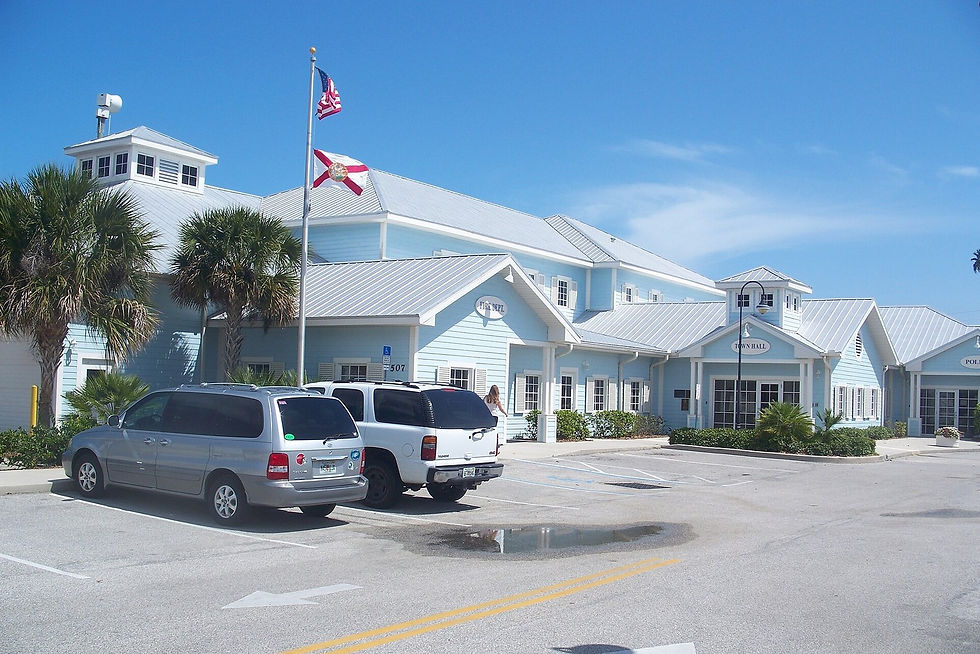
Melbourne Beach's town desk sits at 507 Ocean Avenue, with the main line at (321) 724-5860 and registration running through the Deckard portal under Chapter 74 and Ordinance 2024-05. Indialantic maintains its own separate town desk, its own separate registration process, and its own separate contact information, entirely apart from Melbourne Beach's system.
A host confirming compliance requirements for an Indialantic property should not use Melbourne Beach's address, phone number, or portal; doing so would file paperwork with the wrong town entirely, likely resulting in a rejected or misdirected application. The reverse applies equally to a Melbourne Beach property mistakenly routed through Indialantic's process.
Brevard County's Tourist Development Tax, at 5 percent through the Clerk of Court at (321) 637-6530, does apply countywide and covers both towns under the same rate and the same collection process, unlike the town-level registration systems, which remain genuinely separate. Knowing which pieces are shared countywide and which are town-specific prevents a host from assuming either too much overlap or too little between the two towns' requirements.
Stay Length and Lead Time Also Diverge Between the Two
Melbourne Beach's average stay runs 6.1 nights on a 78-day lead time, giving hosts a fairly long window to refine seasonal content before a guest actually books. Indialantic's own stay-length and lead-time figures, while not identical, follow a similarly extended planning pattern rather than a last-minute booking rhythm, which is common across this stretch of barrier-island coastline generally.
The similarity here is worth noting precisely because it's one of the few places the two towns' data actually rhymes rather than diverges. Both towns reward a listing built for a guest who plans well in advance, with detailed photos, clear house rules, and specific neighborhood information rather than a rushed, thin description built for impulse bookings.
Where the two towns diverge again is in what that planning guest is actually planning around: a Miami-origin guest booking a Melbourne Beach stay 78 days out is likely thinking about a specific kind of coastal escape distinct from what a New York-origin guest booking an Indialantic stay is picturing. The lead time is similar; the content that fills it shouldn't be identical between the two towns.
A Practical Way to Keep the Two Towns Straight
The simplest safeguard against blending Melbourne Beach and Indialantic data is a habit, not a tool: whenever a figure gets typed into a listing description, a compliance note, or a pricing spreadsheet, label which town it belongs to right there in the same line. A number without a town label is a number that's one careless copy-paste away from ending up on the wrong property's page.
This matters most for hosts who happen to manage or research properties in both towns, since the two markets sit close enough geographically that switching between them in the same afternoon of work is easy to do without noticing the swap. A quick habit of naming the town every time a figure is written down catches most of these mistakes before they reach a live listing.
It's a small discipline with an outsized payoff: a guest who reads accurate, town-specific numbers and descriptions is a guest whose expectations match what they actually find on arrival. That match is worth more to a review score than any single statistic borrowed from a more impressive-looking neighboring town's year. It costs nothing beyond a moment of attention, and it is the same discipline that separates a listing built on genuine, verifiable local knowledge from one that reads like it was assembled from whichever nearby town had the more flattering number available at the time.
Related Reading
Related reading for Melbourne Beach Indialantic hosts: same-town spine first, then nearby geo lines. Skip costume national dumps that do not underwrite this driveway.
Frequently Asked Questions
How different are Melbourne Beach's and Indialantic's published market years?
Melbourne Beach's published year runs $61,047 across 288 listings, with a $519 ADR and 39.3 percent occupancy. Indialantic's own published year runs $43,931 across 67 listings, with a $346 ADR and 40.9 percent occupancy. The gap reflects both a much larger listing stock in Melbourne Beach and genuinely different per-listing pricing and fill patterns between the two towns, not simply one town outperforming the other across the board.
Do Melbourne Beach and Indialantic share the same peak season?
Only partially. Melbourne Beach's peak-three is March, June, and February; Indialantic's peak-three is March, February, and April. Both towns share March as a peak month, but June is peak specifically for Melbourne Beach while April is peak specifically for Indialantic. A host pricing either town based on the other's full calendar risks underpricing at least one genuine peak month that doesn't show up in the borrowed calendar.
Is Indialantic part of Melbourne Beach, or a separate town?
Indialantic is a fully separate incorporated town, immediately north of Melbourne Beach, with its own town desk, its own registration process, and its own published market data. The two towns sit close enough on the same barrier island that they're easy to mix up, but they are not the same municipality, and compliance requirements, contact information, and portals for one do not apply to the other.
Why does Indialantic have a higher occupancy rate but lower ADR than Melbourne Beach?
Indialantic's 40.9 percent occupancy slightly exceeds Melbourne Beach's 39.3 percent, while Melbourne Beach's $519 ADR runs well above Indialantic's $346. This suggests the two markets may be positioned differently, with Melbourne Beach commanding a premium rate against somewhat more selective booking, and Indialantic filling more consistently at a lower nightly rate. Neither pattern is inherently better; they reflect two distinct markets with different guest expectations.
Where does Indialantic's top guest-origin city come from, and how does it differ from Melbourne Beach's?
Indialantic's top guest-origin city is New York, while Melbourne Beach's is Miami. That's a meaningfully different guest profile: a Miami-origin guest driving north for a change of pace has different expectations than a New York-origin guest, likely traveling further and possibly booking a longer or more seasonal stay. Marketing copy built around the wrong origin city risks targeting language at a guest who isn't actually the one searching.
Can I use Melbourne Beach's $61,047 figure to market an Indialantic property?
No. That figure belongs specifically to Melbourne Beach's published year across its own 288 listings and would misrepresent an Indialantic property, which has its own separate published year of $43,931 across 67 listings. Using the wrong town's revenue figure in marketing copy, even inadvertently, risks setting a guest's expectations against numbers that don't actually describe the property or town they're booking.
Why is September named as a soft month, and does it apply to both towns?
September is identified as the softer month specifically within Melbourne Beach's own published research. It shouldn't be assumed to apply identically to Indialantic without separately confirming that town's own data, even though both towns share a general coastal Florida seasonal rhythm. Treating a soft-month designation as automatically transferable between two distinct towns risks planning around a pattern that may not actually match the neighboring market.
Do Melbourne Beach and Indialantic use the same town registration portal?
No. Melbourne Beach registers short-term rentals through its own Deckard portal, governed by Chapter 74 and Ordinance 2024-05, with a town desk at 507 Ocean Avenue and a main line at (321) 724-5860. Indialantic maintains its own separate registration system and town desk entirely apart from Melbourne Beach's. A property should only ever be registered through the portal belonging to the town it actually sits inside.
Does the Brevard County Tourist Development Tax differ between Melbourne Beach and Indialantic?
No, the 5 percent Tourist Development Tax, collected through the Brevard County Clerk of Court at (321) 637-6530, applies countywide at the same rate across both towns. This is one area where the two towns share the same process and desk, unlike town-level registration, which remains genuinely separate. A host operating in either town uses the same Brevard Clerk contact for this specific tax.
How do I confirm which town my property actually sits in before advertising?
Confirm the parcel's exact tax-map status and municipal boundary directly with the relevant town desk, rather than assuming based on the general neighborhood or nearby landmarks, since Melbourne Beach and Indialantic sit close enough together to be genuinely confusing. Melbourne Beach's town line is (321) 724-5860. This single confirmation determines which registration portal, which published market data, and which contact information actually applies to the property.
Work with Crest & Cove Creative
Two towns, one shared stretch of coastline, and numbers that don't transfer from one to the other. A guest who searched Melbourne Beach picked this town specifically, not its neighbor.
Crest & Cove Creative writes listing copy that keeps each town's own facts on its own line, never blended with a neighbor's numbers. Start at crestcove.co/audit or call (256) 998-7502. Send the live listing draft and the facts you can actually cite.
Reach out at crestcove.co or (256) 998-7502.


Comments