
Is an STR Marketing Agency Worth It for Neskowin Pacific City Hosts

Updated: Aug 28

If you hold a short-term rental license in Neskowin or Pacific City, you're sitting on something most Oregon coast hosts don't have: a permit that Tillamook County will not simply hand out to the next person who wants one. Since 2023, the county has capped new STR licenses in these unincorporated subareas and built a waitlist system around that cap. That single regulatory fact changes the marketing math for owners here in a way it doesn't for almost anywhere else on the batch's stretch of coast — and it's worth understanding precisely before you decide whether professional marketing is worth paying for.
The Cap Isn't a Rumor — Here's the Actual Mechanism
In July 2023, the Tillamook County Board of Commissioners approved an updated short-term rental ordinance (Ordinance #84, later amended) that formalized a growth-management structure for unincorporated communities, including Pacific City/Woods and Neskowin. The mechanism isn't a flat, permanently frozen number — it's an interim cap tied to a percentage of eligible properties in each community, with the county periodically calculating how many new licenses a given percentage increase would allow. As of July 2026, Neskowin's cap sits at 191 licenses, with a current waitlist of 6. Pacific City/Woods has a cap of 95 licenses, with a current waitlist of 13 — though that cap applies only outside the subarea's "West Division" exemption zone (see below). When commissioners discussed the most recent round of reopened applications, the increase on the table was modest: roughly 11 additional licenses each for Pacific City, Neskowin, and Netarts — not 11 split across all three combined.
There's an important wrinkle specific to Pacific City/Woods: in January 2025, the Board of Commissioners established a "West Division" exemption zone via Board Order #25-002 — the stretch west of the Nestucca River, between Alder Street and Bob Straub State Park. Licenses inside that zone are not subject to the subarea cap at all; the 95-license cap and the 13-name waitlist apply only to Pacific City/Woods properties outside the West Division. Neskowin has no comparable exemption zone — its 191-license cap and 6-name waitlist apply countywide within the subarea.
That's the part worth sitting with. This isn't a market where a well-capitalized newcomer can simply acquire twenty properties and start operating twenty listings, at least not outside the uncapped West Division pocket of Pacific City. Every additional license inside the capped areas has to come from a small, periodically recalculated allotment, and applicants who don't already hold one go on a subarea-specific waitlist — Tillamook County maintains separate waitlist documents for Pacific City/Woods and for Neskowin specifically. The ordinance also includes an use-it-or-lose-it provision: license holders who don't rent a minimum of 30 nights a year risk losing the license at renewal, and in a 2023 county snapshot a meaningful number of existing holders in both subareas — around 91 in Pacific City and 61 in Neskowin — were under-used by that standard for the year reviewed, not out of compliance with any rule, just below the 30-night activity threshold. That's the release valve that keeps the fixed pool from calcifying entirely, but it doesn't change the core structure: the number of licenses that can exist in the capped portions of Neskowin and Pacific City/Woods at any given time is a small, deliberately constrained figure, not an open field.
One more structural detail worth knowing: unincorporated Tillamook County limits any single individual or company to one STR license. That's part of why this market hasn't consolidated under a national property-management brand the way so many coastal markets have — a company can't simply buy up license after license and scale a portfolio here the way it can in an uncapped market. The owners who hold licenses in Neskowin and Pacific City are, almost by definition, independent operators or small local managers, not a regional franchise with fifty units.
What we can confirm: the 2023 ordinance exists, it introduced a percentage-based interim cap and subarea waitlists for Pacific City/Woods and Neskowin, it includes a 30-night use-it-or-lose-it renewal rule, it limits one license per operator, and — as of a dedicated county-record pull in July 2026 — Neskowin's cap stands at 191 licenses with a waitlist of 6, while Pacific City/Woods carries a cap of 95 licenses (outside the uncapped West Division exemption zone established in January 2025) with a waitlist of 13. These figures are updated as the county recalculates its allotments, so anyone making a purchase or licensing decision should still confirm the current numbers with Tillamook County Community Development before acting on them.
Why Scarcity Changes the Marketing Math
In most coastal markets, an owner weighing whether to invest in professional marketing is implicitly competing against an ever-expanding pool of new listings. Every year, more properties get short-term rental permits, more owners self-manage with a phone and a photo app, and the competitive set an existing listing has to out-rank keeps growing. That dynamic caps the return on marketing investment in a specific way: you can sharpen your positioning all you want, but the market itself keeps diluting the value of doing so, because supply never stops arriving.
Neskowin and Pacific City don't work that way. The competitive set of licensed short-term rentals in these subareas is fixed, or close to it, for the foreseeable future — bounded by a county cap that moves in small increments and a waitlist that absorbs most of the demand for new entry. If you already hold a license, you are not racing against next year's crop of new listings. You're racing against a competitive field that mostly stays the same shape year over year, with turnover happening only when an existing owner sells, surrenders a license, or loses it under the use-it-or-lose-it rule.
That changes what a marketing dollar is actually buying. In an uncapped market, marketing spend exists in part just to keep pace with new supply — a kind of treadmill. In a capped market, marketing spend compounds, because the gains you make in search visibility, direct-booking share, and repeat-guest loyalty aren't getting diluted by a constantly growing competitor pool the way they would be almost anywhere else. A license here is a non-replaceable asset. Treating it like a commodity listing — generic photos, copy that could describe any beach house on the Oregon coast, no real search presence beyond the OTA algorithms — means you're sitting on something scarce and marketing it like it isn't.
What a Scarce License Is Actually Protecting
It helps to think about what you're holding onto if you own a licensed Neskowin or Pacific City property. You're not just holding a right to rent a house short-term — you're holding one of a small, county-limited number of legal entry points into a market with two genuinely singular physical draws that almost nowhere else on the West Coast can claim.
Pacific City's dory fleet is the clearest example. Dories are open, flat-bottomed boats that launch directly off the beach at Cape Kiwanda and head straight into the surf — a working tradition that traces back more than a hundred years, with roughly 250 boats still part of the fleet according to the Pacific City Dorymen's Association. Cape Kiwanda's sandstone headland is what makes this possible: it blocks the prevailing north winds during the spring and summer fishing season, creating one of the only places on the West Coast where boats are still launched through the surf on a working basis. That's not marketing copy — it's a genuinely rare, photographable, story-driven feature that a listing built around "cozy Oregon coast getaway" language never captures.
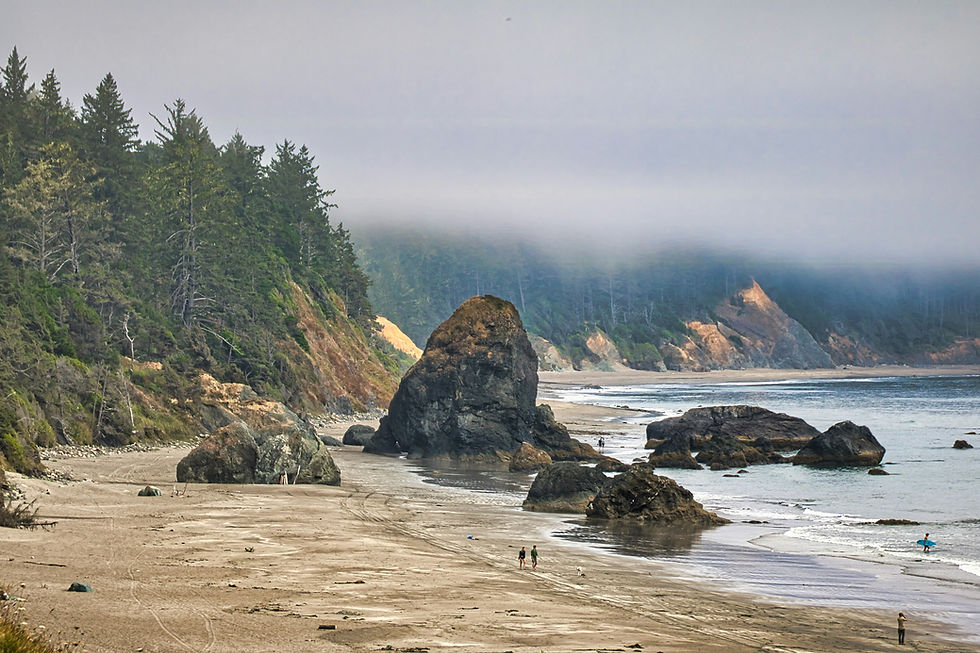
Near Neskowin, at Proposal Rock, the Ghost Forest offers a second singular hook: the exposed stumps of an ancient Sitka spruce forest, confirmed at roughly 2,000 years old via carbon dating, visible at low tide, most dramatically after winter storms strip away the covering sand. Scientists differ on exactly how the forest was buried — either by a sudden Cascadia earthquake or by gradual dune encroachment — but the ~2,000-year age of the stumps themselves is well established, including in Smithsonian-linked research referenced in regional science writing. It's an eerie, unusual, and highly photogenic feature that very few coastal markets anywhere can offer.
A listing that leads with generic beach-house language is leaving both of these hooks — plus the dune landscape at Cape Kiwanda itself — completely unused. And because the license behind that listing is scarce, the cost of under-marketing it isn't just a slower booking season; it's underselling an asset that can't simply be replaced by acquiring a second property once you notice the mistake, the way you could in an open market.
The Honest Caveat: Scarcity Doesn't Fix a Weak Listing
None of this means marketing spend is automatically worth it regardless of what's behind it. A scarce license paired with dated photography, no real description of what makes the property or its access to these landmarks special, and no presence outside the OTA platforms will still underperform — scarcity raises the ceiling on what good marketing can do here, it doesn't lower the floor on what bad marketing produces. If the underlying property can't back up a story built around the dory fleet, the Ghost Forest, or the dunes — because it's poorly maintained, badly photographed, or simply doesn't have the access or views to make the pitch credible — no amount of positioning work fixes that first.
The owners who benefit most from marketing investment here are the ones who already have a legitimate story to tell and simply haven't told it yet: a property within reach of Cape Kiwanda or Proposal Rock, decent bones, and a current listing that reads as if it could be anywhere on the Oregon coast. For that owner, the math is genuinely different from what it is in a saturated, unconstrained market — every improvement compounds against a fixed competitive set instead of an expanding one.
For owners weighing full-service property management against a marketing-only engagement, the same cost-benefit logic applies: verify current local management rates and any specific ADR figures directly before comparing a flat marketing retainer against a percentage-of-revenue management fee. What doesn't need verification is the underlying structural fact in the comparison — a capped, waitlisted license is a different asset from an uncapped one, and it deserves a marketing plan built around that difference rather than a generic "get more bookings" pitch.
Keep going on Crest & Cove: the Crest & Cove intro · local SEO keywords that actually book · the five elements of a converting hero · how to compare STR marketing agencies · OTA fees without leftover occupancy lifts · Neskowin and Pacific City against AirROI pins · Neskowin vs Pacific City against AirROI pins · Destin against AirROI, not leftover year.
Frequently Asked Questions
Is it true that Tillamook County has capped short-term rental licenses in Neskowin and Pacific City?
Since a 2023 ordinance update, unincorporated Tillamook County — including the Pacific City/Woods and Neskowin subareas — operates under an interim cap tied to a percentage of eligible properties in each community, with the county periodically recalculating how many new licenses that percentage allows. As of July 2026, Neskowin's cap is 191 licenses, and Pacific City/Woods's cap is 95 licenses outside its West Division exemption zone. This is a documented mechanism, not an informal practice, but because the county periodically recalculates its allotments, current figures should still be confirmed directly with Tillamook County Community Development before relying on them for a specific decision.
How does the waitlist work if I want a new STR license here?
Tillamook County maintains subarea-specific waitlist documents, including separate lists for Pacific City/Woods and for Neskowin. As of July 2026, the Neskowin waitlist has 6 names, and the Pacific City/Woods waitlist (for the capped area outside the West Division) has 13. Applicants who apply after the cap is met are added to the relevant waitlist and can be granted a license as slots open up, typically through license non-renewal, surrender, or loss under the county's use-it-or-lose-it provision. Because waitlists turn over, confirm the current length and estimated wait directly with the county before making a decision based on it.
What is the "use-it-or-lose-it" rule, and does it actually open up licenses?
Under the ordinance, license holders must rent their property a minimum of 30 nights per year to remain eligible for renewal. In the county's own review, a meaningful number of existing license holders in both Pacific City and Neskowin fell short of that threshold in a given year, which creates some turnover in an otherwise fixed pool. It's a real release valve, but it doesn't change the underlying scarcity — the total number of licenses in circulation stays capped even as the specific properties that hold them shift.
Can a single company or investor buy up multiple STR licenses in Neskowin or Pacific City?
No — unincorporated Tillamook County limits any one individual or company to one short-term rental license. That rule is a meaningful part of why this market hasn't consolidated under a national property-management brand the way many coastal markets have; the owners who hold licenses here are largely independent operators or small local management companies rather than large regional portfolios.
Does a capped license mean my listing will book itself without marketing?
Scarcity limits how much new competition can enter the market, but it doesn't guarantee any individual listing performs well. A licensed property with dated photos, generic copy, and no presence beyond the OTA platforms will still underperform a well-marketed one — scarcity raises the ceiling on what good marketing can achieve here, it doesn't replace the marketing itself.
What makes Pacific City's dory fleet worth featuring in listing marketing?
The dory fleet is a working tradition, more than a century old, in which flat-bottomed boats launch directly off the beach at Cape Kiwanda and into the surf — something the Pacific City Dorymen's Association and regional accounts describe as one of the only places on the West Coast where this still happens on a working basis, with roughly 250 boats part of today's fleet. It's a genuinely rare, photographable story that generic "Oregon coast" listing copy never captures.
What is the Ghost Forest near Neskowin, and how old are the stumps actually?
The Ghost Forest is a set of ancient tree stumps — the remains of a buried Sitka spruce forest — exposed at low tide near Proposal Rock, most dramatically after winter storms clear away sand. Carbon dating confirms the stumps at roughly 2,000 years old. Scientists differ on whether the forest was buried suddenly by a Cascadia earthquake and tsunami debris or gradually by dune encroachment, but the stumps themselves and their ~2,000-year age are established.
Is marketing-only help worth it if I already have a full-service property manager?
It depends on what your current manager's marketing actually covers versus what they charge for it — many full-service managers include only baseline listing management, not dedicated positioning or content strategy. Before comparing costs, verify your current management fee structure and get a clear picture of what marketing work, if any, is already included. If it's minimal, a marketing-only engagement layered on top of operational management can make sense; if your manager already handles strong positioning, additional marketing spend may be redundant. This is worth evaluating case by case rather than assuming one model fits every owner.
Why Scarcity Changes the Marketing Math?
That single regulatory fact changes the marketing math for owners here in a way it doesn't for almost anywhere else on the batch's stretch of coast — and it's worth understanding precisely before you decide whether professional marketing is worth paying for. The owners who benefit most from marketing investment here are the ones who already have a legitimate story to tell and simply haven't told it yet: a property within reach of Cape Kiwanda or Proposal Rock, decent bones, and a current listing that reads as if it could be anywhere on the Oregon coast.
What a Scarce License Is Actually Protecting?
If you hold a short-term rental license in Neskowin or Pacific City, you're sitting on something most Oregon coast hosts don't have: a permit that Tillamook County will not simply hand out to the next person who wants one. In July 2023, the Tillamook County Board of Commissioners approved an updated short-term rental ordinance (Ordinance #84, later amended) that formalized a growth-management structure for unincorporated communities, including Pacific City/Woods and Neskowin.
Does a 30-night setting fill the slow month?
A 30-night minimum is a platform filter. Typical stay on these extracts is still a short trip. The filter is not a filled slow month and it is not a remote-work product you did not photograph. A scarce license paired with dated photography, no real description of what makes the property or its access to these landmarks special, and no presence outside the OTA platforms will still underperform — scarcity raises the ceiling on what good marketing can do here, it doesn't lower the floor on what bad marketing produces.
Related Reading
Keep reading on same-cluster Crest & Cove pages that stay on labeled local lines without costume-corridor copy.
Neskowin, Oregon STR Market Report 2026: $38,932 Median Revenue on 154 Listings
Neskowin Pacific City STR Market Report for Independent Hosts
Market Neskowin by Proposal Rock at Low Tide, Not Stock Beach Copy
Neskowin and Pacific City: The Three Hooks Most Listings Never Name
What It Actually Costs to Start a Neskowin, Oregon Short-Term Rental
Is Neskowin or Pacific City a Good Short Term Rental Investment, IN
Buying a Neskowin Rental in 2026: What the Numbers Actually Support
DIY vs. Hire: Marketing Your Neskowin, Oregon Vacation Rental
DIY vs Hire Marketing for Should Neskowin Pacific City Hosts Manage
Who Books a Neskowin, Oregon Rental? Portland Guests First, Seattle
Financing a Neskowin, Oregon Rental: What DSCR Lenders Want to See
Neskowin Remote-Worker Rentals: What the Booking Data Actually Shows
Neskowin Shoulder Season: Pricing August, June, and September Right
Neskowin, Oregon Tourism vs. STR Occupancy: What the 2026 Data Actually Shows
Neskowin, OR STR Rules: Confirm With Tillamook County Before You List
Work with Crest & Cove Creative
Write this town's year. Do not file another market's number as this stay.
Reach out at crestcove.co or (256) 998-7502.


Comments