
Is Neskowin or Pacific City a Good Short Term Rental Investment, IN

Updated: Aug 28
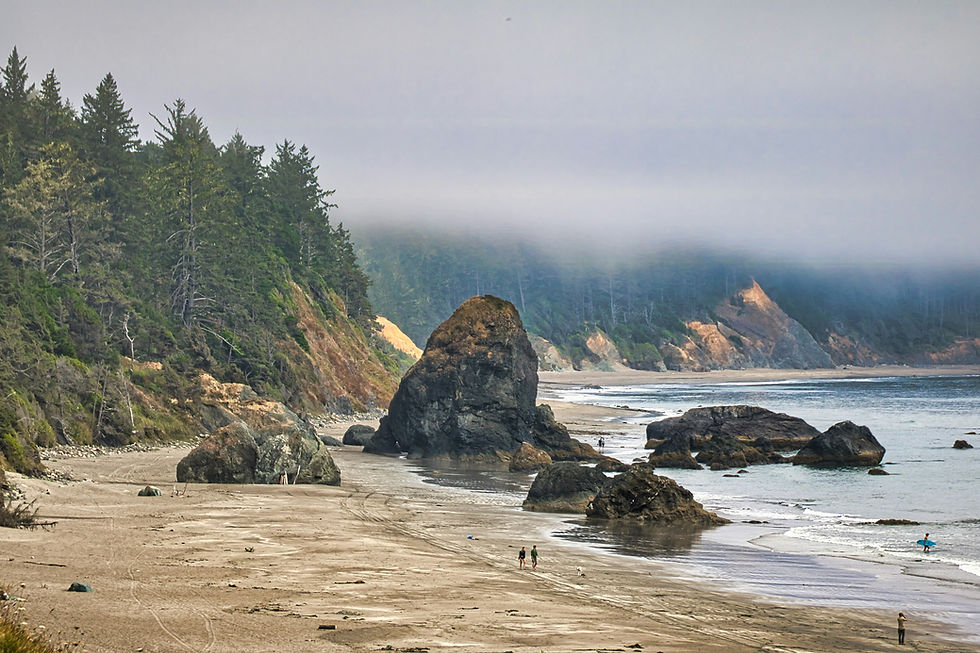
Most Oregon coast investment content treats supply the same way everywhere: more demand justifies more inventory, more inventory eventually caps ADR growth, and the market self-corrects toward equilibrium. Neskowin and Pacific City break that model. Since 2023, Tillamook County has operated these two unincorporated subareas under a hard licensing cap, and that single regulatory fact has reshaped the entire investment thesis. This isn't a demand-growth story. It's a supply-constraint story — and those are rare enough in short-term rental investing that they deserve to be evaluated on their own terms, honestly, including the friction they create for a buyer trying to get in.
The License Cap Is the Investment Thesis
In July 2023, the Tillamook County Board of Commissioners approved an updated short-term rental ordinance (Ordinance #84, Amendment #2) that caps the number of licensed short-term rentals in each unincorporated community in the county, including Neskowin and the Pacific City/Woods subarea, at roughly 1% growth above the number of licenses that existed at the time the ordinance took effect. In practice, that formula sets the current cap at 191 licenses in Neskowin and 95 licenses in the Pacific City/Woods subarea outside the West Division exemption zone described below. The ordinance also added an use-it-or-lose-it provision requiring licensed properties to be rented at least 30 nights a year, plus an one-license-per-licensee limit, both of which further tighten the pool of active, usable licenses rather than letting them sit dormant or get bundled up by a single large owner.
For an investor, this is the entire reason to consider Neskowin or Pacific City rather than an uncapped coastal market. A capped license is a scarce asset. Unlike most coastal towns, where a strong season simply invites more construction and more competing listings the following year, a licensed short-term rental in these two subareas cannot be diluted by an unlimited wave of new supply. The county has structurally limited the number of competitors that can exist. If you already hold — or can acquire — one of a finite number of licenses in a market with genuine, landmark-driven demand, that scarcity is working in your favor every season, not just this one.
That's the upside. The honest caveat is what it takes to actually get there. What is more reliably true, based on the county's licensing framework itself, is that the license cap limits how much new inventory any single manager, national or local, can add going forward. The scarcity thesis only works if the underlying demand justifies fighting for a license in the first place, and in Neskowin and Pacific City, the demand draws are specific and durable rather than a generic "Oregon coast" appeal.
The Real Friction: This Market Is Harder to Enter Than It Looks
Here is the part that most scarcity narratives gloss over, and that this post won't: buying a house in Neskowin or Pacific City does not automatically get you a short-term rental license. Tillamook County maintains separate STR subarea waitlists for Neskowin and for Pacific City/Woods, and because both caps are already essentially full, joining a waitlist is the default path, not a fallback. As of July 2026, Neskowin's waitlist has 6 applicants and Pacific City/Woods' capped-area waitlist has 13 — meaning an investor buying anywhere in Neskowin, or in Pacific City/Woods outside the exemption zone described below, should plan to enter a queue behind those existing applicants rather than assume a license comes with the purchase.
There is exactly one guaranteed exception to that, and it's specific enough that it deserves to be named precisely rather than described in vague "may require a waitlist" terms. In January 2025, the Tillamook County Board of Commissioners created a cap-exemption zone in Pacific City — the West Division — via Board Order #25-002. The West Division sits west of the Nestucca River, bounded by Alder Street and Bob Straub State Park. A property inside that specific boundary is not subject to the 95-license cap or its waitlist at all: a new owner there can obtain a short-term rental license without waiting in line. Everywhere else — all of Neskowin, and the rest of the Pacific City/Woods subarea outside the West Division — a license is not guaranteed and requires joining the waitlist. That distinction, tied to the exact parcel boundary rather than the town name on a listing, is the single most decision-critical fact in this post: confirm in writing with Tillamook County Community Development whether a specific parcel falls inside the West Division before assuming a license is guaranteed.
So the trade-off an investor needs to weigh honestly is this: scarcity protects the value of a license you already hold, but scarcity also means the path to holding one in the capped zones is genuinely harder, slower, and less certain than in almost any other coastal market. This is not a market for an investor who wants to close on a property this quarter and start hosting next month. It's a market for an investor willing to either acquire a property that already carries an active, transferable license, or to commit to a waitlist process with a real, unknown timeline — in exchange for holding a position that, once secured, isn't going to get diluted by the next wave of new construction the way it would almost anywhere else on the Oregon coast.
What the Demand Side Looks Like — And Why the Licenses Are Worth Waiting For
The scarcity thesis only works if the underlying demand justifies fighting for a license in the first place, and in Neskowin and Pacific City, the demand draws are specific and durable rather than a generic "Oregon coast" appeal. Neskowin and Pacific City are not the right fit for an investor who wants the fastest, least-friction path to a licensed short-term rental on the Oregon coast — that investor should either be looking at uncapped markets, or, if committed to this pair of towns, targeting a property specifically inside Pacific City's West Division exemption zone, the one place in either subarea where a license does not require a waitlist.
Pacific City is built around Cape Kiwanda, where a working dory fleet still launches directly off the open beach — flat-bottomed boats rowed and motored straight through the surf, a fishing tradition tracing back roughly a century to when local fishermen switched from river gillnetting to shore-launched dories after gillnetting was banned to protect salmon runs on the Nestucca River. It's a genuinely rare working-waterfront spectacle, not a manufactured tourist attraction, and it gives Pacific City an identity that photographs and markets itself without an agency having to invent a hook.
Neskowin, a few miles south, has its own singular draw: the Ghost Forest near Proposal Rock, a cluster of ancient Sitka spruce stumps — estimated at roughly 2,000 years old — that were buried by a past tsunami or major coastal event and periodically re-exposed by storm erosion, most famously after the severe winter storms of 1997–98. It's an eerie, low-tide-only phenomenon that draws its own dedicated visitor interest independent of the beach-town crowd, and it sits directly beside Proposal Rock, a prominent sea stack reachable on foot at low tide.
On rate, third-party short-term rental data platforms show both markets performing at or above typical central Oregon coast levels, with Neskowin reporting a median daily rate in the $355 at roughly 39.4% occupancy, and Pacific City reporting a median daily rate in the $363 ADR at 35.4% occupancy (AirROI Pacific City as of 2026-07-31). Those figures should be treated as directional rather than confirmed, since third-party estimates vary by methodology, seasonality, and property mix — but they're broadly consistent with the idea that both markets are commanding rates above the Oregon coast average rather than below it, which is what you'd expect from a demand base concentrated in a supply-capped market.
Vacasa's Footprint and What "Independent" Really Means Here
Pacific City has historically carried a meaningful share of professionally managed inventory, including properties under national platforms, alongside a strong base of independently owned and boutique-managed listings. The precise current share of Vacasa-managed or other large-manager inventory in Pacific City specifically is not confirmed in the source material for this post and should be verified directly — through current listing counts or a licensed local property manager — before an investor assumes any particular ownership structure. What is more reliably true, based on the county's licensing framework itself, is that the license cap limits how much new inventory any single manager, national or local, can add going forward. A capped market caps everyone equally; it doesn't just cap independent owners while letting a consolidator scale around them. That structural ceiling is arguably more protective for an independent owner than a headline about any one manager's current footprint.
Who This Investment Actually Fits
Neskowin and Pacific City are not the right fit for an investor who wants the fastest, least-friction path to a licensed short-term rental on the Oregon coast — that investor should either be looking at uncapped markets, or, if committed to this pair of towns, targeting a property specifically inside Pacific City's West Division exemption zone, the one place in either subarea where a license does not require a waitlist. They're a strong fit for an investor who understands the county's licensing structure as a moat rather than an obstacle, has the patience and local diligence to pursue either an already-licensed property or a waitlist position (6 applicants deep in Neskowin, 13 in the capped part of Pacific City/Woods as of July 2026), and wants to hold a position in a market where the number of future competitors is capped by county ordinance rather than by whatever the next building cycle allows. That's a genuinely different risk-and-reward profile than most coastal investment content is built to describe, and it should be evaluated as such — not folded into a generic "Oregon coast is hot" pitch.
Before making any purchase decision in either subarea, confirm current license availability, waitlist position, and whether a specific parcel falls inside the West Division exemption zone directly with Tillamook County Community Development, since ordinance details, waitlist counts, and zone boundaries can change. For the full state-level regulatory picture across the North Oregon Coast and beyond, see "Oregon Coast & High Desert STR Rules in 2026: A Town-by-Town Guide.".
Keep going on Crest & Cove: the Crest & Cove intro · local SEO keywords that actually book · the five elements of a converting hero · how to compare STR marketing agencies · Asheville paddling spots worth the drive · Neskowin and Pacific City against AirROI pins · North Oregon Coast against AirROI pins · Destin against AirROI, not leftover year.
Related Reading
Keep reading on same-cluster Crest & Cove pages that stay on labeled local lines without costume-corridor copy.
Neskowin Pacific City STR Market Report for Independent Hosts
Neskowin and Pacific City: The Three Hooks Most Listings Never Name
Is an STR Marketing Agency Worth It for Neskowin Pacific City Hosts
DIY vs Hire Marketing for Should Neskowin Pacific City Hosts Manage
What It Actually Costs to Start a Neskowin, Oregon Short-Term Rental
Financing a Neskowin, Oregon Rental: What DSCR Lenders Want to See
DIY vs. Hire: Marketing Your Neskowin, Oregon Vacation Rental
Market Neskowin by Proposal Rock at Low Tide, Not Stock Beach Copy
Neskowin, Oregon STR Market Report 2026: $38,932 Median Revenue on 154 Listings
Buying a Neskowin Rental in 2026: What the Numbers Actually Support
Neskowin Remote-Worker Rentals: What the Booking Data Actually Shows
Neskowin vs Forks: Two Different Counties, Two Different Permits
Neskowin vs. Forks: Why You Shouldn't Blend These Two Rental Markets
Who Books a Neskowin, Oregon Rental? Portland Guests First, Seattle
Neskowin, OR STR Rules: Confirm With Tillamook County Before You List
Work with Crest & Cove Creative
Neskowin is $38,932. Pacific City is $40,828. Nationwide. crestcove.co or (256) 998-7502. Reach out atcrestcove.co or (256) 998-7502.
Frequently Asked Questions
Is it currently possible to get a new short-term rental license in Neskowin or Pacific City?
Only in one specific location. Neskowin (191-license cap, 6-applicant waitlist as of July 2026) and the Pacific City/Woods subarea (95-license cap, 13-applicant waitlist as of July 2026) both require joining a county waitlist for a new license — availability is not guaranteed. The one exception is Pacific City's West Division, a cap-exemption zone west of the Nestucca River, between Alder Street and Bob Straub State Park, created in January 2025 via Board Order #25-002, where a new buyer can obtain a license without waiting on a waitlist. Everywhere else in both subareas, confirm the current waitlist position directly with Tillamook County Community Development before purchasing.
What is the Tillamook County STR ordinance, exactly?
It's Ordinance #84, Amendment #2, approved in July 2023, which caps the number of licensed short-term rentals in each unincorporated Tillamook County community at roughly 1% growth above the number licensed at the time of adoption, adds a 30-night minimum use-it-or-lose-it requirement, and limits licensees to one license each. In July 2023, the Tillamook County Board of Commissioners approved an updated short-term rental ordinance (Ordinance #84, Amendment #2) that caps the number of licensed short-term rentals in each unincorporated community in the county, including Neskowin and the Pacific City/Woods subarea, at roughly 1% growth above the number of licenses that existed at the time the ordinance took effect.
Why would an investor want a capped market instead of a growing one?
Because the cap limits how much new competing inventory can enter the market going forward. A licensed property in a capped subarea isn't exposed to the same risk of being diluted by a wave of new construction the way an uncapped coastal market is, which can protect long-term rate and occupancy performance for existing license holders.
What's the difference between Neskowin and Pacific City as investment targets?
Both sit in Tillamook County and share the coastal drive-market pull from Portland, but Pacific City is built around the working dory fleet at Cape Kiwanda and includes the West Division, a cap-exemption zone west of the Nestucca River (between Alder Street and Bob Straub State Park) where new licenses are available without a waitlist, while Neskowin's identity centers on the Ghost Forest near Proposal Rock and has no such exemption — all of Neskowin sits under the standard 191-license cap and its waitlist. That exemption zone is the meaningful difference for how hard licensing is to obtain.
What is the dory fleet at Cape Kiwanda?
It's a working fishing tradition in which flat-bottomed dory boats are launched directly off the open beach through the surf, dating back roughly a century to when local fishermen shifted from river gillnetting to shore-based dory fishing after gillnetting was restricted on the Nestucca River to protect salmon. Pacific City is built around Cape Kiwanda, where a working dory fleet still launches directly off the open beach — flat-bottomed boats rowed and motored straight through the surf, a fishing tradition tracing back roughly a century to when local fishermen switched from river gillnetting to shore-launched dories after gillnetting was banned to protect salmon runs on the Nestucca River.
What is the Neskowin Ghost Forest?
It's a cluster of ancient Sitka spruce stumps, estimated at roughly 2,000 years old, buried by a past coastal event and periodically re-exposed at low tide near Proposal Rock, most notably after major storms in the winter of 1997–98. Neskowin, a few miles south, has its own singular draw: the Ghost Forest near Proposal Rock, a cluster of ancient Sitka spruce stumps — estimated at roughly 2,000 years old — that were buried by a past tsunami or major coastal event and periodically re-exposed by storm erosion, most famously after the severe winter storms of 1997–98.
How do Neskowin and Pacific City rates compare to other central Oregon coast markets?
Third-party short-term rental data platforms show both markets performing at or above typical central Oregon coast levels — directionally in the $355 (AirROI Neskowin as of 2026-07-31) and $363 (AirROI Pacific City as of 2026-07-31) based on available estimates — but these figures should be treated as directional rather than confirmed and verified against current, market-specific data before underwriting any purchase.
Does Vacasa or another large manager control most of the inventory in Pacific City?
Pacific City has historically included a mix of professionally managed and independently owned properties, but the precise current share held by any single manager is not confirmed here and should be verified through current listing data or a local property manager. Regardless of any one manager's footprint, the county's license cap limits how much new inventory any manager — large or independent — can add going forward.
About the Authors
Crest & Cove Creative is a short-term rental marketing agency founded by Thomas Garner and Jacob Mishalanie. We build direct-booking brands, listing optimization systems, and market-specific content strategies for independent STR operators nationwide, including emerging corridors like the North Oregon Coast. Keep going on Crest & Cove: the Crest & Cove intro · local SEO keywords that actually book · the five elements of a converting hero · how to compare STR marketing agencies · Asheville paddling spots worth the drive · Neskowin and Pacific City against AirROI pins · North Oregon Coast against AirROI pins · Destin against AirROI, not leftover year.
Sources
Verified via dedicated research pass (license/waitlist facts confirmed July 2026):. As of July 2026, Neskowin's waitlist has 6 applicants and Pacific City/Woods' capped-area waitlist has 13 — meaning an investor buying anywhere in Neskowin, or in Pacific City/Woods outside the exemption zone described below, should plan to enter a queue behind those existing applicants rather than assume a license comes with the purchase.
Tillamook County's 2023 STR ordinance (Ordinance #84, Amendment #2) and its ~1% growth cap on licensed short-term rentals in unincorporated communities, including Neskowin and Pacific City/Woods, plus the 30-night use-it-or-lose-it provision and one-license-per-licensee limit — confirmed via Tillamook Headlight Herald coverage and Tillamook County government pages.
Current license caps: 191 in Neskowin, 95 in Pacific City/Woods outside the West Division exemption zone — confirmed via Tillamook County Community Development.
Current waitlist counts as of July 2026: 6 applicants in Neskowin, 13 applicants in the capped part of Pacific City/Woods — confirmed via Tillamook County Community Development's official waitlist pages.
The January 2025 creation of the West Division cap-exemption zone in Pacific City via Board Order #25-002 — bounded west of the Nestucca River, between Alder Street and Bob Straub State Park, where the standard cap and waitlist do not apply — confirmed via Tillamook County Community Development and Tillamook Headlight Herald coverage.
The dory fleet tradition at Cape Kiwanda, its origin in a shift away from river gillnetting roughly a century ago, and its continued operation today, is confirmed via multiple regional travel and local-history sources.
The Neskowin Ghost Forest near Proposal Rock, its exposure by major storms in the winter of 1997–98, and its status as ancient buried Sitka spruce stumps estimated at roughly 2,000 years old, confirmed via regional coastal-geology and travel sources.
Unverified / directional — flagged for confirmation before use in underwriting or client-facing claims:. Those figures should be treated as directional rather than confirmed, since third-party estimates vary by methodology, seasonality, and property mix — but they're broadly consistent with the idea that both markets are commanding rates above the Oregon coast average rather than below it, which is what you'd expect from a demand base concentrated in a supply-capped market.
Precise, current ADR and occupancy figures for both markets (third-party platform estimates cited here — $355 ADR at 35.9% occupancy for Neskowin, $363 ADR at 35.4% occupancy for Pacific City — should be treated as directional, not underwriting-grade).
Vacasa's or any other single manager's current specific share of Pacific City short-term rental inventory.
Parcel-specific applicability of the West Division boundary for any individual property; confirm directly with Tillamook County Community Development before purchase.
Waitlist counts and cap figures are current as of July 2026 and can change; reconfirm before underwriting.


Comments