
The Emerald Coast Seasonality Playbook: Four Demand Windows, Not Two
- Jacob Mishalanie

- Jun 21
- 12 min read
Updated: 2 days ago

Ask most Emerald Coast hosts how they price their calendar and you'll get some version of the same answer: summer rate, off-season rate. That two-mode system isn't wrong so much as it's incomplete — it treats eight months of the year as a single undifferentiated block, when the Gulf Coast calendar actually breaks into four distinct demand regimes, each with its own guest segment, booking window, and willingness to pay. Lumping fall, winter, and spring into one 'off-season' bucket is the single most common way Panhandle hosts leave real revenue on the table.
The scale of the swing makes this worth fixing. AirROI's Destin desk prints a typical year of $41,489 at 34.7% occupancy and a $477 average daily rate. Santa Rosa Beach prints $52,659 at 35.6%. Those annual figures sit on top of a peak-to-trough spread that runs 3.7 to 3.8 times from best month to worst across the broader Panhandle — leftover occupancy can run near 79% in July and drop to roughly 20% in January. Peak and trough are not the year. They're the two extremes a four-regime pricing model has to manage separately.
This playbook walks through each of the four windows — peak summer, fall shoulder, snowbird winter, and spring — with the pricing, minimum-stay, and marketing moves that fit each one, plus the tactical toolkit (dynamic pricing, gap-night rules, seasonal listing refreshes) that ties the whole calendar together. This is not legal advice.
Peak Summer: Memorial Day Through Early August
This is the regime every Emerald Coast host already knows, which is exactly why it's the easiest one to get right and the hardest one to leave money on. The Gulf Coast summer season runs roughly from Memorial Day weekend through the first week of August, with July standing as the absolute peak across every Panhandle sub-market. Demand in this window is dense enough that the constraint isn't finding guests — it's not underpricing the ones who are already trying to book.
Set your highest rates of the year here: your peak-season rate should run 40% to 60% above your annual average. On 30A, top-tier gulf-front homes command $700 to $1,200 a night in July; in Destin, well-positioned condos and houses run $400 to $700. The market absorbs that premium because demand exceeds supply in the best weeks — which means an open night in July is almost never a demand problem. It's a listing-quality or minimum-stay problem, and discounting to fill the gap treats the wrong symptom.
Run a seven-night, Saturday-to-Saturday minimum stay through this window. It's the dominant booking pattern on the Emerald Coast in summer — the average stay across the coast runs 5.0 to 5.8 nights depending on sub-market, and the guest booking peak summer is planning a full-week family vacation, not a long weekend. A seven-night minimum captures that highest-value guest and eliminates the operational churn of midweek turnovers during your busiest stretch.
Peak-summer weeks book 75 to 98 days out on this coast, which means your July calendar is being filled in March and April, not in June. If July isn't filling by April, the problem is pricing or visibility, not demand. Layer in event fencing on top of the base summer rate: Fourth of July week and the Blue Angels Air Show week (July 15 through 18 in 2026 for Pensacola Beach) are the two highest-demand stretches of the summer, and both deserve premium-rate blocks — $100 to $200 a night above your standard July rate — with extended minimum stays and a hard block against any smart-pricing tool that might try to discount a perceived gap during those dates.
Fall Shoulder: September Through November
This is the window most Emerald Coast hosts price as off-season and lose money on, and it's the clearest illustration of why the two-mode system fails. September through November is genuine warm-water season — fewer crowds, lower humidity than peak summer, and several named demand events that generate real bookable occupancy if you actually market to them instead of just dropping the rate and waiting.
The Destin Fishing Rodeo is the clearest example. It runs the entire month of October — daily weigh-ins at the Destin Harbor Boardwalk, tournaments, and a month-long festival atmosphere that pulls fishing families, charter groups, and tournament competitors from across the region. This is not a single weekend; it's a 31-day demand driver that most Destin and Okaloosa County hosts never reference in their listing copy or pricing calendar. If your property sits in Destin, Fort Walton Beach, or the surrounding area, update the listing in August to name the Rodeo directly, set a three- to four-night minimum for October, and price at a shoulder-season premium rather than a trough rate.
The Gulf's warm-water secret season is a second, quieter driver. Water temperatures hold in the 78-to-82-degree range well into October in most years and stay swimmable through November. The guest who doesn't know that won't search for it; the guest who does is deliberately planning an off-peak beach trip to get warm water without summer crowds. Update your description and seasonal photo set to say this plainly.
On pricing, drop the minimum stay to three or four nights for the fall shoulder and price at 60% to 75% of your peak summer rate — a level that still reflects the real warm-water, uncrowded-beach value rather than treating September and October as though they were already January. The demand exists in this window, and the guest booking a fall shoulder trip is willing to pay meaningfully more than your winter-trough rate.
Snowbird Winter: November Through March
The winter trough is where most Emerald Coast hosts genuinely bleed revenue — but the Panhandle carries a structural demand segment that turns winter from dead weight into a revenue floor: snowbirds. Building a winter product around this segment is the difference between a calendar that goes quiet for four months and one that keeps generating predictable income through the slowest stretch of the year.
The mechanics favor the host directly. A monthly stay priced at $2,000 to $3,500 for a two-bedroom unit produces a predictable revenue base with a single cleaning turnover, one set of linens, and one guest communication thread. A three-month snowbird booking at $2,500 a month generates $7,500 with that single turnover — compare that to the $6,000 to $9,000 you might earn from three months of nightly bookings at 20% to 28% winter occupancy, but with eight to twelve separate turnovers, proportional cleaning costs, and constant vacancy risk between guests.
The snowbird guest is a specific, identifiable profile: retirees and semi-retired couples from the Midwest, Northeast, and Upper South escaping winter cold for 60-to-75-degree daytime temperatures, walkability, mild outdoor activity, and a slow-travel rhythm. They filter for ground-floor access, a full kitchen, in-unit laundry, reliable internet, and proximity to grocery and pharmacy — and they typically book in September and October for a November-through-March stay, well ahead of a typical leisure booking window.
Set a 28-to-30-night minimum stay from November through March, and consider a separate winter-specific listing variation that leads with snowbird amenities rather than beach-vacation photography. Post it on Furnished Finder and Airbnb's monthly-stay filter in addition to Vrbo, and price the listing monthly rather than nightly so it reads correctly to the guest searching for exactly this product.
Sub-market differences matter here too. Destin and Fort Walton Beach carry the strongest snowbird infrastructure — grocery stores, pharmacies, restaurants, and medical facilities accessible year-round. 30A communities run quieter in winter, with some restaurants and shops closing seasonally, which appeals to a snowbird who genuinely wants quiet but may limit walkable amenities. Cape San Blas and the Forgotten Coast are the most remote winter option, appealing to the solitude-seeking snowbird but operationally harder for a host managing a property in a market with a resident population around 622 people.
Spring: Families, Spring Break, and the Easter Surge
Spring on the Emerald Coast is a two-part demand window that most hosts still treat as a single stretch, which flattens two genuinely different guest segments into one pricing decision.
Spring break in March is the first part. Panama City Beach has repositioned itself as a family-friendly spring break destination since banning alcohol on public beaches during March, a shift that moved the guest demographic from the college-party crowd toward families with kids. If your property sits in PCB, lean into that positioning directly — family-friendly amenities, kid-safe beach access, bunk rooms, and proximity to family attractions. Set a four- to five-night minimum for the core spring break weeks and price at shoulder-premium levels. Across the broader Emerald Coast, spring break also draws significant drive-to family traffic from Alabama, Georgia, Tennessee, and Mississippi.
Easter and the late-March-through-April window is the second, distinct part — a genuine shoulder peak that runs warmer than spring break and less crowded than summer, driven by families with school-age kids on Easter and spring-break-adjacent school schedules. Price this window at 70% to 85% of your peak summer rate with a four- to five-night minimum. This bridge period between snowbird season and peak summer often outperforms both the fall shoulder and the winter trough, which makes it worth pricing as its own regime rather than folding it into either neighboring season.
Reading Destin and Santa Rosa Beach Against the Same Curve
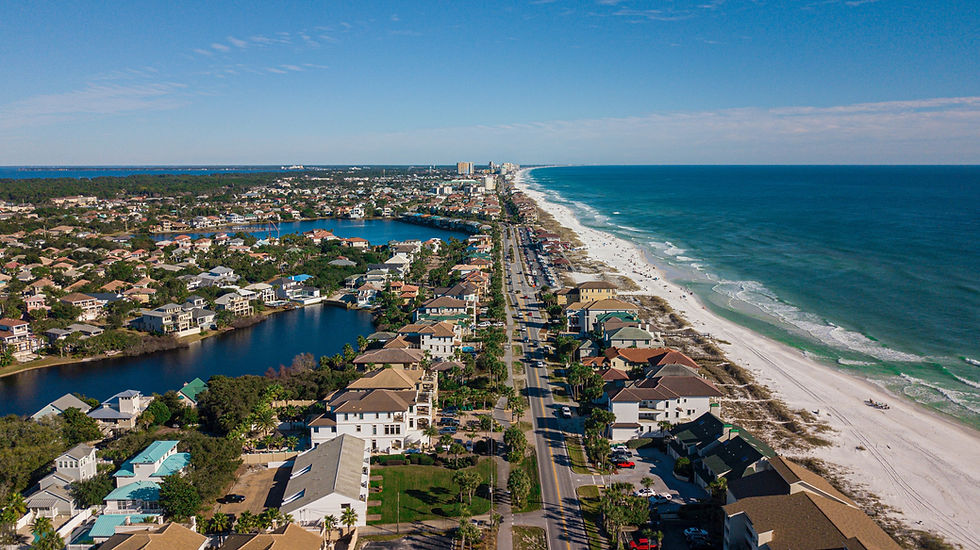
The two labeled AirROI desks closest to this playbook tell a consistent story about how differently 'peak' and 'typical' behave on this coast. Destin prints a typical year of $41,489 at 34.7% occupancy and a $477 ADR. Santa Rosa Beach, covering the 30A corridor, prints a higher typical year of $52,659 at a similar 35.6% occupancy — a gap that reflects 30A's higher gulf-front rate ceiling more than any difference in how full the calendar actually runs. On 30A specifically, peak nights can print leftover occupancy near 70% with leftover rates near $699, numbers that look nothing like the $52,659 annual figure sitting above them.
That's the core lesson embedded in both desks: the annual WATCH figure is an average across a curve with a 3.7-to-3.8-times peak-to-trough spread, not a description of any single month. A host who reads $52,659 and assumes every month should perform somewhere near that number will systematically overprice the winter trough and underprice the July peak — exactly backward from what the four-regime approach in this playbook is built to correct. The annual number is useful for underwriting a purchase or comparing markets at a glance. It is not a pricing tool for any individual week on the calendar.
Used correctly, these two desks become a sanity check rather than a pricing rulebook: if your Destin property's typical year is tracking meaningfully below $41,489, or your 30A property is tracking well under $52,659, that's a signal to look at whether your regime-by-regime pricing above is actually capturing the fall Rodeo window, the snowbird floor, and the spring bridge — the three regimes most likely to be underpriced when a host defaults back to the two-mode system this playbook is built to replace.
The Tactical Toolkit That Ties the Four Regimes Together
Dynamic-pricing tools — PriceLabs, Beyond, and Wheelhouse — analyze comparable listings and adjust rates daily based on demand signals, local events, and booking pace. Configure them with your floor price, your seasonal rate multipliers for each of the four regimes above, and explicit event-date overrides for named local events. Don't set and forget: review the tool's suggestions monthly and override when the algorithm doesn't account for a named local event — like the Destin Fishing Rodeo or the Blue Angels Air Show — that may not be in its database at all.
Gap-night and orphan-night rules solve a narrower but persistent problem: a one- or two-night gap between two reservations that most hosts either leave empty or discount blindly. The better move is configuring your channel manager to automatically discount orphan nights by 10% to 15% and drop the minimum stay to one night specifically for those dates. The marginal revenue from filling a gap night this way is close to pure upside, since the fixed costs of having the property ready are already sunk.
Finally, refresh the listing itself by season, not just the price. Hero photos, title, and first-line description should shift with the calendar: summer leads with pool, beach, gulf water, and family; fall leads with warm water, uncrowded beach, and a direct Rodeo reference where relevant; winter leads with cozy interior, fireplace where applicable, walkable downtown, and monthly-stay language; spring leads with family framing, blooming landscaping, and Easter-week availability. A listing that still says 'summer beach vacation' in November is functionally invisible to the guest searching for a winter stay — no amount of dynamic pricing recovers a booking the listing copy already lost.
A 30-night minimum-stay setting deserves one honest caveat: it's a platform filter, not a strategy on its own. Setting it doesn't fill a slow month by itself, and it isn't a substitute for a remote-work or extended-stay product you haven't actually photographed or described as one. The minimum stay opens the door to the right search filter; the listing content still has to walk through it.
Related Reading
More independent-host reading on listing copy, calendars, and operable decisions guests can trust.
Frequently Asked Questions
How extreme is the seasonal swing on the Emerald Coast?
Leftover occupancy can run near 79% in July and near 20% in January — the peak and trough of a broader 3.7- to 3.8-times peak-to-trough revenue swing across the Panhandle. AirROI's Destin desk prints a typical year of $41,489 at 34.7% occupancy, a figure that sits between those two extremes and shouldn't be mistaken for what any single month actually looks like.
What is the biggest pricing mistake most Emerald Coast hosts make?
Pricing in only two modes — a summer rate and an off-season rate — which folds at least three genuinely distinct shoulder-season demand windows (fall, winter, and spring) into one undifferentiated bucket. Each of those windows has its own guest segment, booking behavior, and willingness to pay, and pricing them all the same way as 'off-season' leaves real revenue unclaimed.
How should peak summer be priced?
Peak-season rates should run 40% to 60% above your annual average, with top-tier gulf-front 30A homes commanding $700 to $1,200 a night in July and well-positioned Destin condos or houses running $400 to $700. Layer named events — Fourth of July week and the Blue Angels Air Show week — on top as premium-rate blocks, $100 to $200 a night above your standard July rate, with extended minimum stays covering the full event window.
How far in advance do peak-summer weeks get booked?
Peak-summer weeks book 75 to 98 days out on this coast, which means July weeks are typically booked in March and April. If your July calendar isn't filling by April, that's a signal of a pricing or visibility problem, not a lack of demand.
What makes the Destin Fishing Rodeo worth pricing around?
It runs the entire month of October — daily weigh-ins at the Destin Harbor Boardwalk plus tournaments — making it a 31-day demand driver rather than a single-weekend event. Most Destin and Okaloosa County hosts never reference it in their listing copy, which leaves an entire month of targeted fishing-family demand unmarketed.
Why does snowbird season beat nightly winter bookings for revenue?
A three-month snowbird booking at $2,500 a month generates $7,500 in revenue with a single cleaning turnover, compared to roughly $6,000 to $9,000 from three months of nightly bookings at 20% to 28% winter occupancy — but with eight to twelve separate turnovers, proportional cleaning costs, and constant vacancy risk between guests. The monthly model converts a volatile winter into a predictable revenue floor.
Who is the typical Emerald Coast snowbird guest?
Retirees and semi-retired couples from the Midwest, Northeast, and Upper South escaping winter for 60-to-75-degree daytime temperatures, walkability, and a slow-travel rhythm. They filter for ground-floor access, a full kitchen, in-unit laundry, and grocery and pharmacy proximity, and they typically book in September and October for a November-through-March stay.
Are spring break and Easter the same pricing window?
No — they're two distinct demand windows that deserve separate pricing. Spring break in March draws family drive-to traffic and suits a four- to five-night minimum at shoulder-premium rates, especially in Panama City Beach's family-repositioned market. The Easter and late-March-through-April window is a separate, often stronger shoulder peak, priced at 70% to 85% of peak summer with the same four- to five-night minimum.
Does a 30-night minimum-stay setting fill a slow month by itself?
No. A 30-night minimum is a platform filter that opens the right search category, but it isn't a filled calendar and it isn't a remote-work product you haven't actually photographed or described as one. The listing content still has to do the work of converting the guest who finds it through that filter.
What's the fix for a listing that still shows summer photos in November?
Refresh hero photos, title, and first-line description by season. Summer leads with pool, beach, and family; fall leads with warm water and event references; winter leads with cozy interior and monthly-stay language; spring leads with family framing and Easter-week availability. A listing that still reads 'summer beach vacation' in November is effectively invisible to a guest searching for a winter stay, regardless of how well the price is set.
Work with Crest & Cove Creative
Most Emerald Coast hosts run their whole year on two settings — summer and 'everything else' — while the calendar underneath is actually charging four different rents for four different guests. Name the failure mode the guest can check on.
Send your Destin, 30A, or Santa Rosa Beach calendar to crestcove.co or call (256) 998-7502 for a review of whether your pricing actually matches the four demand regimes your market runs on. Name the failure mode the guest can check on the listing.
Reach out at crestcove.co or (256) 998-7502.


Comments